JAMB Mathematics 1998 past questions

33 questions from the 1998 paper, showing 1–20. Try each one, then open the solution to check your answer. Sign in to see the worked explanations.

  1. Mathematics1998Number and Numeration
    1. Evaluate [10.03÷10.024]−1\left[\frac{1}{0.03}\div\frac{1}{0.024}\right]^{-1}, correct to 2 decimal places
    1. A.3.76
    2. B.1.25
    3. C.0.94
    4. D.0.75
  2. Mathematics1998Geometry and Mensuration
    2. A market woman sells oils in cylindrical tins 10cm deep and 6cm diameter at #15.00 each. If she bought a full cylindrical jug 18cm deep and 10cm in diameter for #50.00, how much did she make by selling all the oil?
    1. A.#62.50
    2. B.#35.00
    3. C.#31.00
    4. D.#25.00
  3. Mathematics1998Algebraic Processes
    3. A man is paid r naira per hour for normal work and double rate for overtime. If he does a 35-hour week which includes q hours of overtime, what is his weekly earning in naira?
    1. A.r(35+q)r(35+q)
    2. B.q(35r−q)q(35r-q)
    3. C.q(35r+r)q(35r+r)
    4. D.r(35r−q)r(35r-q)
  4. Mathematics1998Algebraic Processes
    4. When the expression pm2+qm+1pm^2+qm+1 is divided by (m−1)(m-1), it has a remainder 2 and when divided by (m+1)(m+1) the remainder is 4. Find p and q respectively
    1. A.2, -1
    2. B.-1, 2
    3. C.3, -2
    4. D.-2, 3
  5. Mathematics1998Algebraic Processes
    5. Factorize r2−r(2p+q)+2pqr^2-r(2p+q)+2pq
    1. A.(r−2q)(2r−p)(r-2q)(2r-p)
    2. B.(r−q)(r+p)(r-q)(r+p)
    3. C.(r−q)(r−2p)(r-q)(r-2p)
    4. D.(2r−q)(r+p)(2r-q)(r+p)
  6. Mathematics1998Algebraic Processes
    6. Solve the equation x−x−2−1=0\sqrt{x}-\sqrt{x-2}-1=0
    1. A.32\frac{3}{2}
    2. B.23\frac{2}{3}
    3. C.49\frac{4}{9}
    4. D.94\frac{9}{4}
  7. Mathematics1998Algebraic Processes
    7. Make ax\frac{a}{x} the subject of the formula x+ax−a=m\frac{x+a}{x-a}=m
    1. A.m−1m+1\frac{m-1}{m+1}
    2. B.1+m1−m\frac{1+m}{1-m}
    3. C.1−m1+m\frac{1-m}{1+m}
    4. D.m+1m−1\frac{m+1}{m-1}
  8. Mathematics1998Algebraic Processes
    8. Express in partial fractions 11x+26x2−x−1\frac{11x+2}{6x^2-x-1}
    1. A.13x−1+32x+1\frac{1}{3x-1}+\frac{3}{2x+1}
    2. B.33x+1−12x−1\frac{3}{3x+1}-\frac{1}{2x-1}
    3. C.33x−1−12x+1\frac{3}{3x-1}-\frac{1}{2x+1}
    4. D.13x+1+32x−1\frac{1}{3x+1}+\frac{3}{2x-1}
  9. Mathematics1998Inequalities
    9. If x is a positive real number, find the range of values for which 13x+12>14x\frac{1}{3x}+\frac{1}{2}>\frac{1}{4x}
    1. A.x>−16x>-\frac{1}{6}
    2. B.x>0x>0
    3. C.0<x<40<x<4
    4. D.0<x<160<x<\frac{1}{6}
  10. Mathematics1998Inequalities
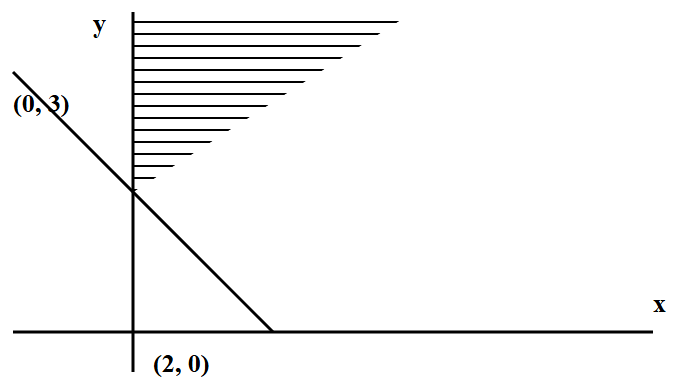
    10. The shaded area above represents
    Figure for: The shaded area above represents
    1. A.x≥0, 3y+2x≥6x\ge0,\ 3y+2x\ge6
    2. B.x≥0, y≥3, 3x+2y≥6x\ge0,\ y\ge3,\ 3x+2y\ge6
    3. C.x≥2, y≥0, 3x+2y≤6x\ge2,\ y\ge0,\ 3x+2y\le6
    4. D.x≥0, y≥0, 3x+2y≥6x\ge0,\ y\ge0,\ 3x+2y\ge6
  11. Mathematics1998Sequences and Series
    11. If p+1p+1, 2p−102p-10, 1−4p21-4p^2 are the consecutive terms of an arithmetic progression, find the possible values of p.
    1. A.-4, 2
    2. B.-2, 4/11
    3. C.-11/4, 2
    4. D.5, -3
  12. Mathematics1998Algebraic Processes
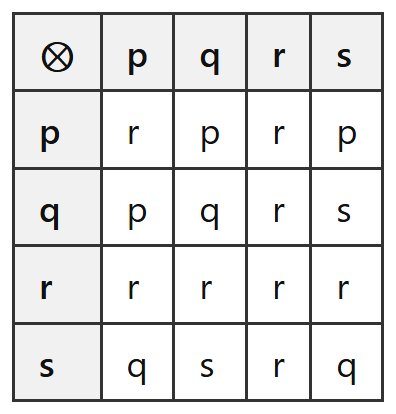
    12. The identity element with respect to the multiplication shown in the table above is
    Figure for: The identity element with respect to the multiplication shown in the table above is
    1. A.p
    2. B.q
    3. C.r
    4. D.s
  13. Mathematics1998Algebraic Processes
    13. The binary operation * is defined by x∗y=xy−y−xx*y = xy - y - x for all real values x and y. x∗3=2∗xx*3 = 2*x, find x.
    1. A.-1
    2. B.0
    3. C.1
    4. D.5
  14. Mathematics1998Matrices and Determinants
    14. The determinant of matrix ∣x101−x2311+x4∣\begin{vmatrix} x & 1 & 0 \\ 1-x & 2 & 3 \\ 1 & 1+x & 4 \end{vmatrix} in terms of x is
    1. A.−3x2−17-3x^2-17
    2. B.−3x2+9x−1-3x^2+9x-1
    3. C.3x2+173x^2+17
    4. D.3x2−9x+53x^2-9x+5
  15. Mathematics1998Matrices and Determinants
    15. Let I=(1001)I=\begin{pmatrix}1&0\\0&1\end{pmatrix}, P=(2345)P=\begin{pmatrix}2&3\\4&5\end{pmatrix}, Q=(u4+u−2vv)Q=\begin{pmatrix}u&4+u\\-2v&v\end{pmatrix} be 2 x 2 matrices such that PQ=IPQ=I. Find (u,v)(u,v)
    1. A.(-5/2, -1)
    2. B.(-5/2, 3/2)
    3. C.(-5/6, 1)
    4. D.(5/2, 2/3)
  16. Mathematics1998Geometry and Mensuration
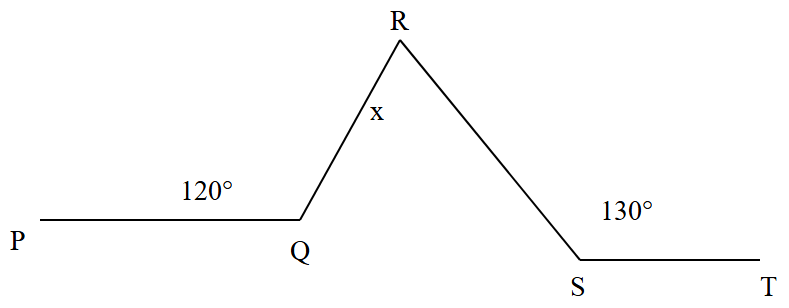
    16. In the diagram above, PQ//ST and ∠PQR=120∘\angle PQR = 120^\circ, ∠RST=130∘\angle RST = 130^\circ. Find the angle marked x.
    Figure for: In the diagram above, PQ//ST and PQR = 120^°, RST = 130^°. Find the angle marked x.
    1. A.50∘50^\circ
    2. B.65∘65^\circ
    3. C.70∘70^\circ
    4. D.80∘80^\circ
  17. Mathematics1998Geometry and Mensuration
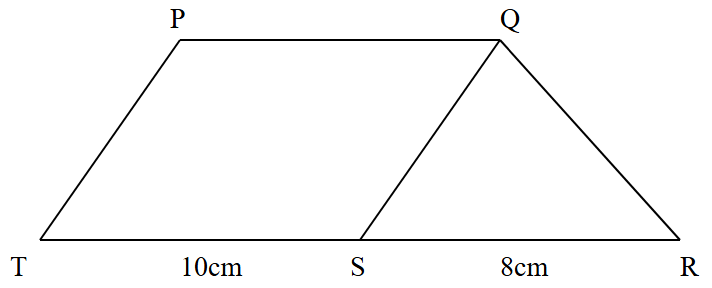
    17. In the figure above, PQST is a parallelogram and TSR is a straight line. If the area of △QRS\triangle QRS is 20 cm2^2, find the area of the trapezium PQRT.
    Figure for: In the figure above, PQST is a parallelogram and TSR is a straight line. If the area of QRS is 20…
    1. A.35 cm2^2
    2. B.65 cm2^2
    3. C.70 cm2^2
    4. D.140 cm2^2
  18. Mathematics1998Geometry and Mensuration
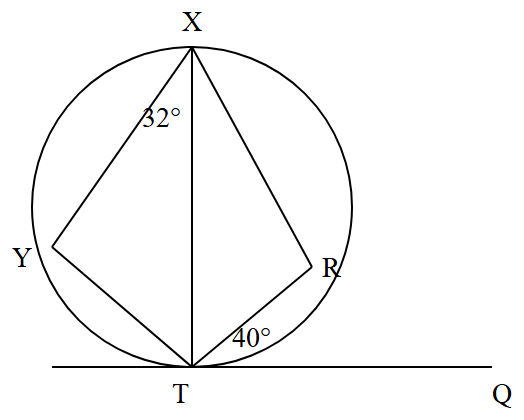
    18. TQ is tangent to circle XYTR. ∠YXT=32∘\angle YXT = 32^\circ, ∠RTQ=40∘\angle RTQ = 40^\circ. Find ∠YTR\angle YTR.
    Figure for: TQ is tangent to circle XYTR. YXT = 32^°, RTQ = 40^°. Find YTR.
    1. A.108∘108^\circ
    2. B.121∘121^\circ
    3. C.140∘140^\circ
    4. D.148∘148^\circ
  19. Mathematics1998Geometry and Mensuration
    19. A chord of a circle radius 3\sqrt{3} cm subtends an angle of 60∘60^\circ on the circumference of the circle. Find the length of the chord.
    1. A.32\frac{\sqrt{3}}{2} cm
    2. B.32\frac{3}{2} cm
    3. C.3\sqrt{3} cm
    4. D.3 cm
  20. Mathematics1998Coordinate Geometry
    20. The locus of all points at a distance 8 cm from a point N passes through point T and S. If S is equidistant from T and N, find the area of triangle STN.
    1. A.434\sqrt{3} cm2^2
    2. B.16316\sqrt{3} cm2^2
    3. C.32 cm2^2
    4. D.64 cm2^2

Other JAMB Mathematics papers