JAMB Economics 2010 past questions

22 questions from the 2010 paper, showing 1–20. Try each one, then open the solution to check your answer. Sign in to see the worked explanations.

  1. Economics2010Price Determination
    1. The demand curve for factors of production
    1. A.is perfect elastic
    2. B.slopes upwards
    3. C.slopes of downwards
    4. D.is perfectly inelastic
  2. Economics2010Price Determination
    2. An agreement among firms on price and segmentation is termed
    1. A.cartel
    2. B.collusion
    3. C.haggling
    4. D.specialization
  3. Economics2010National Income
    3. In national income accounting, tax is determined by the
    1. A.level of income
    2. B.level of consumption
    3. C.level of investment
    4. D.rate of savings
  4. Economics2010National Income
    4. If MPC is 0.7 while government expenditure increased by ₦150m, the equilibrium national income is
    1. A.₦214 million
    2. B.₦45 million
    3. C.₦105 million
    4. D.₦500 million
  5. Economics2010Money and Banking
    5. The function of money which makes division of labour possible is its
    1. A.unit of account
    2. B.store of value
    3. C.medium of exchange
    4. D.standard of deferred payment
  6. Economics2010Money and Banking
    6. By buying treasury bills, the Central Bank of Nigeria intends to
    1. A.increase money supply in the economy
    2. B.reduce the cash reserve ratio for banks
    3. C.reduce money supply in the economy
    4. D.increase the capital base of commercial banks
  7. Economics2010Money and Banking
    7. The velocity of money is represented as
    1. A.Money supplyReal GDP\frac{\text{Money supply}}{\text{Real GDP}}
    2. B.Real GDPMoney supply\frac{\text{Real GDP}}{\text{Money supply}}
    3. C.Nominal GDPMoney supply\frac{\text{Nominal GDP}}{\text{Money supply}}
    4. D.Real GDPNominal GDP\frac{\text{Real GDP}}{\text{Nominal GDP}}
  8. Economics2010Money and Banking
    8. One of the functions of commercial banks is
    1. A.maintaining stable price in the economy
    2. B.regulating monetary policies
    3. C.granting loans to customers
    4. D.issuing bank notes and coins
  9. Economics2010Labour and Employment
    9. A strategy for curbing unemployment is to
    1. A.implement government stabilization policy
    2. B.increase taxes and decrease government expenditure
    3. C.increase government expenditure and decrease taxes
    4. D.ensure even distribution of job opportunities
  10. Economics2010Economic Systems
    10. National development plans in Nigeria fail mainly because of
    1. A.overdependence on foreign aids
    2. B.inadequate funding of projects
    3. C.poor implementation strategies
    4. D.shortage of skilled manpower
  11. Economics2010Agricultural Economics
    11. The ultimate aim of agricultural policies in Nigeria is to achieve
    1. A.food sufficiency
    2. B.industrialization
    3. C.full employment
    4. D.industrial capacity utilization
  12. Economics2010Agricultural Economics
    12. Government can boost agricultural output in Nigeria primarily by
    1. A.embarking on buffer stock programmes
    2. B.placing embargo on food importation
    3. C.granting subsidies on farm inputs
    4. D.placing farmers on monthly income
  13. Economics2010Economic Systems
    13. Localization of industries refers to the
    1. A.spread of firms producing different products
    2. B.siting of industries near the market
    3. C.concentration of firms of an industry
    4. D.siting of firms producing different products
  14. Economics2010Economic Systems
    14. In developing countries, governments influence the location of industries in order to
    1. A.spread development
    2. B.redistribute wealth
    3. C.encourage entrepreneurs
    4. D.encourage industries to earn high profits
  15. Economics2010International Trade
    15. A disadvantage of Nigeria's dependence on imported petroleum products is the
    1. A.instability in the demand for the products
    2. B.dominance of multinational firms
    3. C.instability in the supply of the product
    4. D.poor maintenance of the refineries
  16. Economics2010Economic Systems
    16. The maximum number of shareholders for a limited liability company's is
    1. A.twenty
    2. B.five
    3. C.seven
    4. D.infinite
  17. Economics2010Population and Economic Development
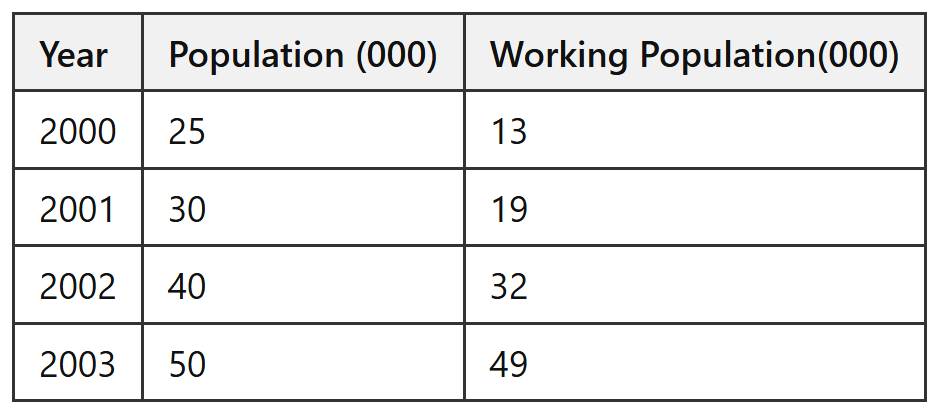
    17. The percentage of working population in 2002 is?
    Figure for: The percentage of working population in 2002 is?
    1. A.50%
    2. B.25%
    3. C.8%
    4. D.80%
  18. Economics2010International Trade
    18. One of the characteristics of free trade zone is
    1. A.common tariff against non-member countries
    2. B.different trade policies of non-member countries
    3. C.free factor mobility within the zone
    4. D.harmonized trade among member countries
  19. Economics2010International Trade
    19. If Nigeria imports vehicles from Japan the transaction will appear as a
    1. A.debit on Japan's balance of payments
    2. B.credit on Japan's balance of payments
    3. C.credit on Nigeria's balance of trade
    4. D.credit on Nigeria's balance of payment
  20. Economics2010Money and Banking
    20. One of the objectives of ADB is to
    1. A.provide subsidies on imported goods to member countries
    2. B.mobilize short-term loans for member countries
    3. C.promote economic and social development of member countries
    4. D.provide technical assistance to only poor member countries

Other JAMB Economics papers