JAMB Economics 2014 past questions

40 questions from the 2014 paper, showing 1–20. Try each one, then open the solution to check your answer. Sign in to see the worked explanations.

  1. Economics2014Economic Systems
    1. The choice of how to produce in a command economy is determined by
    1. A.government
    2. B.consumer
    3. C.industrialists
    4. D.labour unions
  2. Economics2014Population and Economic Development
    2. The best measure of dispersion to determine the tallest tree in a forest is
    1. A.range
    2. B.variance
    3. C.standard deviation
    4. D.mean deviation
  3. Economics2014National Income
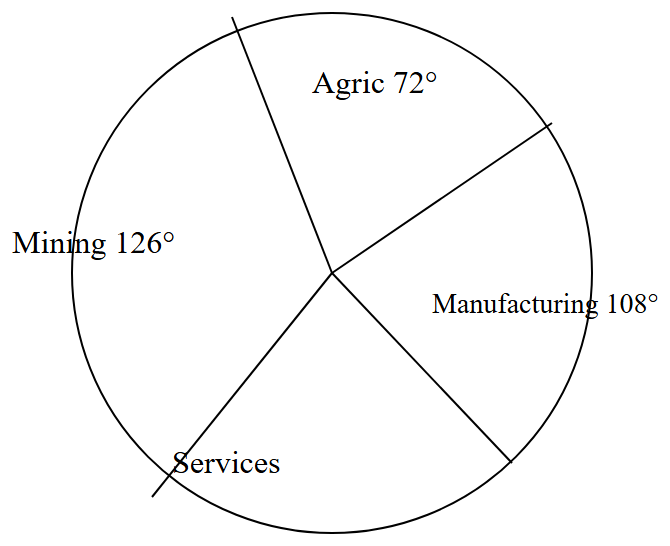
    3. What is the percentage contribution of services to the national income?
    Figure for: What is the percentage contribution of services to the national income?
    1. A.15%
    2. B.10%
    3. C.54%
    4. D.24%
  4. Economics2014Price Determination
    4. Given that Qd = 40-2P and Qs = 6P+24. Calculate the equilibrium price.
    1. A.₦34
    2. B.₦32
    3. C.₦36
    4. D.₦16
  5. Economics2014Demand and Supply
    5. A change in demand for a normal goods implies that, there is a
    1. A.change in the quantity demanded as price changes
    2. B.shift in the demand curve
    3. C.movement along a given demand curve
    4. D.change in the price elasticity of demand
  6. Economics2014Demand and Supply
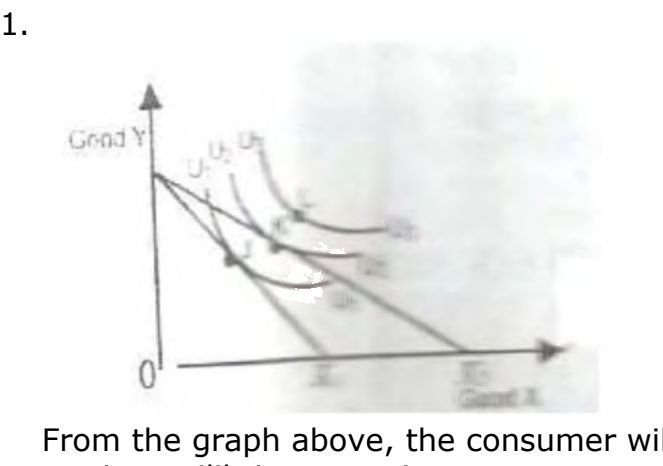
    6. From the graph above, the consumer will attain equilibrium at point
    Figure for: From the graph above, the consumer will attain equilibrium at point
    1. A.J
    2. B.K
    3. C.L
    4. D.M
  7. Economics2014Demand and Supply
    7. A rightward shift of the budget line is caused by a
    1. A.fall in consumer income
    2. B.change in consumer taste
    3. C.fall in the commodity relative price
    4. D.rise in the commodity relative price
  8. Economics2014Demand and Supply
    8. Given the supply function P=14(Qs+10)P = \frac{1}{4}(Q_s+10) when P = ₦10, what is QsQ_s?
    1. A.20
    2. B.15
    3. C.50
    4. D.30
  9. Economics2014Demand and Supply
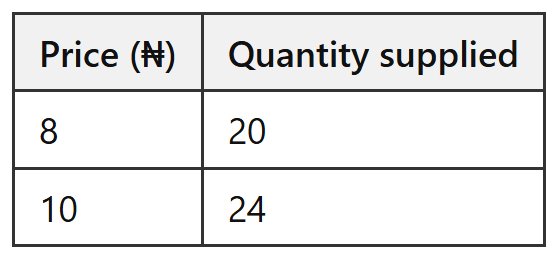
    9. From the table above, Calculate the price elasticity of supply
    Figure for: From the table above, Calculate the price elasticity of supply
    1. A.0.50
    2. B.0.80
    3. C.2.00
    4. D.1.25
  10. Economics2014Price Determination
    10. When price is set below equilibrium, this will lead to
    1. A.an increase in the quantity supplied
    2. B.a new equilibrium
    3. C.a decrease in the quantity supplied
    4. D.a fall in price
  11. Economics2014Price Determination
    11. Price mechanism determines the prices of commodities through
    1. A.auctioning
    2. B.market forces
    3. C.the sales of treasury bills
    4. D.government legislation
  12. Economics2014Price Determination
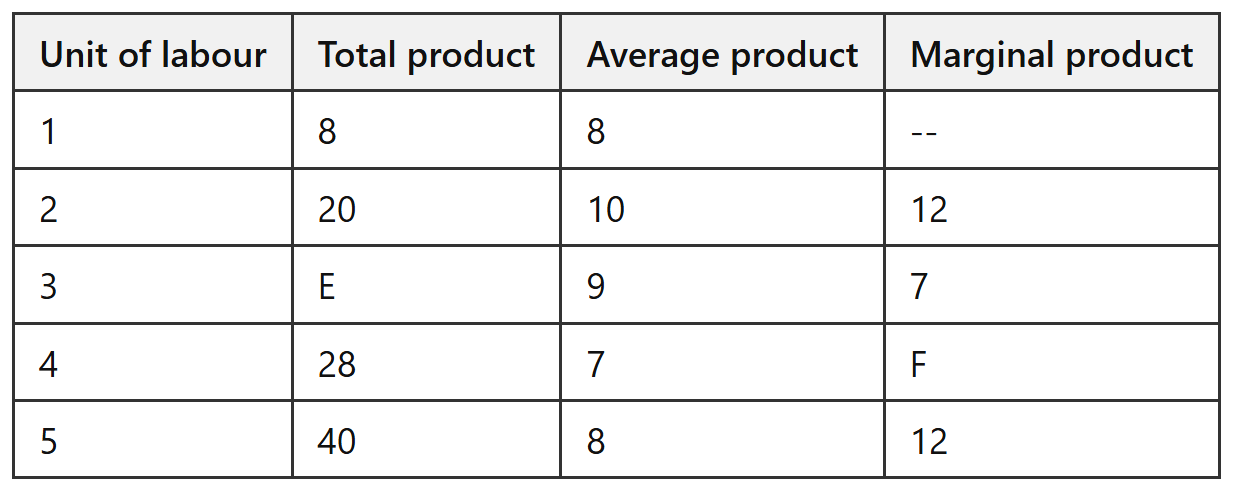
    12. From the table above, find the values of E and F respectively
    Figure for: From the table above, find the values of E and F respectively
    1. A.27 and 1
    2. B.68 and 12
    3. C.28 and 5
    4. D.12 and 19
  13. Economics2014Price Determination
    13. If the production of a large firm is higher than that of a small firm, it is experiencing.
    1. A.external economies of scale
    2. B.external diseconomies of scale
    3. C.internal economies of scale
    4. D.internal diseconomies of scale
  14. Economics2014Price Determination
    14. Division of labour requires that, the tasks in a production line be performed
    1. A.by specialists
    2. B.in stages
    3. C.by all workers
    4. D.by unskilled labourers
  15. Economics2014Price Determination
    15. Given that FC = ₦500, VC = ₦1,500, and Q = 50 units. Find the average cost of the product.
    1. A.₦30
    2. B.₦40
    3. C.₦10
    4. D.₦20
  16. Economics2014Price Determination
    16. Rent and administrative expenses are examples of
    1. A.average fixed costs
    2. B.average variable costs
    3. C.fixed costs
    4. D.variable costs
  17. Economics2014Price Determination
    17. One of the characteristics of a monopolist is that, he can influence
    1. A.quantity produced by other producers
    2. B.prices charged by other producers
    3. C.both price and quantity
    4. D.price or quantity
  18. Economics2014National Income
    18. Which of the following can be used to measure the Gross National product in an open economy?
    1. A.C+I+G+(X+M)
    2. B.C+I+G+X
    3. C.C+I+G
    4. D.C+I+G+(X-M)
  19. Economics2014National Income
    19. If MPC = 2/3 and investment is ₦100 million, the level of national income is
    1. A.₦100 million
    2. B.₦10 million
    3. C.₦303 million
    4. D.₦300 million
  20. Economics2014Money and Banking
    20. One of the challenges facing the banking industry in Nigeria is
    1. A.ensuring technological security
    2. B.providing employment
    3. C.providing loans for investment
    4. D.creating more money

Other JAMB Economics papers