JAMB Biology 2011 past questions

42 questions from the 2011 paper, showing 1–20. Try each one, then open the solution to check your answer. Sign in to see the worked explanations.

  1. Biology2011Ecology and Environment
    1. In which of the following species is the biomass of an individual the smallest?
    1. A.Agama sp.
    2. B.Bufo sp.
    3. C.Spirogyra sp.
    4. D.Tilapia sp.
  2. Biology2011Classification of Living Things
    2. Seed plants are divided into
    1. A.tracheophytes and ferns
    2. B.angiosperms and gymnosperms
    3. C.monocotyledons and dicotyledons
    4. D.thallophytes and bryophytes
  3. Biology2011Animal Biology
    3. In which of the following groups of vertebrates is parental care mostly exhibited?
    1. A.Reptilia
    2. B.Amphibia
    3. C.Aves
    4. D.Mammalia
  4. Biology2011Animal Biology
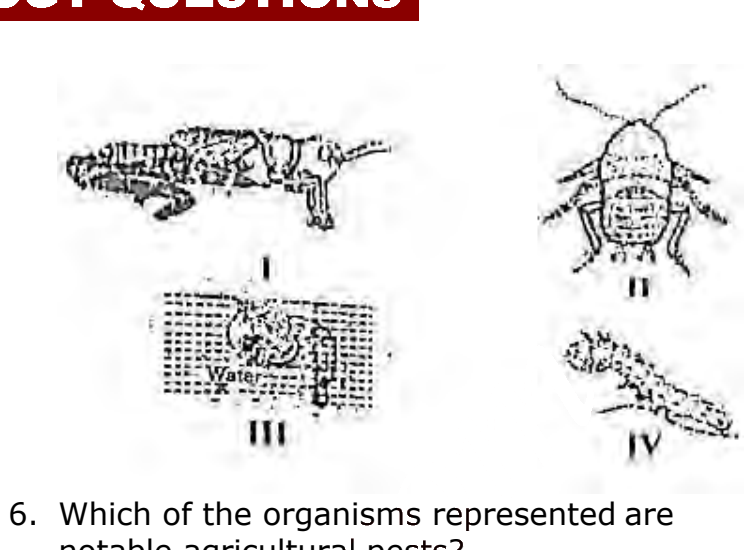
    4. Use the diagrams to answer questions 6 to 8. Which of the organisms represented are notable agricultural pests?
    Figure for: Use the diagrams to answer questions 6 to 8. Which of the organisms represented are notable…
    1. A.II and IV
    2. B.I and IV
    3. C.II and III
    4. D.I and III
  5. Biology2011Animal Biology
    5. An economic importance of the organism represented by IV is that
    Figure for: An economic importance of the organism represented by IV is that
    1. A.it transmits water borne disease to humans
    2. B.it is destructive to farm crops
    3. C.its faeces pollutes drinking water
    4. D.it helps in the control of mosquito larvae
  6. Biology2011Animal Biology
    6. The adult form of III is a vector of
    Figure for: The adult form of III is a vector of
    1. A.sleeping sickness
    2. B.river blindness
    3. C.cholera
    4. D.elephantiasis
  7. Biology2011Animal Biology
    7. The adaptive importance of nuptial flight from termite colonies is to
    1. A.disperse the reproductives in order to establish new colonies
    2. B.provide abundant food for birds and other animals during the early rains
    3. C.ensure cross-breeding between members of one colony and another
    4. D.expel the reproductives so as to provide enough food for other members
  8. Biology2011Cell Biology
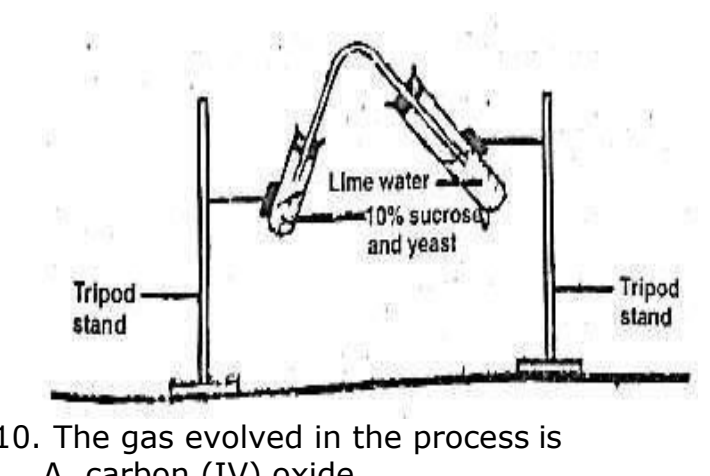
    8. Use the diagram to answer questions 10 and 11 (a set-up with lime water and 10% sucrose and yeast in tubes on tripod stands). The gas evolved in the process is
    Figure for: Use the diagram to answer questions 10 and 11 (a set-up with lime water and 10% sucrose and yeast…
    1. A.carbon (IV) oxide
    2. B.nitrogen
    3. C.oxygen
    4. D.carbon (II) oxide
  9. Biology2011Cell Biology
    9. The experimental set-up above is used to demonstrate the process of
    Figure for: The experimental set-up above is used to demonstrate the process of
    1. A.diffusion
    2. B.photosynthesis
    3. C.fermentation
    4. D.plasmolysis
  10. Biology2011Cell Biology
    10. Which of the following can cause shrinkage of living cells?
    1. A.Hypotonic solution
    2. B.Isotonic solution
    3. C.Deionized water
    4. D.Hypertonic solution
  11. Biology2011Human Biology and Physiology
    11. Which of the following is true of leucocytes?
    1. A.they are respiratory pigments
    2. B.they are most numerous and ramify all cells
    3. C.they are large and nucleated
    4. D.they are involved in blood clotting
  12. Biology2011Nutrition
    12. The conversion of a nutrient into a molecule in the body of a consumer is referred to as
    1. A.digestion
    2. B.assimilation
    3. C.absorption
    4. D.inhibition
  13. Biology2011Cell Biology
    13. The ability of living organism to detect and respond to changes in the environment is referred to as
    1. A.locomotion
    2. B.irritability
    3. C.growth
    4. D.taxis
  14. Biology2011Human Biology and Physiology
    14. In mammals, the exchange of nutrients and metabolic products occurs in the
    1. A.lungs
    2. B.oesophagus
    3. C.trachea
    4. D.lymph
  15. Biology2011Plant Biology
    15. An example of an endospermous seed is
    1. A.maize grain
    2. B.cashew nut
    3. C.cotton seed
    4. D.bean seed
  16. Biology2011Nutrition
    16. Use the following information to answer questions 19 and 20. I. Test tube containing cane sugar and water. II. Test tube containing cane sugar and diluted acid. III. Test tube containing cane sugar and its degrading enzyme. In which of the test tubes will glucose be detected after complete hydrolysis?
    1. A.I and II only
    2. B.II and III only
    3. C.I only
    4. D.I, II and III
  17. Biology2011Animal Biology
    17. The movement response of a cockroach away from a light source can be described as
    1. A.positive phototaxism
    2. B.negative phototaxism
    3. C.negative phototropism
    4. D.positive phototropism
  18. Biology2011Plant Biology
    18. The vascular tissues in higher plants are responsible for
    1. A.the movement of food and water
    2. B.suction pressure
    3. C.transpiration pull
    4. D.the transport of gases and water
  19. Biology2011Excretion
    19. Which of the following organs regulates the levels of water, salts, hydrogen ions and urea in the mammalian blood?
    1. A.Liver
    2. B.Kidney
    3. C.Bladder
    4. D.Colon
  20. Biology2011Animal Biology
    20. The sequence of the one-way gaseous exchange mechanism in a fish is
    1. A.operculum → gills → mouth
    2. B.gills → operculum → mouth
    3. C.mouth → operculum → gills
    4. D.mouth → gills → operculum

Other JAMB Biology papers