JAMB Biology 2014 past questions

44 questions from the 2014 paper, showing 1–20. Try each one, then open the solution to check your answer. Sign in to see the worked explanations.

  1. Biology2014Classification of Living Things
    1. Which of the following organisms is multi-cellular?
    1. A.Chlamydomonas
    2. B.Spirogyra
    3. C.Amoeba
    4. D.Euglena
  2. Biology2014Classification of Living Things
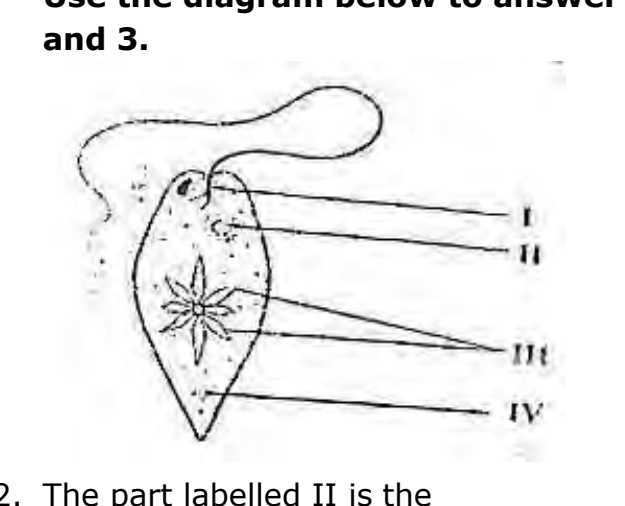
    2. The part labelled II is the
    Figure for: The part labelled II is the
    1. A.nucleus
    2. B.eyespot
    3. C.basal granule
    4. D.contractile vacuole
  3. Biology2014Classification of Living Things
    3. The part responsible for photosynthesis is labelled
    Figure for: The part responsible for photosynthesis is labelled
    1. A.III
    2. B.IV
    3. C.I
    4. D.II
  4. Biology2014Cell Biology
    4. The lowest level of organization in living organisms is
    1. A.organ
    2. B.cell
    3. C.system
    4. D.tissue
  5. Biology2014Cell Biology
    5. Which of the following is the most complex according to their cellular level of organization?
    1. A.Heart
    2. B.Hair
    3. C.Euglena
    4. D.Hydra
  6. Biology2014Animal Biology
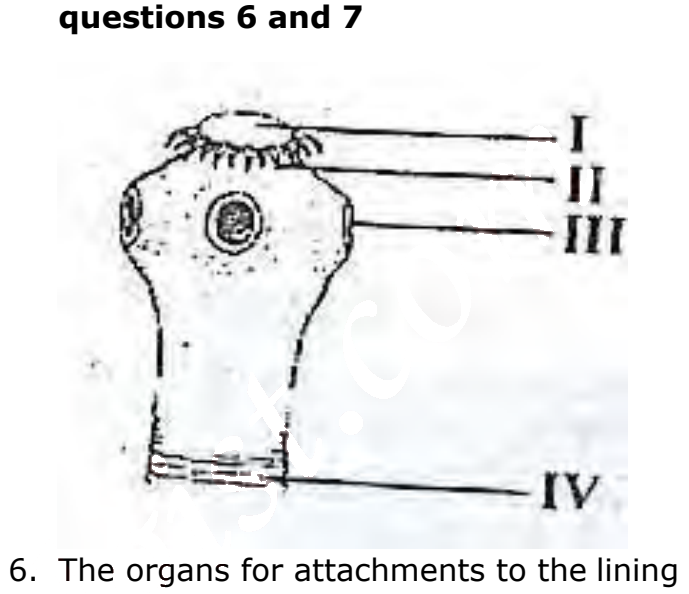
    6. The organs for attachments to the lining of the host's intestine are labelled
    Figure for: The organs for attachments to the lining of the host's intestine are labelled
    1. A.II and III
    2. B.III and IV
    3. C.I and II
    4. D.I and III
  7. Biology2014Plant Biology
    7. In bryophytes, sex organs are produced in the
    1. A.protonema
    2. B.sporophyte
    3. C.gametophyte
    4. D.rhizoid
  8. Biology2014Plant Biology
    8. Seed plants are the most dominant vegetation on land because of
    1. A.their motile gametes
    2. B.their ability to photosynthesize
    3. C.efficient seed dispersal
    4. D.availability of water
  9. Biology2014Ecology and Environment
    9. Which of the following is an arboreal organism?
    1. A.Elephant
    2. B.Fish
    3. C.Antelope
    4. D.Bird
  10. Biology2014Animal Biology
    10. I21,c00,pm32,m33I\frac{2}{1}, c\frac{0}{0}, pm\frac{3}{2}, m\frac{3}{3}. The general formula above represents that of
    1. A.an omnivore
    2. B.a detritus feeder
    3. C.a carnivore
    4. D.a herbivore
  11. Biology2014Human Biology and Physiology
    11. A circulatory system is very essential in mammals but not in smaller organisms like Amoeba because
    1. A.amoeba lives in freshwater
    2. B.diffusion is sufficient to transport materials in Amoeba
    3. C.amoeba lacks blood containing haemoglobin
    4. D.amoeba exhibits anaerobic respiration
  12. Biology2014Plant Biology
    12. In vascular plants, the sieve tubes and companion cells are present in the
    1. A.cambium
    2. B.cortex
    3. C.xylem
    4. D.phloem
  13. Biology2014Plant Biology
    13. The stomata of leaves are similar in function to the
    1. A.pharynx of humans
    2. B.scales of fish
    3. C.spiracle of insects
    4. D.trachea of toads
  14. Biology2014Animal Biology
    14. The use of moist skin for respiration in amphibians is known as
    1. A.cellular respiration
    2. B.cutaneous respiration
    3. C.buccal respiration
    4. D.pulmonary respiration
  15. Biology2014Plant Biology
    15. Water in plants is removed as water vapour through the process of
    1. A.diffusion
    2. B.osmosis
    3. C.evaporation
    4. D.transpiration
  16. Biology2014Plant Biology
    16. An example of an organ of perennation in plants is
    1. A.rhizome
    2. B.seed
    3. C.petal of a flower
    4. D.calyx of flower
  17. Biology2014Plant Biology
    17. Alternation of generation is a feature shown in
    1. A.mosses
    2. B.fungi
    3. C.grasses
    4. D.conifers
  18. Biology2014Plant Biology
    18. I. Growth is mainly apical II. Growth is specific with definite shape III. Growth is throughout life. Which of the above correctly describes the growth pattern in plants?
    1. A.I, II and III only
    2. B.II and III only
    3. C.I and II only
    4. D.I and III only
  19. Biology2014Human Biology and Physiology
    19. Coordination and regulation of body activities in mammals are achieved by the
    1. A.nerves and muscle
    2. B.nerves and hormones
    3. C.nerves only
    4. D.hormones only
  20. Biology2014Human Biology and Physiology
    20. The Cerebellum of the Brain controls
    1. A.reflex action
    2. B.muscular activity
    3. C.emotional expressions
    4. D.the Endocrine system

Other JAMB Biology papers