JAMB Physics 1987 past questions

47 questions from the 1987 paper, showing 1–20. Try each one, then open the solution to check your answer. Sign in to see the worked explanations.

  1. Physics1987Measurement and Units
    1. Which of the following units is equivalent to kg m s−1\mathrm{kg\,m\,s^{-1}}?
    1. A.N s−1\mathrm{N\,s^{-1}}
    2. B.N m s\mathrm{N\,m\,s}
    3. C.N s\mathrm{N\,s}
    4. D.J s−1\mathrm{J\,s^{-1}}
  2. Physics1987Mechanics
    2. A man walks 8 km north and then 5 km in a direction 60∘60^\circ east of north. Find the distance from his starting point.
    1. A.11.36 km
    2. B.12.36 km
    3. C.13.00 km
    4. D.14.36 km.
  3. Physics1987Motion and Forces
    3. A jet engine develops a thrust of 270 N s when the velocity of the exhaust gases relative to the engine is 300 m s−1300\,\mathrm{m\,s^{-1}}. What is the mass of the material ejected per second?
    1. A.81.00 kg
    2. B.9.00 kg
    3. C.0.90 kg
    4. D.0.09 kg
  4. Physics1987Mechanics
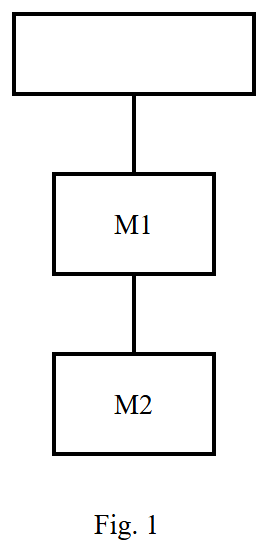
    4. Figure 1 above shows two connected bodies of masses m1m_1 and m2m_2 in equilibrium under gravity. The tension in the upper string is
    Figure for: Figure 1 above shows two connected bodies of masses m1 and m2 in equilibrium under gravity. The…
    1. A.(m1−m2)g(m_1 - m_2)g
    2. B.m1gm_1 g
    3. C.m2gm_2 g
    4. D.(m1+m2)g(m_1 + m_2)g.
  5. Physics1987Motion and Forces
    5. An elevator of mass 4800 kg is supported by a cable which can safely withstand a maximum tension of 60 000 N. The maximum upward acceleration the elevator can have is (g=10 m s−2g = 10\,\mathrm{m\,s^{-2}})
    1. A.2.5 m s−22.5\,\mathrm{m\,s^{-2}}
    2. B.5.0 m s−25.0\,\mathrm{m\,s^{-2}}
    3. C.7.5 m s−27.5\,\mathrm{m\,s^{-2}}
    4. D.10.0 m s−210.0\,\mathrm{m\,s^{-2}}
  6. Physics1987Energy
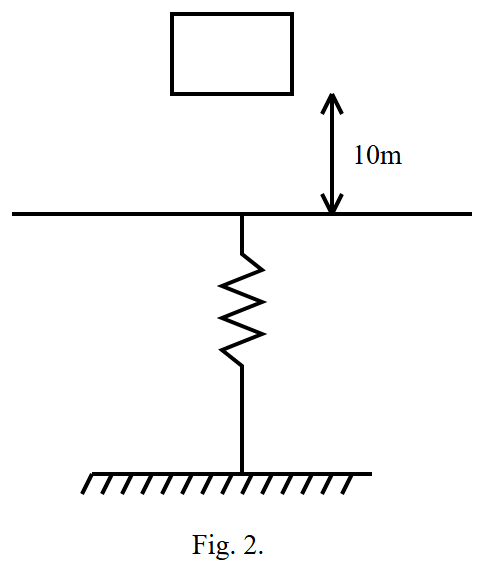
    6. A 50.0 kg block is dropped on a spring from a point 10 m above (Fig. 2). If the force constant of the spring is 4.0×10⁴ N m−14.0\times10^4\,\mathrm{N\,m^{-1}}, find the maximum compression of the spring. (g=10 m s−2g = 10\,\mathrm{m\,s^{-2}})
    Figure for: A 50.0 kg block is dropped on a spring from a point 10 m above (Fig. 2). If the force constant of…
    1. A.1.25 m
    2. B.0.50 m
    3. C.0.25 m
    4. D.0.05 m
  7. Physics1987Energy
    7. A constant force of 40 N acting on a body initially at rest gives an acceleration of 0.1 m s−20.1\,\mathrm{m\,s^{-2}} for 4 s. Calculate the work done by the force.
    1. A.8 J
    2. B.10 J
    3. C.32 J
    4. D.160 J
  8. Physics1987Energy
    8. A body rolls down a slope from a height of 100 m. Its velocity at the foot of the slope is 20 m s−120\,\mathrm{m\,s^{-1}}. What percentage of its initial potential energy is converted into kinetic energy? (g=10 m s−2g = 10\,\mathrm{m\,s^{-2}})
    1. A.40 %
    2. B.35 %
    3. C.20%
    4. D.15 %
  9. Physics1987Energy
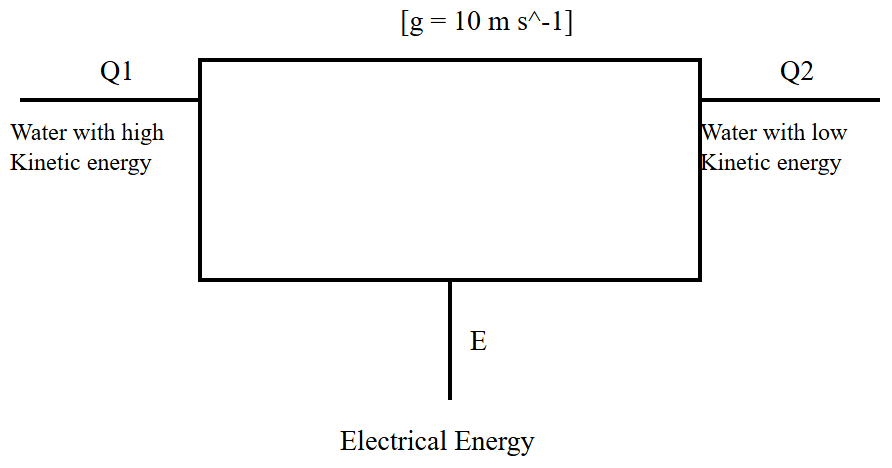
    9. Figure 3 above represents the main sequence of energy conversion at Kainji dam. The efficiency of the system is
    Figure for: Figure 3 above represents the main sequence of energy conversion at Kainji dam. The efficiency of…
    1. A.Q1Q2\frac{Q_1}{Q_2}
    2. B.EQ1\frac{E}{Q_1}
    3. C.EQ1−Q2\frac{E}{Q_1 - Q_2}
    4. D.EQ1+Q2\frac{E}{Q_1 + Q_2}
  10. Physics1987Motion and Forces
    10. The coefficient of static friction between a 40 kg crate and a concrete surface is 0.25. Find the magnitude of the minimum force needed to keep the crate stationary on the concrete base inclined at 45∘45^\circ to the horizontal. [g=10 m s−2g = 10\,\mathrm{m\,s^{-2}}]
    1. A.400 N
    2. B.300 N
    3. C.283 N
    4. D.212 N
  11. Physics1987Properties of Matter
    11. If a beaker is filled with water, it is observed that the surface of the water is not horizontal at the glass-water interface. This behaviour is due to
    1. A.Friction
    2. B.Viscosity
    3. C.Surface tension
    4. D.Evaporation.
  12. Physics1987Mechanics
    12. The mechanical advantage (MA) of an inclined plane depends on
    1. A.Its length
    2. B.Its height
    3. C.The product of its length and height
    4. D.The ratio of its length and its height.
  13. Physics1987Properties of Matter
    13. A load of 5N gives an extension of 0.56cm in a wire which obeys Hooke’s law. What is the extension caused by a load of 20N?
    1. A.1.12 cm
    2. B.2.14 cm
    3. C.2.24 cm
    4. D.2.52 cm
  14. Physics1987Properties of Matter
    14. A cube of side 10cm and mass 0.5kg floats in a liquid with only 15\frac{1}{5} of its height above the liquid surface. What is the relative density of the liquid?
    1. A.0.125
    2. B.0.250
    3. C.0.625
    4. D.2.500
  15. Physics1987Heat and Temperature
    15. The distance between the fixed points of centigrade thermometer is 20cm. What is the temperature when the mercury level is 4.5cm above the lower mark?
    1. A.22.5∘C22.5^\circ\mathrm{C}
    2. B.29.0∘C29.0^\circ\mathrm{C}
    3. C.90.0∘C90.0^\circ\mathrm{C}
    4. D.100.0∘C100.0^\circ\mathrm{C}
  16. Physics1987Heat and Temperature
    16. The length of a side of a metallic cube at 20∘C20^\circ\mathrm{C} is 5.0cm. Given that the linear expansivity of the metal is 4.0×10⁻⁵ K−14.0\times10^{-5}\,\mathrm{K^{-1}} Find the volume of the cube at 120∘C120^\circ\mathrm{C}.
    1. A.126.50 cm3126.50\,\mathrm{cm^3}
    2. B.126.25 cm3126.25\,\mathrm{cm^3}
    3. C.126.00 cm3126.00\,\mathrm{cm^3}
    4. D.125.00 cm3125.00\,\mathrm{cm^3}
  17. Physics1987Properties of Matter
    17. As a result of air at the top of a barometer, the height of the mercury column is 73.5cm when it should be 75.0cm; the volume of the space above the mercury is 8.0 cm38.0\,\mathrm{cm^3}. Calculate the correct barometric height when the barometer reads 74.0cm and the volume of the space above the mercury is 6.0 cm36.0\,\mathrm{cm^3}.
    1. A.72.0 cm
    2. B.74.5 cm
    3. C.75.1 cm
    4. D.76.0 cm
  18. Physics1987Heat and Temperature
    18. Hot water is added to three times its mass of water at 10∘C10^\circ\mathrm{C} and the resulting temperature is 20∘C20^\circ\mathrm{C}. What is the initial temperature of the hot water?
    1. A.100∘C100^\circ\mathrm{C}
    2. B.80∘C80^\circ\mathrm{C}
    3. C.50∘C50^\circ\mathrm{C}
    4. D.40∘C40^\circ\mathrm{C}
  19. Physics1987Heat and Temperature
    19. 22,000 J of heat is required to raise the temperature of 1.5 kg of paraffin from 20∘C20^\circ\mathrm{C} to 30∘C30^\circ\mathrm{C}. Calculate the specific heat capacity of paraffin.
    1. A.1466 J kg−1 ∘C−11466\,\mathrm{J\,kg^{-1}\,^\circ C^{-1}}
    2. B.2933 J kg−1 ∘C−12933\,\mathrm{J\,kg^{-1}\,^\circ C^{-1}}
    3. C.4400 J kg−1 ∘C−14400\,\mathrm{J\,kg^{-1}\,^\circ C^{-1}}
    4. D.5866 J kg−1 ∘C−15866\,\mathrm{J\,kg^{-1}\,^\circ C^{-1}}
  20. Physics1987Heat and Temperature
    20. Calculate the amount of heat required to convert 2 kg of ice at −2∘C-2^\circ\mathrm{C} to water at 0∘C0^\circ\mathrm{C}. (Specific heat capacity of ice = 2090 J kg−1 ∘C−12090\,\mathrm{J\,kg^{-1}\,^\circ C^{-1}}, specific latent heat of fusion = 333 kJ kg−1333\,\mathrm{kJ\,kg^{-1}}).
    1. A.666 J
    2. B.8 360 J
    3. C.666 000 J
    4. D.674 360 J

Other JAMB Physics papers