JAMB Physics 1998 past questions

47 questions from the 1998 paper, showing 1–20. Try each one, then open the solution to check your answer. Sign in to see the worked explanations.

  1. Physics1998Measurement and Units
    1. The physical quantity that has the same dimensions as impulse is
    1. A.Energy
    2. B.Momentum
    3. C.Surface tension
    4. D.Pressure.
  2. Physics1998Mechanics
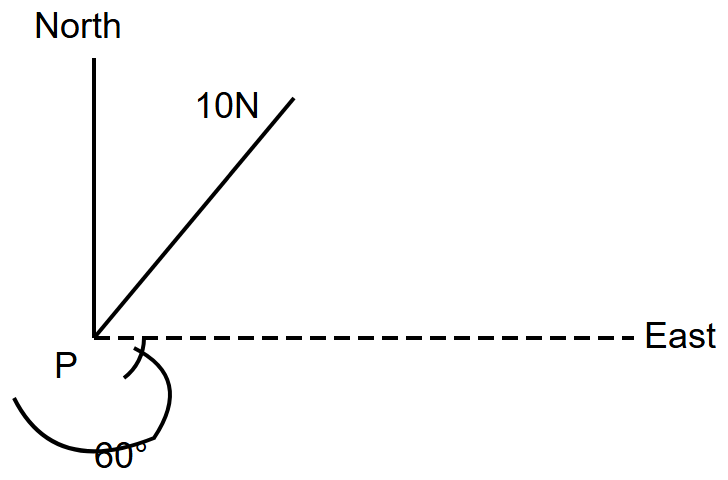
    2. A body on the ground is acted on by a force of 10N at a point P as shown in the diagram above. What force is needed to stop the body from moving eastward?
    Figure for: A body on the ground is acted on by a force of 10N at a point P as shown in the diagram above…
    1. A.5N in the direction of East
    2. B.5N in the direction of West
    3. C.535\sqrt{3}N in the direction of West.
    4. D.10N in the Southwest direction.
  3. Physics1998Motion and Forces
    3. In free fall, a body of mass 1kg drops from a height of 125m from rest in 5s. How long will it take another body of mass 2kg to fall from rest from the same height? (g=10 ms−2g = 10\,\mathrm{ms^{-2}})
    1. A.5 s
    2. B.10 s
    3. C.12 s
    4. D.15 s
  4. Physics1998Mechanics
    4. A ball of mass 0.15kg is kicked against a rigid vertical wall with a horizontal velocity of 50 ms−150\,\mathrm{ms^{-1}}, calculate the impulse of the ball on the wall.
    1. A.3.0Ns
    2. B.4.5Ns
    3. C.7.5Ns
    4. D.12.0Ns
  5. Physics1998Mechanics
    5. The force of attraction between two point masses is 10−410^{-4}N when the distance between them is 0.18m. If the distance is reduced to 0.06m, calculate the force.
    1. A.1.1×10−51.1 \times 10^{-5}N
    2. B.3.3×10−53.3 \times 10^{-5}N
    3. C.3.0×10−43.0 \times 10^{-4}N
    4. D.9.0×10−49.0 \times 10^{-4}N
  6. Physics1998Motion and Forces
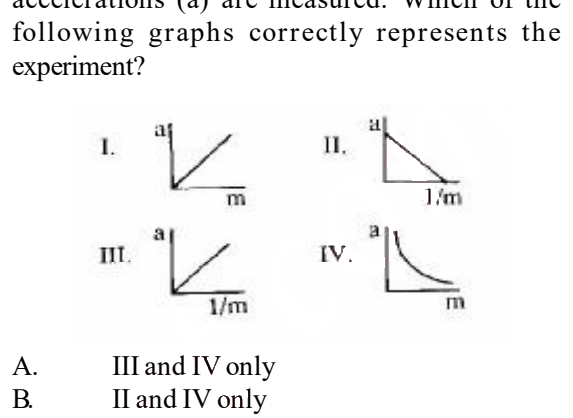
    6. In an experiment, a constant force is applied to several masses (m) and the corresponding accelerations (a) are measured. Which of the following graphs correctly represents the experiment?
    Figure for: In an experiment, a constant force is applied to several masses (m) and the corresponding…
    1. A.III and IV only
    2. B.II and IV only
    3. C.I and III only
    4. D.I and II only
  7. Physics1998Mechanics
    7. A uniform metre rule weighing 0.5N is to be pivoted on a knife-edge at the 30cm-mark. Where will a force of 2N be placed from the pivot to balance the metre rule?
    1. A.95cm
    2. B.25cm
    3. C.20cm
    4. D.5cm
  8. Physics1998Energy
    8. A bullet fired at a wooden block of thickness 0.15m manages to penetrate the block. If the mass of the bullet is 0.025kg and the average resisting force of the wood is 7.5×1037.5 \times 10^{3}N, calculate the speed of the bullet just before it hits the wooden block.
    1. A.450 ms−1450\,\mathrm{ms^{-1}}
    2. B.400 ms−1400\,\mathrm{ms^{-1}}
    3. C.300 ms−1300\,\mathrm{ms^{-1}}
    4. D.250 ms−1250\,\mathrm{ms^{-1}}
  9. Physics1998Energy
    9. A man whose mass is 80kg climbs a staircase in 20s and expends a power of 120W. Find the height of the staircase. [g=10 ms−2g = 10\,\mathrm{ms^{-2}}]
    1. A.1.8m
    2. B.2.0m
    3. C.2.5m
    4. D.3.0m
  10. Physics1998Properties of Matter
    10. A parachute attains a terminal velocity when
    1. A.Its density is equal to the density of air
    2. B.The viscous force of the air and the upthrust completely counteract its weight.
    3. C.It expands as a result of reduced external pressure
    4. D.The viscous force of the is equal to the sum of the weight and upthrust.
  11. Physics1998Mechanics
    11. In a wheel and axle mechanism, the diameters of the wheel and axle are 40cm and 8cm respectively. Given that the machine is 80% efficient, what effort is required to lift a load of 100N?
    1. A.20 N
    2. B.25 N
    3. C.50 N
    4. D.80 N
  12. Physics1998Properties of Matter
    12. The tendon in a man's leg is 0.01m long. If a force of 5N stretches the tendon by 2.0×10−52.0 \times 10^{-5}m, calculate the strain on the muscle.
    1. A.5×1065 \times 10^6
    2. B.5×1025 \times 10^2
    3. C.2×10−32 \times 10^{-3}
    4. D.2×10−72 \times 10^{-7}
  13. Physics1998Properties of Matter
    13. Which of these statements are correct for the pressures in liquids? I Pressure in a liquid at a point acts equally in all directions II Pressure increases with depth III Pressure at a depth depends on the shape of the container. IV Pressures at the same depth in different liquids are proportional to the densities of the liquids.
    1. A.I, II and III only
    2. B.I, II and IV only
    3. C.I, III and IV only
    4. D.II, III and IV only
  14. Physics1998Properties of Matter
    14. A solid of weight 0.600N is totally immersed in oil and water respectively. If the upthrust in oil is 0.210N and the relative density of oil is 0.875 find the upthrust in water.
    1. A.0.6000N
    2. B.0.360N
    3. C.0.240N
    4. D.0.180N
  15. Physics1998Heat and Temperature
    15. A platinum resistance thermometer records 3.0 Ω3.0\,\Omega at 0∘0^\circC and 8.0 Ω8.0\,\Omega at 100∘100^\circC. If it records 6.0 Ω6.0\,\Omega in a certain environment, the temperature of the medium is
    1. A.80∘80^\circC
    2. B.60∘60^\circC
    3. C.50∘50^\circC
    4. D.30∘30^\circC
  16. Physics1998Heat and Temperature
    16. The linear expansivity of brass is 2×10⁻⁵ ∘C−12 \times 10^{-5}\,^\circ\mathrm{C}^{-1}. If the volume of a piece of brass is 15.00 cm315.00\,\mathrm{cm^3} at 0∘0^\circC, what is the volume at 100∘100^\circC?
    1. A.16.03 cm316.03\,\mathrm{cm^3}
    2. B.16.00 cm316.00\,\mathrm{cm^3}
    3. C.15.09 cm315.09\,\mathrm{cm^3}
    4. D.15.03 cm315.03\,\mathrm{cm^3}
  17. Physics1998Heat and Temperature
    17. A gas has a volume of 100 cm3100\,\mathrm{cm^3} at 27∘27^\circC. If it is heated to temperature T until a final volume of 120 cm3120\,\mathrm{cm^3} is attained, calculate T.
    1. A.33∘33^\circC
    2. B.60∘60^\circC
    3. C.87∘87^\circC
    4. D.114∘114^\circC
  18. Physics1998Heat and Temperature
    18. A 500W heater is used to heat 0.6kg of water from 25∘25^\circC to 100∘100^\circC in t1t_1 seconds. If another 1000W heater is used to heat 0.2kg of water from 10∘10^\circC to 100∘100^\circC in t2t_2 seconds, find t1/t2t_1/t_2.
    1. A.50
    2. B.5
    3. C.5/45/4
    4. D.1/51/5
  19. Physics1998Heat and Temperature
    19. How many grams of water at 17∘17^\circC must be added to 42g of ice at 0∘0^\circC to melt the ice completely? [Specific latent heat of fusion of ice = 3.4×10⁵ J kg−13.4 \times 10^5\,\mathrm{J\,kg^{-1}}, Specific heat capacity of water = 4200 J kg−1K−14200\,\mathrm{J\,kg^{-1}K^{-1}}]
    1. A.200g
    2. B.300g
    3. C.320g
    4. D.400g
  20. Physics1998Heat and Temperature
    20. A vapour is said to be saturated when
    1. A.More molecules return to the liquid than the amount that left it.
    2. B.A dynamic equilibrium exist between the molecules of the liquid and the vapour molecules at a given temperature.
    3. C.The vapour pressure is equal to the atmospheric pressure
    4. D.All molecules are moving with the same speed in all directions at a given temperature.

Other JAMB Physics papers