JAMB Physics 1992 past questions

47 questions from the 1992 paper, showing 1–20. Try each one, then open the solution to check your answer. Sign in to see the worked explanations.

  1. Physics1992Measurement and Units
    1. What is the least possible error in using rule graduated in centimeters?
    1. A.0.1cm
    2. B.0.5cm
    3. C.1.0cm
    4. D.2.0cm
  2. Physics1992Mechanics
    2. Which of the following affects the period of a simple pendulum? I Mass of the pendulum bob II Length of the pendulum III Acceleration due to gravity.
    1. A.I, II and III
    2. B.II and III only
    3. C.I and III only
    4. D.I and II only.
  3. Physics1992Motion and Forces
    3. A boy sits in a train moving with uniform speed on a straight track. If from his outstretched palm he gently tosses a coin vertically upwards, the coin will fall
    1. A.In front of his palm
    2. B.Behind his palm
    3. C.Beside his palm
    4. D.Into his palm
  4. Physics1992Motion and Forces
    4. A body starts from rest and moves with uniform acceleration of 6 m/s26\,\mathrm{m/s^2}. What distance does it cover in the third second?
    1. A.15m
    2. B.18m
    3. C.27m
    4. D.30m
  5. Physics1992Motion and Forces
    5. A stone, Q is thrown with velocity u at an angle of 75∘75^\circ to the horizontal. Another stone R is thrown with the same velocity u but at an angle of 15∘15^\circ to the horizontal. The ranges covered by the stones will be
    1. A.Greater for Q
    2. B.Greater for R
    3. C.The same for Q and R
    4. D.Greater for heavier of the stones
  6. Physics1992Energy
    6. A man weighing 800N climbs up a flight of stairs to a height of 15m in 12.5s. What is the man's average power output?
    1. A.667W
    2. B.810W
    3. C.960W
    4. D.15000W
  7. Physics1992Mechanics
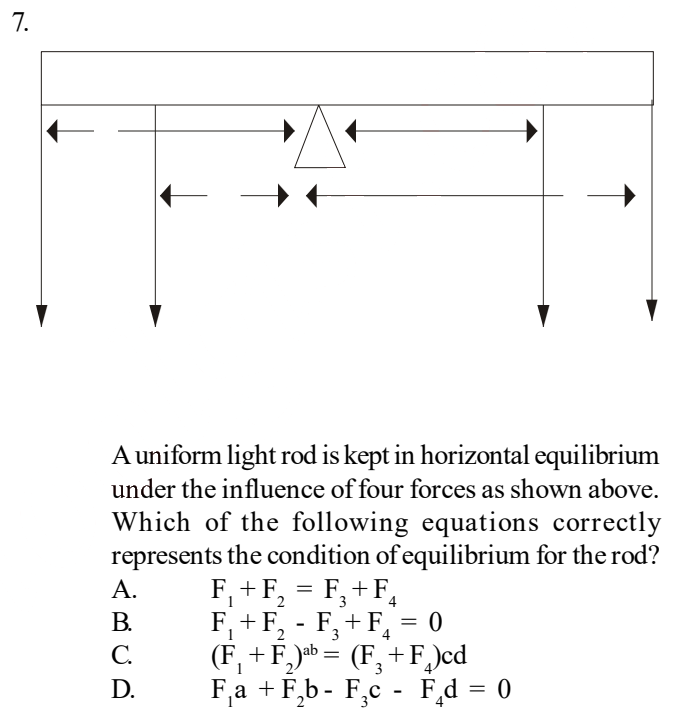
    7. A uniform light rod is kept in horizontal equilibrium under the influence of four forces as shown above. Which of the following equations correctly represents the condition of equilibrium for the rod?
    Figure for: A uniform light rod is kept in horizontal equilibrium under the influence of four forces as shown…
    1. A.F1+F2=F3+F4F_1+F_2=F_3+F_4
    2. B.F1+F2−F3+F4=0F_1+F_2-F_3+F_4=0
    3. C.(F1+F2)ab=(F3+F4)cd(F_1+F_2)ab=(F_3+F_4)cd
    4. D.F1a+F2b−F3c−F4d=0F_1a+F_2b-F_3c-F_4d=0
  8. Physics1992Energy
    8. A machine requires 1000J of work to raise a load of 500N through a vertical distance of 1.5m. Calculate the efficiency of the machine.
    1. A.80%
    2. B.75%
    3. C.50%
    4. D.33%
  9. Physics1992Properties of Matter
    9. In an experiment to determine Young's Modulus for a wire, several loads are attached to the wire and the corresponding extensions measured. The tensile stress in each case depends on the
    1. A.Load and the extension
    2. B.Load and the radius of the wire
    3. C.Radius of the wire and the extension
    4. D.Extension and the original length of the wire.
  10. Physics1992Properties of Matter
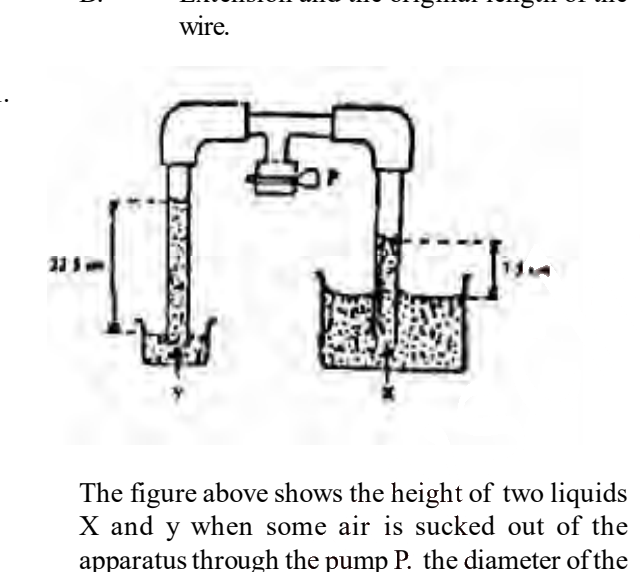
    10. The figure above shows the height of two liquids X and Y when some air is sucked out of the apparatus through the pump P. The diameter of the tube in X is twice that of the Y. What is the relative density of the liquid X with respect to liquid Y?
    Figure for: The figure above shows the height of two liquids X and Y when some air is sucked out of the…
    1. A.1/3
    2. B.2/3
    3. C.3
    4. D.6
  11. Physics1992Properties of Matter
    11. If a plastic sphere floats in water (density = 1000 kg m−31000\,\mathrm{kg\,m^{-3}}) with 0.5 of its volume submerged and floats in oil with 0.4 volume submerged, the density of the oil is
    1. A.800 kg m−3800\,\mathrm{kg\,m^{-3}}
    2. B.1 200 kg m−31\,200\,\mathrm{kg\,m^{-3}}
    3. C.1 250 kg m−31\,250\,\mathrm{kg\,m^{-3}}
    4. D.2 000 kg m−32\,000\,\mathrm{kg\,m^{-3}}
  12. Physics1992Heat and Temperature
    12. A platinum resistance thermometer wire has a resistance of 5 ohms at 0∘0^\circC and 5.5 ohms at 100∘100^\circC. Calculate the temperature of the wire when the resistance is 5.2 ohms
    1. A.80∘80^\circC
    2. B.60∘60^\circC
    3. C.40∘40^\circC
    4. D.10∘10^\circC
  13. Physics1992Heat and Temperature
    13. A bridge made of steel is 600m long. What is the daily variation in its length if the night-time and day-time temperatures are 10∘10^\circC and 35∘35^\circC respectively. The linear expansivity of steel is 0.000012 C−10.000012\,\mathrm{C^{-1}}.
    1. A.0.18cm
    2. B.1.80cm
    3. C.18.00cm
    4. D.1800cm
  14. Physics1992Heat and Temperature
    14. One of the most important applications of bimetallic strip is found in the construction of
    1. A.A thermostat
    2. B.An altimeter
    3. C.A thermocouple
    4. D.A hygrometer
  15. Physics1992Heat and Temperature
    15. At constant pressure, the density of a fixed mass of gas is
    1. A.Constant with temperature
    2. B.Proportional to its volume
    3. C.Inversely proportional to its temperature
    4. D.Independent of its volume
  16. Physics1992Heat and Temperature
    16. How much heat is absorbed when a block of copper of mass 0.05kg and specific heat capacity 390 J kg−1K−1390\,\mathrm{J\,kg^{-1}K^{-1}} is heated from 20∘20^\circC to 70∘70^\circC?
    1. A.3.98×10−13.98\times10^{-1} J
    2. B.9.75×1029.75\times10^{2} J
    3. C.3.98×1033.98\times10^{3} J
    4. D.9.75×1039.75\times10^{3} J
  17. Physics1992Properties of Matter
    17. A block of ice floats on water inside a container. If the block of ice gets completely melted, the level of water in the container will
    1. A.Increase
    2. B.Remain the same
    3. C.Decrease
    4. D.First decrease and then increase.
  18. Physics1992Heat and Temperature
    18. The space between the double glass walls of a thermos flask is evacuated and the two surfaces facing the evacuated space are silvered. The residual source of heat loss takes place by
    1. A.Convection
    2. B.Radiation from the surfaces
    3. C.Conduction through the stopper and the glass.
    4. D.Conduction across the walls.
  19. Physics1992Waves and Sound
    19. The equation of wave is y=0.005sin⁡[π(0.5x−200t)]y = 0.005\sin[\pi(0.5x - 200t)] where x and y are in metres and t is in seconds. What is the velocity of the wave?
    1. A.4 000 m s−14\,000\,\mathrm{m\,s^{-1}}
    2. B.400 m s−1400\,\mathrm{m\,s^{-1}}
    3. C.250 m s−1250\,\mathrm{m\,s^{-1}}
    4. D.40 m s−140\,\mathrm{m\,s^{-1}}
  20. Physics1992Waves and Sound
    20. Which of the following characteristics of a wave is used in the measurement of the depth of the sea?
    1. A.Diffraction
    2. B.Interference
    3. C.Refraction
    4. D.Reflection

Other JAMB Physics papers