JAMB Physics 1988 past questions

46 questions from the 1988 paper, showing 1–20. Try each one, then open the solution to check your answer. Sign in to see the worked explanations.

  1. Physics1988Measurement and Units
    1. Which of the following are the correct SI units of the quantities indicated? I N (Force) II. Nm−1\mathrm{Nm^{-1}} (Torque) III Watt (power) IV kg ms−2\mathrm{kg\,ms^{-2}} (Momentum).
    1. A.I and II only
    2. B.I, II and III only
    3. C.I, II and IV only
    4. D.I and III only.
  2. Physics1988Motion and Forces
    2. A lorry travels 10km northwards, 4km eastwards, 6km southwards and 4km westwards to arrive at a point T. What is the total displacement?
    1. A.6km south
    2. B.4km north
    3. C.6km north
    4. D.4km east.
  3. Physics1988Mechanics
    3. Two forces whose resultant is 100N, are at right angles to each other. If one of them makes an angle of 30∘30^\circ with the resultant, determine its magnitude.
    1. A.8.66 N
    2. B.50.0 N
    3. C.57.7 N
    4. D.86.6 N
  4. Physics1988Mechanics
    4. Which of the following quantities are scalars? I Electrical potential II Torque III Momentum IV Kinetic energy
    1. A.II and III only
    2. B.I and II only
    3. C.III and IV only
    4. D.I and IV only.
  5. Physics1988Motion and Forces
    5. A particle starts from rest and moves with a constant acceleration of 0.5 m s−20.5\,\mathrm{m\,s^{-2}}. The distance covered by the particle in 10s is
    1. A.2.5m
    2. B.5.0m
    3. C.25.0m
    4. D.50.0m
  6. Physics1988Motion and Forces
    6. When taking a penalty kick, a footballer applies a force of 30.0N for a period of 0.05s. If the mass of the ball is 0.075kg, calculate the speed with which the ball moves off.
    1. A.4.50 m s−14.50\,\mathrm{m\,s^{-1}}
    2. B.11.25 m s−111.25\,\mathrm{m\,s^{-1}}
    3. C.20.00 m s−120.00\,\mathrm{m\,s^{-1}}
    4. D.45.00 m s−145.00\,\mathrm{m\,s^{-1}}
  7. Physics1988Mechanics
    7. A 20-toothed gear wheel drives a 60-toothed one, if the angular speed of the smaller wheel is 120 rev s−1120\,\mathrm{rev\,s^{-1}}, the angular speed of the wheel is
    1. A.3 rev s−13\,\mathrm{rev\,s^{-1}}
    2. B.40 rev s−140\,\mathrm{rev\,s^{-1}}
    3. C.360 rev s−1360\,\mathrm{rev\,s^{-1}}
    4. D.2 400 rev s−12\,400\,\mathrm{rev\,s^{-1}}
  8. Physics1988Motion and Forces
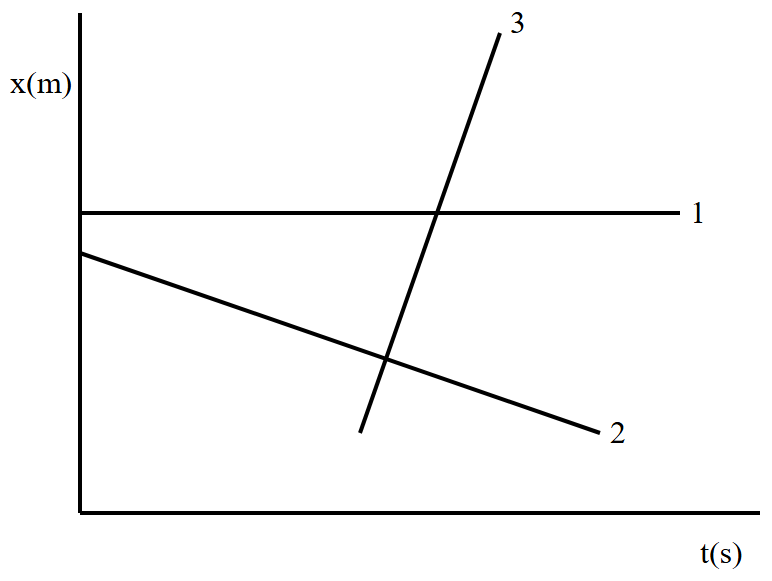
    8. The figure above show the displacement – time graphs for three different motions. Which of the following statements is correct?
    Figure for: The figure above show the displacement – time graphs for three different motions. Which of the…
    1. A.Graph 2 corresponds to the highest velocity
    2. B.Graph 1 corresponds to zero velocity
    3. C.Graph 3 corresponds to a particle moving in the negative x direction.
    4. D.Graph 2 corresponds to a particle moving in the positive x directions.
  9. Physics1988Energy
    9. How long will it take a 60kg man to climb a height of 22m if he expended energy at the rate of 0.25kW? [g = 10 m s−210\,\mathrm{m\,s^{-2}}]
    1. A.5.3s
    2. B.34.5s
    3. C.41.6s
    4. D.52.8s
  10. Physics1988Motion and Forces
    10. A force, 10N, drags a mass 10kg on a horizontal table with an acceleration of 0.2 m s−20.2\,\mathrm{m\,s^{-2}}. If the acceleration due to gravity is 10 m s−210\,\mathrm{m\,s^{-2}}, the coefficient of friction between the moving mass and the table is
    1. A.0.02
    2. B.0.08
    3. C.0.20
    4. D.0.80
  11. Physics1988Mechanics
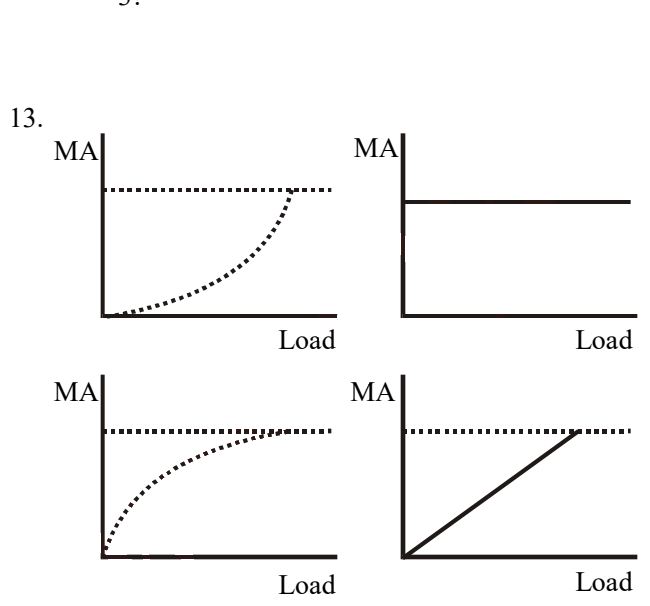
    11. Which of the following graphs correctly describes the variation of the mechanical advantage with load for a simple machine whose velocity ratio is 3? A. Figure A (top left) B. Figure B (top right) C. Figure C (bottom left) D. Figure D (bottom right)
    Figure for: Which of the following graphs correctly describes the variation of the mechanical advantage with…
    1. A.Figure A
    2. B.Figure B
    3. C.Figure C
    4. D.Figure D
  12. Physics1988Properties of Matter
    12. A body whose mass is 2kg and has a volume of 500 cm3500\,\mathrm{cm^3} just floats when completely immersed in a liquid. Calculate the density of the liquid.
    1. A.4.0×102 kg m−34.0\times10^2\,\mathrm{kg\,m^{-3}}
    2. B.4.0×103 kg m−34.0\times10^3\,\mathrm{kg\,m^{-3}}
    3. C.1.0×103 kg m−31.0\times10^3\,\mathrm{kg\,m^{-3}}
    4. D.1.0×106 kg m−31.0\times10^6\,\mathrm{kg\,m^{-3}}
  13. Physics1988Properties of Matter
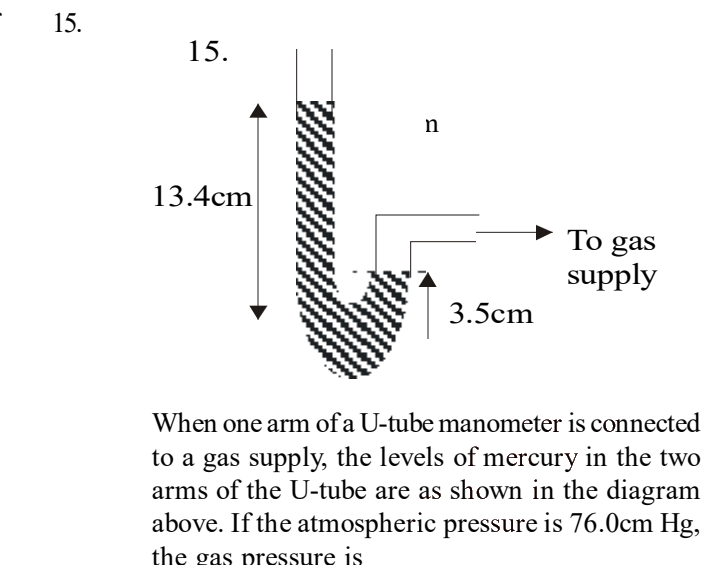
    13. When one arm of a U-tube manometer is connected to a gas supply, the levels of mercury in the two arms of the U-tube are as shown in the diagram above. If the atmospheric pressure is 76.0cm Hg, the gas pressure is
    Figure for: When one arm of a U-tube manometer is connected to a gas supply, the levels of mercury in the two…
    1. A.62.6cmHg
    2. B.72.5cmHg
    3. C.79.5cmHg
    4. D.85.9cmHg
  14. Physics1988Measurement and Units
    14. The product PV where P is pressure and V is volume has the same unit as
    1. A.Force
    2. B.Power
    3. C.Energy
    4. D.Acceleration
  15. Physics1988Heat and Temperature
    15. The amount of heat needed to raise the temperature of 10kg of copper by 1K is its
    1. A.Specific heat capacity
    2. B.Heat capacity
    3. C.Latent heat
    4. D.Internal heat.
  16. Physics1988Heat and Temperature
    16. A tap supplies water at 25∘25^\circC while another supplies water at 75∘75^\circC. If a man wishes to bathe with water at 40∘40^\circC, the ratio of the mass of cold water to the mass of hot water required is
    1. A.1 : 3
    2. B.15 : 8
    3. C.7 : 3
    4. D.3 : 1
  17. Physics1988Heat and Temperature
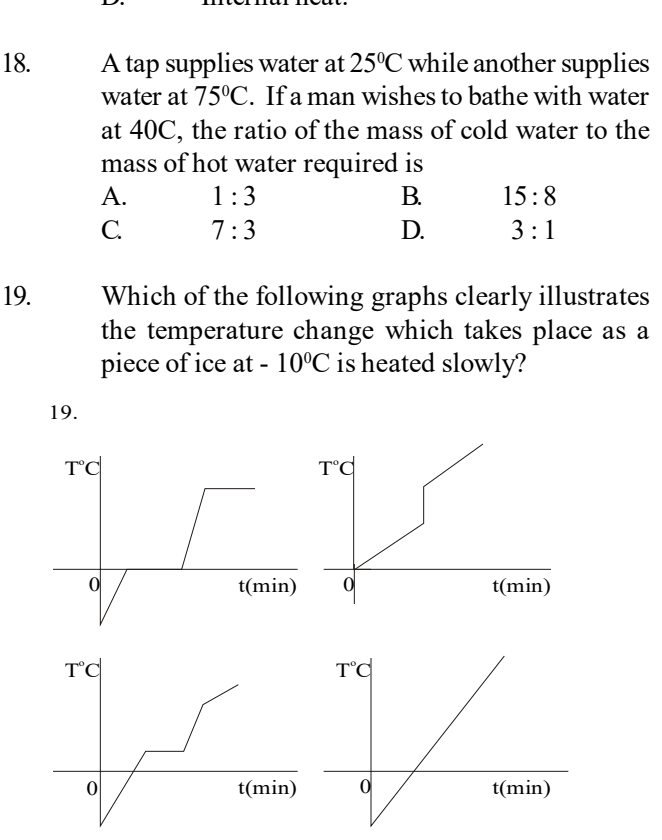
    17. Which of the following graphs clearly illustrates the temperature change which takes place as a piece of ice at −10∘-10^\circC is heated slowly?
    Figure for: Which of the following graphs clearly illustrates the temperature change which takes place as a…
    1. A.Figure A
    2. B.Figure B
    3. C.Figure C
    4. D.Figure D
  18. Physics1988Heat and Temperature
    18. When heat is applied to one end of a metal rod, the molecules at the other end soon begin to vibrate with greater amplitude than before because heat has been transfer by
    1. A.Radiation
    2. B.Convection
    3. C.Conduction
    4. D.Evaporation.
  19. Physics1988Waves and Sound
    19. Which of the following media allow the transmission of sound waves through them? I Air II Liquids III Solids
    1. A.I and II only
    2. B.I and III only
    3. C.II and III only
    4. D.I, II and III.
  20. Physics1988Waves and Sound
    20. Which of the following properties is/are common to all waves? I Diffraction II refraction III Interference
    1. A.I only
    2. B.III only
    3. C.I and III only
    4. D.I, II and III.

Other JAMB Physics papers