JAMB Physics 1999 past questions

47 questions from the 1999 paper, showing 1–20. Try each one, then open the solution to check your answer. Sign in to see the worked explanations.

  1. Physics1999Energy
    1. A car of mass 800kg attains a speed of 25 ms−125\,\mathrm{ms^{-1}} in 20 seconds. The power developed in the energy is
    1. A.1.25×104 W1.25 \times 10^4\,\mathrm{W}
    2. B.2.50×104 W2.50 \times 10^4\,\mathrm{W}
    3. C.1.25×106 W1.25 \times 10^6\,\mathrm{W}
    4. D.2.50×106 W2.50 \times 10^6\,\mathrm{W}
  2. Physics1999Mechanics
    2. A lead bullet of mass 0.05kg is fired with a velocity of 200 ms−1200\,\mathrm{ms^{-1}} into a lead block of mass 0.95 kg. Given that the lead block can move freely, the final kinetic energy after impact is
    1. A.50 J
    2. B.100 J
    3. C.150 J
    4. D.200 J
  3. Physics1999Energy
    3. A ball of mass 0.1kg is thrown vertically upwards with a speed of 10 ms−110\,\mathrm{ms^{-1}} from the top of a tower 10m high. Neglecting air resistance, its total energy just before hitting the ground is [g = 10 ms−210\,\mathrm{ms^{-2}}].
    1. A.5 J
    2. B.10 J
    3. C.15 J
    4. D.20 J
  4. Physics1999Mechanics
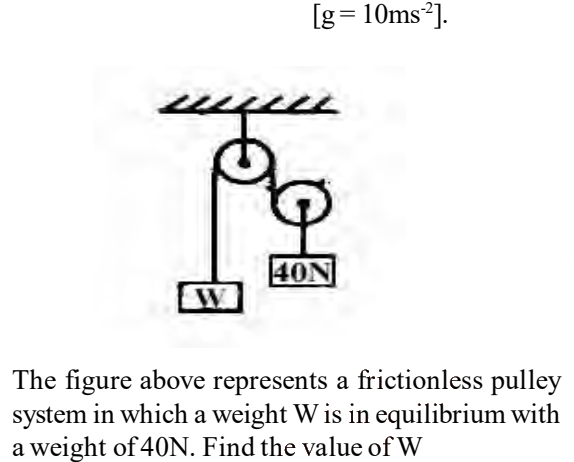
    4. The figure above represents a frictionless pulley system in which a weight W is in equilibrium with a weight of 40N. Find the value of W
    Figure for: The figure above represents a frictionless pulley system in which a weight W is in equilibrium…
    1. A.13.1 N
    2. B.20.0 N
    3. C.40.0 N
    4. D.80.0 N
  5. Physics1999Mechanics
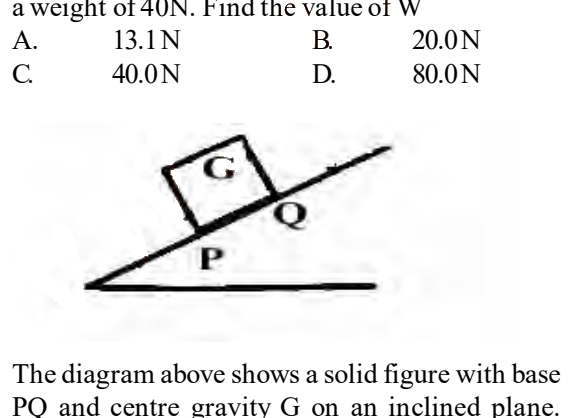
    5. The diagram above shows a solid figure with base PQ and centre gravity G on an inclined plane. Which of the following statements is correct?
    Figure for: The diagram above shows a solid figure with base PQ and centre gravity G on an inclined plane…
    1. A.The solid will fall over if the vertical line through G lies outside the base.
    2. B.The solid will fall over if the vertical line through G lines inside the base.
    3. C.The solid will not fall over if the vertical line through G lies outside the base.
    4. D.The solid can never fall over.
  6. Physics1999Motion and Forces
    6. Two bodies have masse in the ratio 3 : 1. They experience forces which impart to them accelerations in the ratio 2: 9 respectively. Find the ratio of the forces the masses experience.
    1. A.1: 4
    2. B.2: 1
    3. C.2: 3
    4. D.2: 5.
  7. Physics1999Motion and Forces
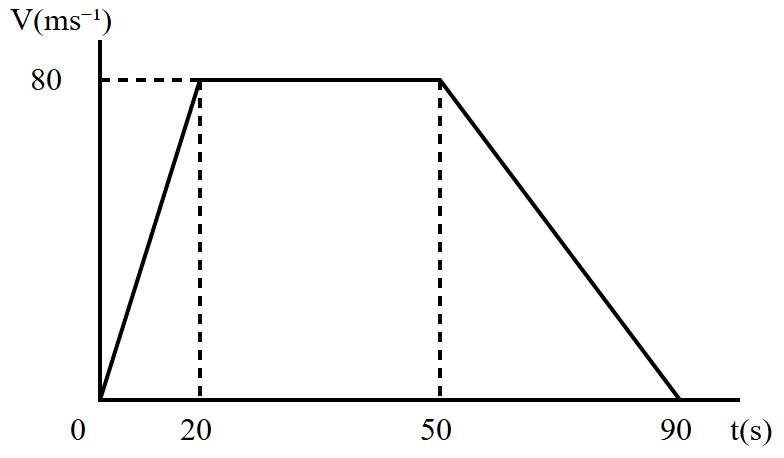
    7. The diagram above shows the velocity-time graph of a vehicle. Its acceleration and retardation respectively are
    Figure for: The diagram above shows the velocity-time graph of a vehicle. Its acceleration and retardation…
    1. A.8.0 ms−28.0\,\mathrm{ms^{-2}}, 4.0 ms−24.0\,\mathrm{ms^{-2}}
    2. B.4.0 ms−24.0\,\mathrm{ms^{-2}}, 8.0 ms−28.0\,\mathrm{ms^{-2}}
    3. C.4.0 ms−24.0\,\mathrm{ms^{-2}}, 2.0 ms−22.0\,\mathrm{ms^{-2}}
    4. D.2.0 ms−22.0\,\mathrm{ms^{-2}}, 4.0 ms−24.0\,\mathrm{ms^{-2}}
  8. Physics1999Motion and Forces
    8. A particle of mass 10−2 kg10^{-2}\,\mathrm{kg} is fixed to the tip of a fan blade which rotates with angular velocity of 100 rad s−1100\,\mathrm{rad\,s^{-1}}. If the radius of the blade is 0.2m, the centripetal force is
    1. A.2 N
    2. B.20 N
    3. C.200 N
    4. D.400 N
  9. Physics1999Measurement and Units
    9. The inner diameter of a small test tube can be measured accurately using a
    1. A.Micrometer screw guage
    2. B.Pair of dividers
    3. C.Metre rule
    4. D.Pair of vernier calipers.
  10. Physics1999Heat and Temperature
    10. A gas at a volume V0V_0 in a container at pressure P0P_0, is compressed to one fifth of its volume. What will be its pressure if it maintains its original temperature T?
    1. A.P0/5P_0/5
    2. B.45P0\frac{4}{5}P_0
    3. C.P0P_0
    4. D.5P05P_0
  11. Physics1999Heat and Temperature
    11. A piece of substance of specific heat capacity 450 J kg−1 K−1450\,\mathrm{J\,kg^{-1}\,K^{-1}} falls through a vertical distance of 20m from rest. Calculate the rise in temperature of the substance on hitting the ground when all its energies are converted into heat. [g = 10 ms−210\,\mathrm{ms^{-2}}].
    1. A.29 ∘C\frac{2}{9}\,^\circ\mathrm{C}
    2. B.49 ∘C\frac{4}{9}\,^\circ\mathrm{C}
    3. C.94 ∘C\frac{9}{4}\,^\circ\mathrm{C}
    4. D.92 ∘C\frac{9}{2}\,^\circ\mathrm{C}
  12. Physics1999Properties of Matter
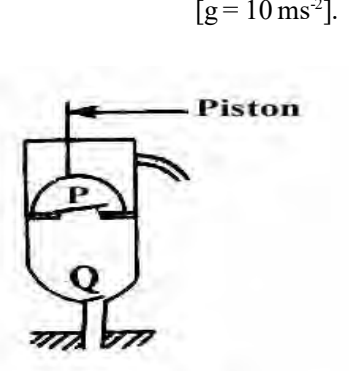
    12. The diagram above shows a lift pump with valves at P and Q. during a downward stroke of the piston,
    Figure for: The diagram above shows a lift pump with valves at P and Q. during a downward stroke of the piston,
    1. A.Both valves are open
    2. B.P is open while Q is closed
    3. C.P is closed while Q is open
    4. D.Both valves are closed.
  13. Physics1999Properties of Matter
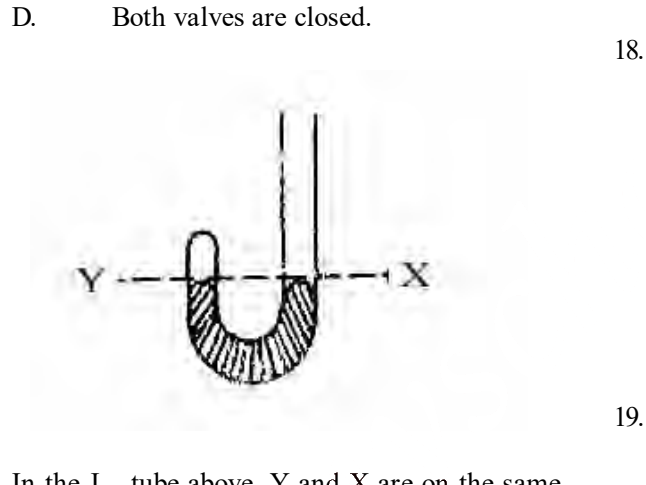
    13. In the J – tube above, Y and X are on the same horizontal level and 30 cm330\,\mathrm{cm^3} of air is trapped above Y when the atmospheric pressure is 75cm Hg. Calculate the volume of air trapped above Y when 15cm Hg is now poured into the limb above X.
    Figure for: In the J – tube above, Y and X are on the same horizontal level and 30 cm^3 of air is trapped…
    1. A.15 cm315\,\mathrm{cm^3}
    2. B.25 cm325\,\mathrm{cm^3}
    3. C.35 cm335\,\mathrm{cm^3}
    4. D.45 cm345\,\mathrm{cm^3}
  14. Physics1999Properties of Matter
    14. If the stress on a wire is 107 Nm−210^7\,\mathrm{Nm^{-2}} and the wire is stretched from its original length of 10.00cm to 10.05 cm. The young's modulus of the wire is
    1. A.5.0×104 Nm−25.0 \times 10^4\,\mathrm{Nm^{-2}}
    2. B.5.0×105 Nm−25.0 \times 10^5\,\mathrm{Nm^{-2}}
    3. C.2.0×108 Nm−22.0 \times 10^8\,\mathrm{Nm^{-2}}
    4. D.2.0×109 Nm−22.0 \times 10^9\,\mathrm{Nm^{-2}}
  15. Physics1999Properties of Matter
    15. A solid weights 10.0N in air, 6.0 N when fully immersed in water and 7.0 N when fully immersed in a certain liquid X. Calculate the relative density of the liquid.
    1. A.5/3
    2. B.4/3
    3. C.3/4
    4. D.7/10
  16. Physics1999Heat and Temperature
    16. I. A liquid boils when its saturated vapour pressure is equal to the external pressure. II. Dissolved substances in pure water lead to increase in the boiling point. III. When the external pressure is increased, the boiling point increases. IV. Dissolved substances in pure water decrease the boiling point. Which combination of the above are peculiarities of the boiling point of a liquid?
    1. A.I, II and III
    2. B.I, II, III and IV
    3. C.I, II and IV
    4. D.II, III and IV.
  17. Physics1999Properties of Matter
    17. When the temperature of a liquid is increased, its surface tension
    1. A.Decreases
    2. B.Increases
    3. C.Remains constant
    4. D.Increase then decreases.
  18. Physics1999Motion and Forces
    18. When the brakes in a car are applied, the frictional force on the tyres is
    1. A.A disadvantage because it is in the direction of motion of the car
    2. B.A disadvantage because it is in the opposite direction of motion of the car.
    3. C.An advantage because it is in the direction of motion of the car.
    4. D.An advantage because it is in the opposite direction of motion of the car.
  19. Physics1999Waves and Sound
    19. The lowest note emitted by a stretched string has a frequency of 40Hz. How many overtones are there between 40Hz and 180 Hz?
    1. A.4
    2. B.3
    3. C.2
    4. D.1
  20. Physics1999Light and Optics
    20. A man stands 4m in front of a plane mirror. If the mirror is moved 1m towards the man, the distance between him and his image is
    1. A.3m
    2. B.5m
    3. C.6m
    4. D.10m

Other JAMB Physics papers