JAMB Physics 1992 past questions

47 questions from the 1992 paper, showing 21–40. Try each one, then open the solution to check your answer. Sign in to see the worked explanations.

  1. Physics1992Waves and Sound
    21. A note is the octave of another note if it has
    1. A.A frequency twice that of the first note
    2. B.Frequency half that of the first note
    3. C.The same frequency as the first one
    4. D.A frequency eight times that of the first note.
  2. Physics1992Waves and Sound
    22. What is the frequency of the sound made by a siren having a disc with 32 holes and making 25 revolutions per second?
    1. A.80 Hz
    2. B.600 Hz
    3. C.800 Hz
    4. D.1600 Hz
  3. Physics1992Light and Optics
    23. Which of the following properties make the convex mirror useful as a driving mirror? I The image is real II The image is erect III It has a wide field of view IV The image is magnified
    1. A.I, II and IV
    2. B.I, II and III
    3. C.II and III
    4. D.I and III.
  4. Physics1992Light and Optics
    24. When an object is placed very close to the pole of a concave mirror, the virtual image obtained is
    1. A.Diminished and upright
    2. B.Diminished and inverted
    3. C.Enlarged and inverted
    4. D.Enlarged and upright.
  5. Physics1992Light and Optics
    25. A concave mirror has a radius of curvature of 36cm. At what distance from the mirror should an object be placed to give a real image three times the size of the object?
    1. A.12 cm
    2. B.24 cm
    3. C.48 cm
    4. D.108 cm
  6. Physics1992Light and Optics
    26. Which of the following statements is CORRECT about a long-sighted boy who does not put on glasses?
    1. A.He cannot see distance objects clearly
    2. B.Rays of light from a close objects are focused in front of his retina
    3. C.His eyeball is too long
    4. D.Parallel rays of light are focused behind his retina.
  7. Physics1992Light and Optics
    27. The speed of light in air is 3×10⁸ m s−13\times10^8\,\mathrm{m\,s^{-1}}. What is the speed in glass with a refractive index of 1.50?
    1. A.1.5×108 m s−11.5\times10^8\,\mathrm{m\,s^{-1}}
    2. B.3.0×108 m s−13.0\times10^8\,\mathrm{m\,s^{-1}}
    3. C.2.0×108 m s−12.0\times10^8\,\mathrm{m\,s^{-1}}
    4. D.6.0×108 m s−16.0\times10^8\,\mathrm{m\,s^{-1}}
  8. Physics1992Light and Optics
    28. If the refractive index of a medium in air is 2.0, what is the critical angle for this medium?
    1. A.30∘30^\circ
    2. B.42∘42^\circ
    3. C.45∘45^\circ
    4. D.50∘50^\circ
  9. Physics1992Waves and Sound
    29. Which of the following arrangements of the components of electromagnetic spectrum is in ascending order of wavelengths?
    1. A.Gamma rays, ultraviolet rays, x-rays, infra-red rays.
    2. B.Gamma rays, x-rays, ultraviolet rays, infra-red rays
    3. C.Infra-red rays, ultraviolet rays, x-rays, gamma rays.
    4. D.Gamma rays, ultraviolet rays, infra-red rays, x-rays.
  10. Physics1992Electricity and Magnetism
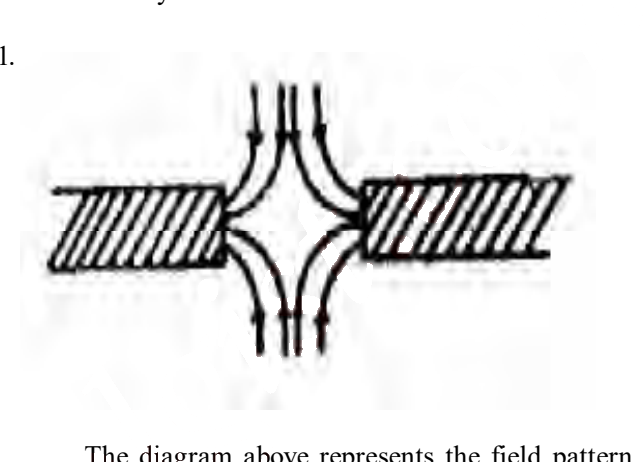
    30. The diagram above represents the field pattern obtained by bringing the poles of two magnets near each other. The poles must be
    Figure for: The diagram above represents the field pattern obtained by bringing the poles of two magnets near…
    1. A.N – N poles
    2. B.S – S poles
    3. C.S – N poles
    4. D.N – S poles
  11. Physics1992Electricity and Magnetism
    31. The angle between the direction of the earth's magnetic field and the horizontal is called the
    1. A.Angle of deviation
    2. B.Magnetic declination
    3. C.Magnetic meridian
    4. D.Angle of dip
  12. Physics1992Electricity and Magnetism
    32. Calculate the force acting on an electron of charge 1.6×10−191.6\times10^{-19} C placed in an electric field of intensity 108 V m−110^8\,\mathrm{V\,m^{-1}}.
    1. A.1.6×10−111.6\times10^{-11} N
    2. B.1.6×10−141.6\times10^{-14} N
    3. C.1.6×10−161.6\times10^{-16} N
    4. D.1.0×10−161.0\times10^{-16} N
  13. Physics1992Electricity and Magnetism
    33. When an ebonite rod is rubbed with fur, it has
    1. A.No charge at all
    2. B.A negative charge
    3. C.A positive charge
    4. D.Negative and positive charges.
  14. Physics1992Electricity and Magnetism
    34. Which of the following factors has no effect on e.m.f. of a primary cell?
    1. A.Temperature
    2. B.Size of the cell
    3. C.Nature of the plates
    4. D.Nature of the electrolyte.
  15. Physics1992Electricity and Magnetism
    35. A wire of length 15 m made of a material of resistivity 1.8×10−61.8 \times 10^{-6} ohm-m has a resistance of 0.27 ohms. Determine the area of the wire
    1. A.1.5×10−4 m21.5 \times 10^{-4}\,\mathrm{m^2}
    2. B.1.0×10−4 m21.0 \times 10^{-4}\,\mathrm{m^2}
    3. C.2.7×10−5 m22.7 \times 10^{-5}\,\mathrm{m^2}
    4. D.7.3×10−5 m27.3 \times 10^{-5}\,\mathrm{m^2}
  16. Physics1992Electricity and Magnetism
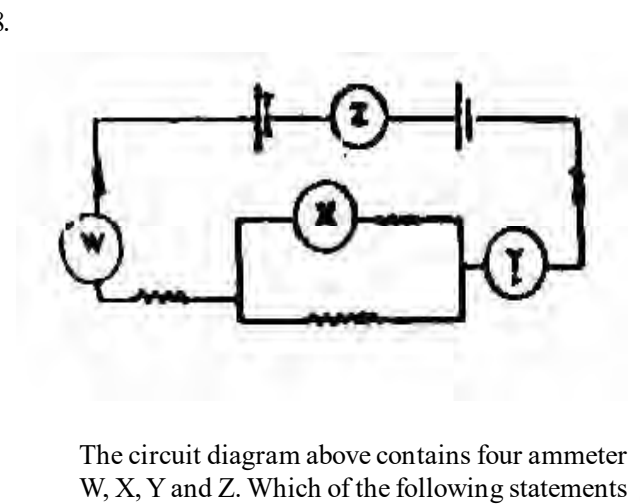
    36. The circuit diagram above contains four ammeters W, X, Y and Z. Which of the following statements about the ammeter reading is correct?
    Figure for: The circuit diagram above contains four ammeters W, X, Y and Z. Which of the following statements…
    1. A.The reading of W is equal to that of Y and twice that of X.
    2. B.The reading of Y is greater than that of Z
    3. C.The readings of W and Y are equal and each is greater than that of X.
    4. D.The reading of Z is equal to the sum of the readings of W and Y.
  17. Physics1992Electricity and Magnetism
    37. A 5-V battery is connected across the plates of a 2.0 μF2.0\,\mu\mathrm{F} uncharged parallel plate capacitor. The charge on the capacitor after a long time is
    1. A.1.5 μC1.5\,\mu\mathrm{C}
    2. B.10.0 μC10.0\,\mu\mathrm{C}
    3. C.20.0 μC20.0\,\mu\mathrm{C}
    4. D.50.0 μC50.0\,\mu\mathrm{C}
  18. Physics1992Electricity and Magnetism
    38. Which of the following apparatus will require the smallest fuse rating for its protection?
    1. A.60 W, 240 V
    2. B.60 W, 40 V
    3. C.40 W, 12 V
    4. D.40 W, 5 V
  19. Physics1992Electricity and Magnetism
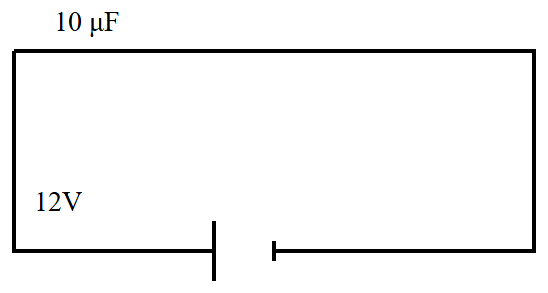
    39. A capacitor of 10 μF10\,\mu\mathrm{F} is connected across a cell of 12 volts as shown above. Calculate the energy stored in the capacitor.
    Figure for: A capacitor of 10 μ F is connected across a cell of 12 volts as shown above. Calculate the energy…
    1. A.7.2×10−4 J7.2 \times 10^{-4}\,\mathrm{J}
    2. B.1.4×10−3 J1.4 \times 10^{-3}\,\mathrm{J}
    3. C.1.4×10−4 J1.4 \times 10^{-4}\,\mathrm{J}
    4. D.1.3×10−2 J1.3 \times 10^{-2}\,\mathrm{J}
  20. Physics1992Electricity and Magnetism
    40. The heat produced in a conductor carrying an electric current is
    1. A.Inversely proportional to the current and the resistance
    2. B.Directly proportional to the current, resistance and the time.
    3. C.Inversely proportional to the square of the resistance, current and the time.
    4. D.Directly proportional to the square of the current, the resistance and the time.

Other JAMB Physics papers