JAMB Physics 1998 past questions

47 questions from the 1998 paper, showing 21–40. Try each one, then open the solution to check your answer. Sign in to see the worked explanations.

  1. Physics1998Heat and Temperature
    21. One valid assumption of the kinetic theory of gases is that
    1. A.the molecules of a gas are constantly in state of motion and the number of collisions remain constant.
    2. B.The number of molecules of gas increases with increasing pressure
    3. C.As the temperature increases, the number of collisions made by the gas molecules remain constant.
    4. D.The molecules of gas are all identical and are very small in size.
  2. Physics1998Waves and Sound
    22. The physical properties of sound waves can best be described by
    1. A.Reflection and diffraction
    2. B.Polarization and reflection
    3. C.Polarization and diffraction
    4. D.Polarization and refraction
  3. Physics1998Waves and Sound
    23. The velocity of a sound wave at 27∘27^\circC is 360 ms−1360\,\mathrm{ms^{-1}}. Its velocity at 127∘127^\circC is
    1. A.1203 ms−1120\sqrt{3}\,\mathrm{ms^{-1}}
    2. B.240 ms−1240\,\mathrm{ms^{-1}}
    3. C.2403 ms−1240\sqrt{3}\,\mathrm{ms^{-1}}
    4. D.7203 ms−1720\sqrt{3}\,\mathrm{ms^{-1}}
  4. Physics1998Waves and Sound
    24. In a closed organ pipe producing a musical note, an antinode will always be produced at
    1. A.The closed end
    2. B.The open end
    3. C.The middle
    4. D.All the parts of the pipe.
  5. Physics1998Waves and Sound
    25. A steel wire of length 0.50m is stretched between two fixed points and its fundamental frequency is 200Hz. The speed of the wave in the wire is
    1. A.100 ms−1100\,\mathrm{ms^{-1}}
    2. B.120 ms−1120\,\mathrm{ms^{-1}}
    3. C.200 ms−1200\,\mathrm{ms^{-1}}
    4. D.250 ms−1250\,\mathrm{ms^{-1}}
  6. Physics1998Waves and Sound
    26. In a resonance tube experiment, if the fundamental frequency of the vibrating air column is 280Hz, the frequency of the third overtones is
    1. A.70Hz
    2. B.840Hz
    3. C.1120Hz
    4. D.1960Hz
  7. Physics1998Light and Optics
    27. An object O lies at a distance m in front of a concave mirror of the focal length f. If m<f, then the final image obtained will be
    1. A.Virtual and diminished
    2. B.Magnified and erect
    3. C.Real and inverted
    4. D.Diminished and erect.
  8. Physics1998Light and Optics
    28. An object is placed in front of two plane mirrors inclined at an angle θ∘\theta^\circ. If the total number of images formed is 7, find the value of θ\theta?
    1. A.30∘30^\circ
    2. B.45∘45^\circ
    3. C.51∘51^\circ
    4. D.90∘90^\circ
  9. Physics1998Light and Optics
    29. The most suitable type of mirror used for the construction of a searchlight is the
    1. A.Concave mirror
    2. B.Convex mirror
    3. C.Spherical mirror
    4. D.Parabolic mirror.
  10. Physics1998Light and Optics
    30. The displacement d produced in a glass block of thickness t and refractive index n when an object is viewed through it is
    1. A.t−nt - n
    2. B.t(1+1/n)t(1 + 1/n)
    3. C.t(1−1/n)t(1 - 1/n)
    4. D.t(1/n−1)t(1/n - 1)
  11. Physics1998Light and Optics
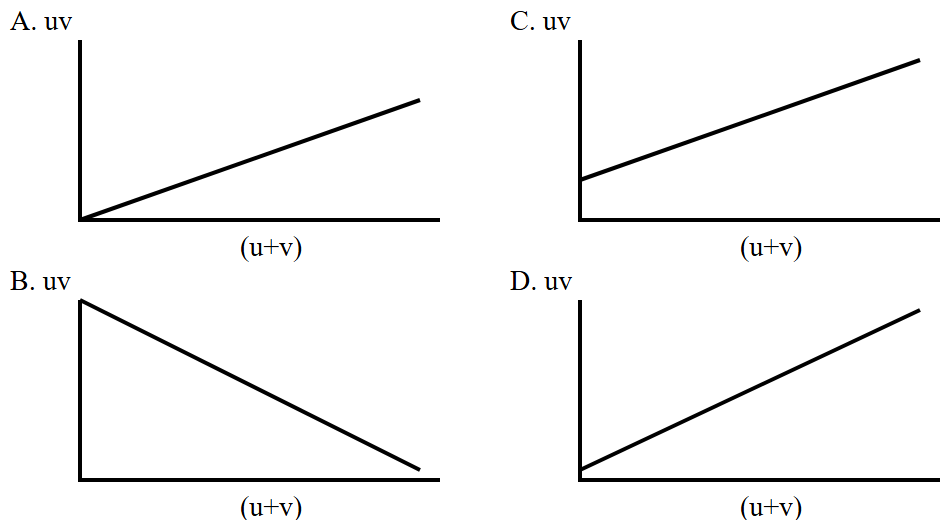
    31. The correct shape of the graph of uv against (u + v) for an object distance u and image distance v in an experiment to find the focal length of a convex lens is given as
    Figure for: The correct shape of the graph of uv against (u + v) for an object distance u and image distance v…
    1. A.Figure A
    2. B.Figure B
    3. C.Figure C
    4. D.Figure D
  12. Physics1998Light and Optics
    32. A man wears convex lens glasses of focal length 30cm in order to correct his eye defect. Instead of the optimum 25cm, his least distance of distinct vision is
    1. A.14cm
    2. B.28cm
    3. C.75cm
    4. D.150cm
  13. Physics1998Waves and Sound
    33. Which of the following are true about infra-red radiation? I It is invisible II It is called heat ray III Its frequency is higher than that of blue light IV It travels as a transverse wave.
    1. A.I, II, III and IV.
    2. B.I, II and IV only
    3. C.I, III and IV only.
    4. D.II, III and IV only.
  14. Physics1998Electricity and Magnetism
    34. The force of repulsion between two point positive charges 5uC and 8uC separated at a distance of 0.02m apart is
    1. A.1.8×10−101.8 \times 10^{-10}N
    2. B.9.0×10−89.0 \times 10^{-8}N
    3. C.9.0×1029.0 \times 10^{2}N
    4. D.4.5×1034.5 \times 10^{3}N
  15. Physics1998Electricity and Magnetism
    35. An ebonite rod rubbed with fur attracts a glass rod rubbed with silk because
    1. A.Ebonite has a negative charge while glass has a positive charge
    2. B.Ebonite has a positive charge while glass has a negative charge
    3. C.Both have negative charges
    4. D.Both have positive charges.
  16. Physics1998Electricity and Magnetism
    36. Which of the following can be used to reduce local action in a Leclanche cell?
    1. A.A carbon rod as the positive pole.
    2. B.Pure zinc as the negative pole.
    3. C.Potassium permanganate solution in contact with the positive pole.
    4. D.Common salt solution.
  17. Physics1998Electricity and Magnetism
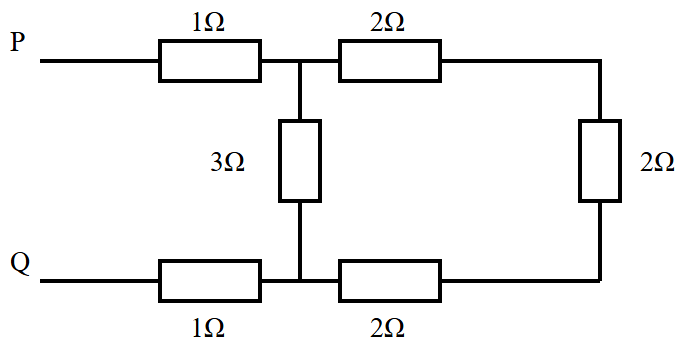
    37. The total resistance measured at PQ in the diagram above is
    Figure for: The total resistance measured at PQ in the diagram above is
    1. A.18.0 Ohms
    2. B.11.0 Ohms
    3. C.4.0 Ohms
    4. D.2.0 Ohms
  18. Physics1998Electricity and Magnetism
    38. Find the work done in moving a 2C charges between two points X and Y in an electric field if the potential difference is 100 volts.
    1. A.50J
    2. B.100J
    3. C.200J
    4. D.400J
  19. Physics1998Electricity and Magnetism
    39. A parallel capacitor has a common plate area of 5×10⁻⁸ m25 \times 10^{-8}\,\mathrm{m^2} and plate separation of 2×10⁻³² \times 10^{-3}m. Assuming free space, what is the capacitance?
    1. A.2.25×10−172.25 \times 10^{-17}F
    2. B.4.50×10−174.50 \times 10^{-17}F
    3. C.2.25×10−162.25 \times 10^{-16}F
    4. D.4.50×10−164.50 \times 10^{-16}F
  20. Physics1998Electricity and Magnetism
    40. The iron core of an induction coil is made from bundles of wires so as to
    1. A.Minimize eddy-currents
    2. B.Generate eddy-currents
    3. C.Prevent sparking at the contact breaker
    4. D.Get the greatest possible secondary voltage.

Other JAMB Physics papers