JAMB Chemistry 1983 past questions

29 questions from the 1983 paper, showing 1–20. Try each one, then open the solution to check your answer. Sign in to see the worked explanations.

  1. Chemistry1983Organic Chemistry
    1. The flame used by welders in cutting metals is
    1. A.butane gas flame
    2. B.acetylene flame
    3. C.kerosene flame
    4. D.oxy-acetylene flame
  2. Chemistry1983Chemical Bonding
    2. The three-dimensional shape of methane is
    1. A.hexagonal
    2. B.trigonal
    3. C.linear
    4. D.tetrahedral
  3. Chemistry1983Organic Chemistry
    3. PASSAGE: An unknown organic compound X has a relative molecular mass of 180. It is a colourless crystalline solid, readily soluble in water. X contains the elements C, H, and O in the atomic ratio 1:2:1. The compound has a sweet taste and melts on heating. In the presence of yeast and in the absence of air, X is converted to compound Y and a colourless gas. Compound Y reacts with sodium metal to produce a gas Z which gives a 'pop' sound with a glowing splint. Y also reacts with ethanoic acid to give a sweet smelling compound W. QUESTION: Compound W is
    1. A.a soap
    2. B.an oil
    3. C.an alkane
    4. D.an ester
  4. Chemistry1983Stoichiometry
    4. PASSAGE: An unknown organic compound X has a relative molecular mass of 180. It is a colourless crystalline solid, readily soluble in water. X contains the elements C, H, and O in the atomic ratio 1:2:1. The compound has a sweet taste and melts on heating. In the presence of yeast and in the absence of air, X is converted to compound Y and a colourless gas. Compound Y reacts with sodium metal to produce a gas Z which gives a 'pop' sound with a glowing splint. Y also reacts with ethanoic acid to give a sweet smelling compound W. QUESTION: The molecular formula of X is
    1. A.C12H22O11\mathrm{C_{12}H_{22}O_{11}}
    2. B.C6H12O6\mathrm{C_6H_{12}O_6}
    3. C.C3H6O3\mathrm{C_3H_6O_3}
    4. D.C7H14O7\mathrm{C_7H_{14}O_7}
  5. Chemistry1983Organic Chemistry
    5. PASSAGE: An unknown organic compound X has a relative molecular mass of 180. It is a colourless crystalline solid, readily soluble in water. X contains the elements C, H, and O in the atomic ratio 1:2:1. The compound has a sweet taste and melts on heating. In the presence of yeast and in the absence of air, X is converted to compound Y and a colourless gas. Compound Y reacts with sodium metal to produce a gas Z which gives a 'pop' sound with a glowing splint. Y also reacts with ethanoic acid to give a sweet smelling compound W. QUESTION: The reaction of X with yeast forms the basis of the
    1. A.plastic industry
    2. B.textile industry
    3. C.brewing industry
    4. D.soap industry
  6. Chemistry1983Separation Techniques
    6. A mixture of common salt, ammonium chloride and barium sulphate can best be separated by
    1. A.addition of water followed by filtration then sublimation
    2. B.addition of water followed by sublimation then filtration
    3. C.sublimation followed by addition of water then filtration
    4. D.fractional distillation
  7. Chemistry1983Electrochemistry
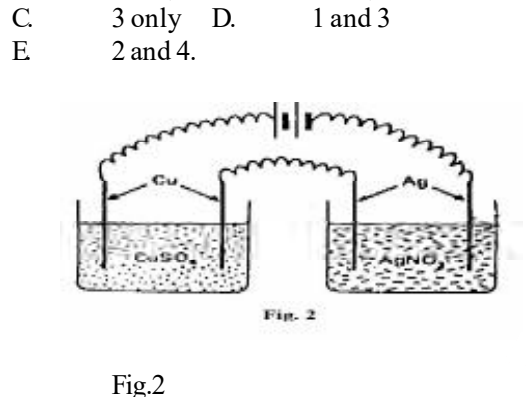
    7. In the above experiment (fig. 2), a current was passed for 10 minutes and 0.63 g of copper was found to be deposited on the cathode of CuSO4\mathrm{CuSO_4} cell. The weight of silver deposited in the AgNO3\mathrm{AgNO_3} cell during the same period would be [Cu = 63, Ag = 108]
    Figure for: In the above experiment (fig. 2), a current was passed for 10 minutes and 0.63 g of copper was…
    1. A.0.54 g
    2. B.1.08 g
    3. C.1.62 g
    4. D.2.16 g
  8. Chemistry1983Electrochemistry
    8. In the reaction Fe+Cu2+→Fe2++Cu\mathrm{Fe + Cu^{2+} \rightarrow Fe^{2+} + Cu}, iron displaces copper ions to form copper. This is due to the fact that
    1. A.iron is in the metallic form while the copper is in the ionic form
    2. B.the atomic weight of copper is greater than that of iron
    3. C.copper metal has more electrons than iron metal
    4. D.iron is higher in the electrochemical series than copper.
  9. Chemistry1983Organic Chemistry
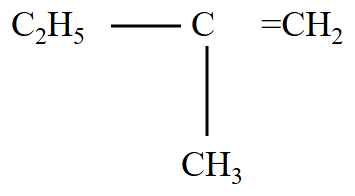
    9. The correct name of the compound with the above structural formula is
    Figure for: The correct name of the compound with the above structural formula is
    1. A.2-methylbut-1-ene
    2. B.2-methylbut-2-ene
    3. C.2-methylbut-3-ene
    4. D.2-ethylprop-1-ene
  10. Chemistry1983Organic Chemistry
    10. How many isomeric forms are there for the molecular formula C3H6Br2\mathrm{C_3H_6Br_2}?
    1. A.1
    2. B.2
    3. C.3
    4. D.4
  11. Chemistry1983Metals and Non-metals
    11. A piece of burning sulphur will continue to burn in a gas jar of oxygen to give misty fumes which readily dissolve in water. The resulting liquid is
    1. A.sulphur (IV) trioxide
    2. B.Tetraoxosulphate (VI) acid
    3. C.Trioxosulphate (IV) acid
    4. D.Dioxosulphate (II) acid
  12. Chemistry1983Water, Solutions and Solubility
    12. Sodium sulphate decahydrate (Na2SO4⋅10H2O\mathrm{Na_2SO_4{\cdot}10H_2O}) on exposure to air loses all its water of crystallization. The process of loss is known as
    1. A.Efflorescence
    2. B.Hygroscopy
    3. C.Deliquescence
    4. D.Effervescence
  13. Chemistry1983Periodic Table
    13. An element is electronegative if
    1. A.it has a tendency to exist in the gaseous form
    2. B.its ions dissolve readily in water
    3. C.it has a tendency to lose electrons
    4. D.it has a tendency to gain electrons
  14. Chemistry1983Energy Changes
    14. In the reactions (I) H2(g)+12O2(g)→H2O(l)\mathrm{H_2(g) + \tfrac{1}{2}O_2(g) \rightarrow H_2O(l)}; ΔH=−2.86\Delta H = -2.86 kJ (II) C(s)+O2(g)→CO2(g)\mathrm{C(s) + O_2(g) \rightarrow CO_2(g)}; ΔH=−406\Delta H = -406 kJ the equations imply that
    1. A.more heat is absorbed than heat is evolved in (I)
    2. B.more heat is absorbed in (II)
    3. C.less heat is evolved in (I)
    4. D.reaction (II) proceeds faster than (I)
  15. Chemistry1983Energy Changes
    15. In the reactions (i) H2(g)+12O2(g)→H2O(l)\mathrm{H_2(g) + \tfrac{1}{2}O_2(g) \rightarrow H_2O(l)}; ΔH=−2.86 kJ\Delta H = -2.86\,\mathrm{kJ} (ii) C(s)+O2(g)→CO2(g)\mathrm{C(s) + O_2(g) \rightarrow CO_2(g)}; ΔH=−406 kJ\Delta H = -406\,\mathrm{kJ} the equations imply that
    1. A.more heat is absorbed than heat is evolved in (i)
    2. B.more heat is absorbed in (ii)
    3. C.less heat is evolved in (i)
    4. D.reaction (ii) proceeds faster than (i)
  16. Chemistry1983Energy Changes
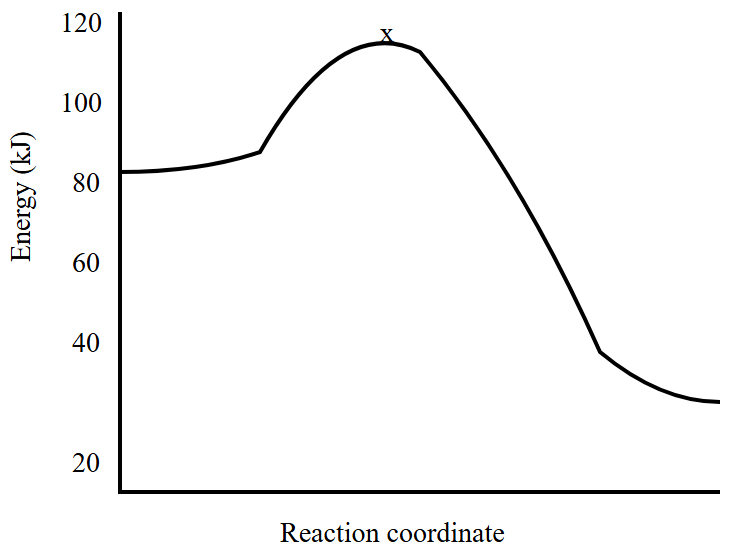
    16. The diagram above (Fig.3) shows the energy profile for the reaction A+B = C+ D. form this diagram, its clear that the reaction is
    Figure for: The diagram above (Fig.3) shows the energy profile for the reaction A+B = C+ D. form this diagram…
    1. A.spontaneous
    2. B.isothermal
    3. C.adiabatic
    4. D.exothermic
  17. Chemistry1983Water, Solutions and Solubility
    17. Lime–water, which is used in the laboratory for the detection of carbon (IV) oxide, is an aqueous solution of:
    1. A.Ca(OH)2\mathrm{Ca(OH)_2}
    2. B.CaCO3\mathrm{CaCO_3}
    3. C.CaHCO3\mathrm{CaHCO_3}
    4. D.CaSO4\mathrm{CaSO_4}
  18. Chemistry1983Metals and Non-metals
    18. Sulphur....
    1. A.Forms two alkaline oxides
    2. B.Is spontaneously flammable
    3. C.Burns with a blue flame
    4. D.Conducts electricity in the molten state
  19. Chemistry1983Acids, Bases and Salts
    19. From the reactions: ZnO+Na2O→Na2ZnO2\mathrm{ZnO + Na_2O \to Na_2ZnO_2} and ZnO+CO2→ZnCO3\mathrm{ZnO + CO_2 \to ZnCO_3} it may be concluded that zinc oxide is
    1. A.neutral
    2. B.basic
    3. C.acidic
    4. D.amphoteric
  20. Chemistry1983Redox Reactions
    20. 3Cl2+2NH3→N2+6HCl3\mathrm{Cl_2} + 2\mathrm{NH_3} \to \mathrm{N_2} + 6\mathrm{HCl}. In the above reaction, ammonia acts as .
    1. A.a reducing agent
    2. B.an oxidizing agent
    3. C.an acid
    4. D.a catalyst

Other JAMB Chemistry papers