JAMB Chemistry 1989 past questions

44 questions from the 1989 paper, showing 1–20. Try each one, then open the solution to check your answer. Sign in to see the worked explanations.

  1. Chemistry1989Separation Techniques
    1. Which of the following would support the conclusion that a solid sample is a mixture?
    1. A.The solid can be ground to a fine powder
    2. B.The density of the solid is 2.25 g dm−32.25\,\mathrm{g\,dm^{-3}}
    3. C.The solid has a melting range of 300∘300^\circC to 375∘375^\circC.
    4. D.The solid absorbs moisture from the atmosphere.
  2. Chemistry1989Stoichiometry
    2. The molar ratio of carbon to hydrogen of a volatile liquid compound is 1:2. 0.12 g of the liquid evaporated at s.t.p gave 32 cm332\,\mathrm{cm^3} of vapour. The molecular formula of the liquid is [G.M.V = 22.4 dm3\mathrm{dm^3}, C=12, H=1]
    1. A.C3H6\mathrm{C_3H_6}
    2. B.C4H8\mathrm{C_4H_8}
    3. C.C5H10\mathrm{C_5H_{10}}
    4. D.C6H12\mathrm{C_6H_{12}}
  3. Chemistry1989Stoichiometry
    3. 20.00 cm320.00\,\mathrm{cm^3} of a solution containing 0.53 g of anhydrous Na2CO3\mathrm{Na_2CO_3} in 100 cm3100\,\mathrm{cm^3} requires 25.00 cm325.00\,\mathrm{cm^3} of H2SO4\mathrm{H_2SO_4} for complete neutralization. The concentration of the acid solution in moles per dm3\mathrm{dm^3} is [H= 1, C= 12, O = 16, Na = 23, S =32]
    1. A.0.02
    2. B.0.04
    3. C.0.06
    4. D.0.08
  4. Chemistry1989Gas Laws
    4. The minimum volume of oxygen required for the complete combustion of a mixture of 10 cm310\,\mathrm{cm^3} of CO and 15 cm315\,\mathrm{cm^3} of H2\mathrm{H_2} is
    1. A.25.0 cm325.0\,\mathrm{cm^3}
    2. B.12.5 cm312.5\,\mathrm{cm^3}
    3. C.10.0 cm310.0\,\mathrm{cm^3}
    4. D.5.0 cm35.0\,\mathrm{cm^3}
  5. Chemistry1989Gas Laws
    5. What is the partial pressure of hydrogen gas collected over water at standard atmospheric pressure and 25∘25^\circC if the saturation vapour pressure of water is 23 mm Hg at that temperature?
    1. A.737 mmHg
    2. B.763 mmHg
    3. C.777 mmHg
    4. D.783 mmHg
  6. Chemistry1989Periodic Table
    6. The atomic radii of Li, Na and K are 1.33 Å, 1.54 Å and 1.96 Å respectively. Which of the following explains this gradation in atomic radius?
    1. A.Electropositivity decreases from Li to Na to K
    2. B.Electronegativity decreases from Li to Na to K
    3. C.The number of electron shells increases from Li to Na to K
    4. D.The elements are in the same period.
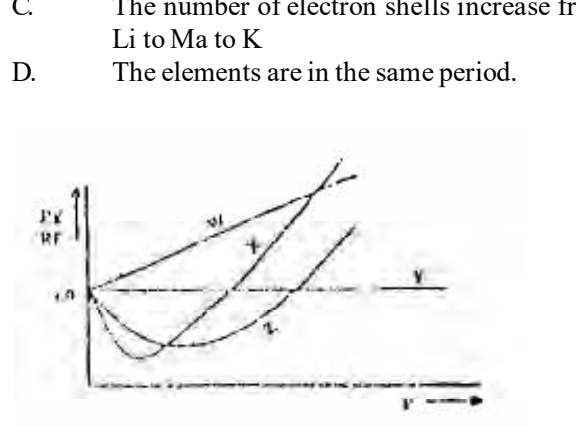
  7. Chemistry1989Gas Laws
    7. Which of the curves in the above graph illustrates the behaviour of an ideal gas?
    Figure for: Which of the curves in the above graph illustrates the behaviour of an ideal gas?
    1. A.W
    2. B.X
    3. C.Y
    4. D.Z
  8. Chemistry1989Chemical Bonding
    8. Elements X and Y have electronic configurations 1s22s22p41s^22s^22p^4 and 1s22s22p63s23p11s^22s^22p^63s^23p^1 respectively. When they combine, the formula of the compound formed is
    1. A.XY
    2. B.YX
    3. C.X2Y3\mathrm{X_2Y_3}
    4. D.Y2X3\mathrm{Y_2X_3}
  9. Chemistry1989Atomic Structure
    9. The atomic number of cesium is 55 and its atomic mass is 133. The nucleus of cesium atom therefore contains
    1. A.78 protons and 55 electrons
    2. B.55 protons and 78 neutrons
    3. C.55 neutrons and 78 electrons
    4. D.78 neutrons and 55 neutrons
  10. Chemistry1989Periodic Table
    10. Four elements P, Q, R and S have atomic numbers of 4, 10, 12, and 14 respectively. Which of these elements is a noble gas?
    1. A.P
    2. B.Q
    3. C.R
    4. D.S
  11. Chemistry1989Atomic Structure
    11. How many valence electrons are contained in the element represented by 1531P^{31}_{15}\mathrm{P}?
    1. A.3
    2. B.5
    3. C.15
    4. D.31
  12. Chemistry1989Metals and Non-metals
    12. The gaseous pollutant sulphur (IV) oxide is most likely to be detected in fairly reasonable quantities in the area around a plant for the
    1. A.extraction of aluminium from bauxite
    2. B.production of margarine
    3. C.smelting of copper
    4. D.production of chlorine from brine
  13. Chemistry1989Water, Solutions and Solubility
    13. Calcium hydroxide is added in the treatment of town water supply to
    1. A.kill bacteria in the water
    2. B.facilitate coagulation of organic particles
    3. C.facilitate sedimentation
    4. D.improve the taste of the water.
  14. Chemistry1989Stoichiometry
    14. A hydrated salt of formula MSO4.XH2O\mathrm{MSO_4.XH_2O} contains 45.3% by mass of the water of crystallization. Calculate the value of X. [M = 56, S= 32, O =16, H= 1]
    1. A.3
    2. B.5
    3. C.7
    4. D.10
  15. Chemistry1989Stoichiometry
    15. Using 50 cm350\,\mathrm{cm^3} of 1 M potassium hydroxide and 100 cm3100\,\mathrm{cm^3} of 1 M tetraoxosulphate (VI) acid, calculate the respective volumes in cm3\mathrm{cm^3} of base and acid that would be required to produce the maximum amount of potassium tetraoxosulphate (VI) [K= 39, S=32, O=16, H=1]
    1. A.50, 50
    2. B.25, 50
    3. C.50, 25
    4. D.25, 25
  16. Chemistry1989Stoichiometry
    16. A solution of calcium bromide contains 20 g dm−320\,\mathrm{g\,dm^{-3}}. What is the molarity of the solution with respect to calcium bromide and bromide ions? [Ca = 40, Br = 80]
    1. A.0.1, 0.1
    2. B.0.1, 0.2
    3. C.0.1, 0.05
    4. D.0.05, 0.1
  17. Chemistry1989Acids, Bases and Salts
    17. The substance ZnO dissolves in sodium hydroxide solution and mineral acid solution to give soluble products in each case. ZnO is therefore referred to as
    1. A.an allotropic acid
    2. B.an amphoteric oxide
    3. C.a peroxide
    4. D.a dioxide.
  18. Chemistry1989Acids, Bases and Salts
    18. An acid and its conjugate base
    1. A.can neutralize each other to form a salt
    2. B.differ only by a proton
    3. C.differ only by the opposite charges they carry
    4. D.are always neutral substances
  19. Chemistry1989Electrochemistry
    19. The same current is passed for the same time through solutions of AgNO3\mathrm{AgNO_3} and CuSO4\mathrm{CuSO_4} connected in series. How much silver will be deposited if 1.0 g of copper is produced? [Cu = 63.5, S = 32, O = 16, Ag = 108, N = 14]
    1. A.1.7 g
    2. B.3.4 g
    3. C.6.8 g
    4. D.13.6 g
  20. Chemistry1989Electrochemistry
    20. What is discharged at the cathode during the electrolysis of copper (II) tetraoxosulphate (VI) solution?
    1. A.Cu2+\mathrm{Cu^{2+}} only
    2. B.H+\mathrm{H^+} only
    3. C.Cu2+\mathrm{Cu^{2+}} and H+\mathrm{H^+}
    4. D.Cu2+\mathrm{Cu^{2+}} and SO42−\mathrm{SO_4^{2-}}

Other JAMB Chemistry papers