JAMB Chemistry 1997 past questions

43 questions from the 1997 paper, showing 1–20. Try each one, then open the solution to check your answer. Sign in to see the worked explanations.

  1. Chemistry1997Gas Laws
    1. 35 cm3^3 of hydrogen was sparked with 12 cm3^3 of oxygen at 110∘110^\circC and 760 mm Hg to produce steam. What percentage of the total volume gas left after the reaction is hydrogen
    1. A.11%
    2. B.31%
    3. C.35%
    4. D.69%
  2. Chemistry1997Stoichiometry
    2. 2.85 g of an oxide of copper gave 2.52 g of copper on reduction and 1.90 g of another oxide gave 1.52 g of copper on reduction. The data above illustrates the law of
    1. A.constant composition
    2. B.conservation of mass
    3. C.reciprocal proportions
    4. D.multiple proportions.
  3. Chemistry1997Separation Techniques
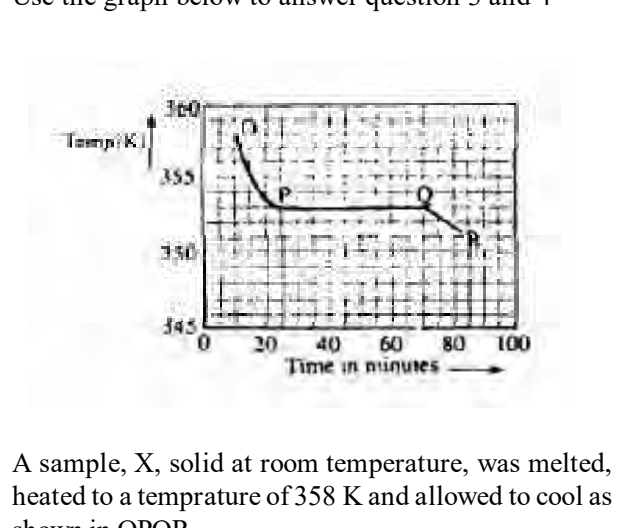
    3. A sample, X, solid at room temperature, was melted, heated to a temprature of 358 K and allowed to cool as shown in OPQR. The section PQ indicate that X is
    Figure for: A sample, X, solid at room temperature, was melted, heated to a temprature of 358 K and allowed to…
    1. A.a mixture of salt
    2. B.a hydrated salt
    3. C.an ionic salt
    4. D.a pure compound.
  4. Chemistry1997Separation Techniques
    4. The section OP suggests that X is in the
    Figure for: The section OP suggests that X is in the
    1. A.Liquid state
    2. B.Solid/liquid state
    3. C.Solid state
    4. D.Gaseous state.
  5. Chemistry1997Stoichiometry
    5. An element, X, format a volatile hydride XH3\mathrm{XH_3} with a vapour density of 17.0. The relation mass of X is
    1. A.34.0
    2. B.31.0
    3. C.20.0
    4. D.14.0
  6. Chemistry1997Gas Laws
    6. A mixture of 0.20 mole of Ar, 0.20 mole of N2\mathrm{N_2} and 0.30 mole of He exerts a total pressure of 2.1 atm. The partial pressure of He in the mixture is
    1. A.0.90 atm
    2. B.0.80 atm
    3. C.0.70 atm
    4. D.0.60 atm
  7. Chemistry1997Gas Laws
    7. If 30 cm3^3 of oxygen diffuses through a porous plug in 7 s, how long will it take 60 cm3^3 of chlorine to diffuse through the same plug
    1. A.12 s
    2. B.14 s
    3. C.21 s
    4. D.30 s
  8. Chemistry1997Periodic Table
    8. The electron configuration of two elements with similar chemical properties are represented by
    1. A.1s22s22p51s^22s^22p^5 and 1s22s22p41s^22s^22p^4
    2. B.1s22s22p41s^22s^22p^4 and 1s22s22p63s11s^22s^22p^63s^1
    3. C.1s22s22p63s11s^22s^22p^63s^1 and 1s22s11s^22s^1
    4. D.1s22s22p41s^22s^22p^4 and 1s22s11s^22s^1
  9. Chemistry1997Energy Changes
    9. The temperature of a body decreases when drops of liquid placed on it evaporates because
    1. A.the atmospheric vapour pressure has a cooling effect on the body
    2. B.a temperature gradient exists between the drops of liquid and the body
    3. C.the heat of vapourization is drawn from the body causing it to cool
    4. D.the random motion of the liquid molecules causes a cooling effect on the body.
  10. Chemistry1997Periodic Table
    10. In the periodic table, what is the property that decrease along the period and increases down the group
    1. A.Atomic number
    2. B.Electron affinity.
    3. C.Ionization potential
    4. D.Atomic radius.
  11. Chemistry1997Chemical Bonding
    11. Two elements, P and Q with atomic numbers 11 and 8 respectively, combine chemically to form a compound PxQy\mathrm{P_xQ_y}. The values of x and y are
    1. A.1 and 1
    2. B.1 and 2
    3. C.2 and 1
    4. D.3 and 1
  12. Chemistry1997Atomic Structure
    12. Oxygen is a mixture of two isotopes 816O^{16}_{8}\mathrm{O} and 818O^{18}_{8}\mathrm{O} with relative abundance of 90% and 10% respectively. The relative atomic mass of oxygen
    1. A.16.0
    2. B.16.2
    3. C.17.0
    4. D.18.0
  13. Chemistry1997Gas Laws
    13. 200 cm3^3 of air was passed over heated copper in a syringe several times to produce copper (II) oxide. When cooled the final volume of air recorded was 158 cm3^3. Estimate the percentage of oxygen in the air.
    1. A.31%
    2. B.27%
    3. C.21%
    4. D.19%
  14. Chemistry1997Acids, Bases and Salts
    14. Which of the following gases is the most dangerous pollutant
    1. A.Hydrogen sulphide
    2. B.Carbon (IV) oxide
    3. C.Sulphur (IV) oxide
    4. D.Carbon (II) oxide
  15. Chemistry1997Water, Solutions and Solubility
    15. A major process involve in the softening of hard water is the
    1. A.conversion of a soluble calcium salt to its trioxocarbonate (IV)
    2. B.decomposition of calcium trioxocarbonate (IV)
    3. C.conversion of an insoluble calcium salt to its trioxocrbonate (IV)
    4. D.oxidation of calcium atom to its ions.
  16. Chemistry1997Stoichiometry
    16. On recrystallization, 20 g of magnesium tetraoxosulphate (VI) forms 41 g of magnesium tetraoxosulphate (VI) crystals, MgSO4.yH2O\mathrm{MgSO_4.yH_2O}. The value of y is (Mg = 24, S=32, O=16, H= 1)
    1. A.1
    2. B.3
    3. C.5
    4. D.7
  17. Chemistry1997Water, Solutions and Solubility
    17. A saturated solution of AgCl was found to have a concentration of 1.30×10⁻⁵ mol dm−31.30 \times 10^{-5}\,\mathrm{mol\,dm^{-3}}. The solution product of AgCl therefore is.
    1. A.1.30×10−5 mol2dm−61.30\times10^{-5}\,\mathrm{mol^2dm^{-6}}
    2. B.1.30×10−7 mol2dm−61.30\times10^{-7}\,\mathrm{mol^2dm^{-6}}
    3. C.1.69×10−10 mol2dm−61.69\times10^{-10}\,\mathrm{mol^2dm^{-6}}
    4. D.2.60×10−12 mol2dm−62.60\times10^{-12}\,\mathrm{mol^2dm^{-6}}
  18. Chemistry1997Acids, Bases and Salts
    18. The hydroxyl ion concentration, [OH−][\mathrm{OH^-}], in a solution of sodium hydroxide of pH 10.0 is
    1. A.10−10 mol dm−310^{-10}\,\mathrm{mol\,dm^{-3}}
    2. B.10−6 mol dm−310^{-6}\,\mathrm{mol\,dm^{-3}}
    3. C.10−4 mol dm−310^{-4}\,\mathrm{mol\,dm^{-3}}
    4. D.10−2 mol dm−310^{-2}\,\mathrm{mol\,dm^{-3}}
  19. Chemistry1997Acids, Bases and Salts
    19. Which of the aqueous solution with the pH values below will liberate hydrogen when it reacts with magnesium metal?
    1. A.13.0
    2. B.7.0
    3. C.6.5
    4. D.3.0
  20. Chemistry1997Stoichiometry
    20. Given that 15.00 cm3^3 of H2SO4\mathrm{H_2SO_4} was required to completely neutralize 25.00 cm3^3 of 0.125 mol dm−3^{-3} NaOH, calculate the molar concentration of the acid solution.
    1. A.0.925 mol dm−3^{-3}
    2. B.0.156 mol dm−3^{-3}
    3. C.0.104 mol dm−3^{-3}
    4. D.0.023 mol dm−3^{-3}

Other JAMB Chemistry papers