JAMB Chemistry 1993 past questions

46 questions from the 1993 paper, showing 1–20. Try each one, then open the solution to check your answer. Sign in to see the worked explanations.

  1. Chemistry1993Water, Solutions and Solubility
    1. The dissolution of common salt in water is physical change because
    1. A.the salt can be obtained by crystallization
    2. B.the salt can be recovered by the evaporation of water.
    3. C.Heat is not generated during mixing
    4. D.The solution will not boil at 100∘C100^\circ\mathrm{C}
  2. Chemistry1993Separation Techniques
    2. Which of the following substances is mixture?
    1. A.Sulphur powder
    2. B.Bronze
    3. C.Distilled water
    4. D.Ethanol
  3. Chemistry1993Stoichiometry
    3. How many moles of oxygen molecules would be produced from the decomposition of 2.5 moles of potassium trioxochlorate (V)?
    1. A.2.50
    2. B.3.50
    3. C.3.75
    4. D.7.50
  4. Chemistry1993Stoichiometry
    4. A balanced chemical equation obeys the law of
    1. A.Conservation of mass
    2. B.Definite proportions
    3. C.Multiple proportions
    4. D.Conservation of energy
  5. Chemistry1993Gas Laws
    5. At 25∘C25^\circ\mathrm{C} and 1 atm, a gas occupies a volume of 1.50 dm31.50\,\mathrm{dm^3}. What volume will it occupy at 100∘C100^\circ\mathrm{C} at 1 atm?
    1. A.1.88 dm31.88\,\mathrm{dm^3}
    2. B.6.00 dm36.00\,\mathrm{dm^3}
    3. C.18.80 dm318.80\,\mathrm{dm^3}
    4. D.60.00 dm360.00\,\mathrm{dm^3}
  6. Chemistry1993Gas Laws
    6. A gaseous mixture of 80.0 g of oxygen and 56.0 g of nitrogen has a total pressure of 1.8 atm. The partial pressure of oxygen in the mixture is [O= 16, N= 14]
    1. A.0.8 atm
    2. B.1.0 atm
    3. C.1.2 atm
    4. D.1.4 atm
  7. Chemistry1993Gas Laws
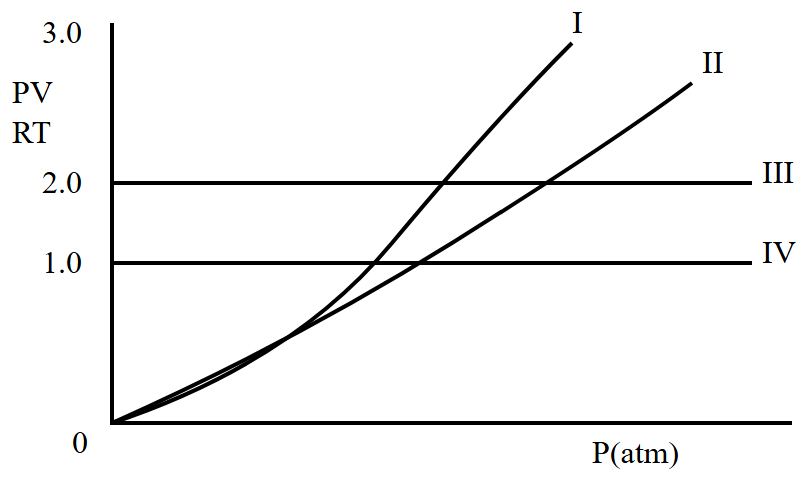
    7. Which of the curves above represents the behavior of 1 mole of an ideal gas?
    Figure for: Which of the curves above represents the behavior of 1 mole of an ideal gas?
    1. A.I
    2. B.II
    3. C.III
    4. D.IV
  8. Chemistry1993Chemical Bonding
    8. For iodine crystals to sublime on heating, the molecules must acquire energy that is
    1. A.less than the forces of attraction in the solid
    2. B.equal to the forces of attraction in the solid
    3. C.necessary to melt the solid
    4. D.greater than the forces of attraction in both solid and the liquid phases
  9. Chemistry1993Periodic Table
    9. An element, E, has the electronic configuration 1s22s22p63s23p31s^22s^22p^63s^23p^3. The reaction of E with a halogen X can give.
    1. A.EX3\mathrm{EX_3} and EX5\mathrm{EX_5}
    2. B.EX3\mathrm{EX_3} only
    3. C.EX5\mathrm{EX_5} only
    4. D.EX2\mathrm{EX_2} and EX3\mathrm{EX_3}
  10. Chemistry1993Atomic Structure
    10. Two atoms represented as 92235U^{235}_{92}\mathrm{U} and 92238U^{238}_{92}\mathrm{U} are
    1. A.isomers
    2. B.allotropes
    3. C.isotopes
    4. D.anomers
  11. Chemistry1993Chemical Bonding
    11. As the difference in electronegativity between bonded atoms increase, polarity of the bond
    1. A.decreases
    2. B.increases
    3. C.remains unchanged
    4. D.reduces to zero.
  12. Chemistry1993Chemical Bonding
    12. Which group of elements forms hydrides that are pyramidal in structure?
    1. A.III
    2. B.IV
    3. C.V
    4. D.VI
  13. Chemistry1993Chemical Bonding
    13. Water has a rather high boiling point despite its low molecular mass because of the presence of
    1. A.hydrogen bonding
    2. B.covalent bonding
    3. C.ionic bonding
    4. D.metallic bonding
  14. Chemistry1993Organic Chemistry
    14. The air around a petroleum refinery is most likely to contain
    1. A.CO2\mathrm{CO_2}, SO3\mathrm{SO_3} and N2O\mathrm{N_2O}
    2. B.CO2\mathrm{CO_2}, CO and N2O\mathrm{N_2O}
    3. C.SO3\mathrm{SO_3}, CO and NO2\mathrm{NO_2}
    4. D.PH3\mathrm{PH_3}, H2O\mathrm{H_2O} and CO2\mathrm{CO_2}
  15. Chemistry1993Water, Solutions and Solubility
    15. Water can be identified by the use of
    1. A.an hydrogen copper(II) tetraoxosulphate(VI)
    2. B.an hydrogen sodium trioxocarbonate(IV)
    3. C.potassium heptaoxochromate(VII)
    4. D.copper (II) trioxocarbonate(IV)
  16. Chemistry1993Water, Solutions and Solubility
    16. The phenomenon whereby sodium trioxocarbonate (IV) decahydrate loses some of its water of crystallization on exposure to the atmosphere is known as
    1. A.deliquescence
    2. B.hygroscopy
    3. C.effervescence
    4. D.efflorescence
  17. Chemistry1993Acids, Bases and Salts
    17. A student prepares 0.5 M solution each of hydrochloric and ethanoic acids and then measured their pH. The result would show that the
    1. A.pH values are equal
    2. B.HCl solution has higher pH
    3. C.Sum of the pH values is 14
    4. D.Ethanoic acid solution has a higher pH.
  18. Chemistry1993Water, Solutions and Solubility
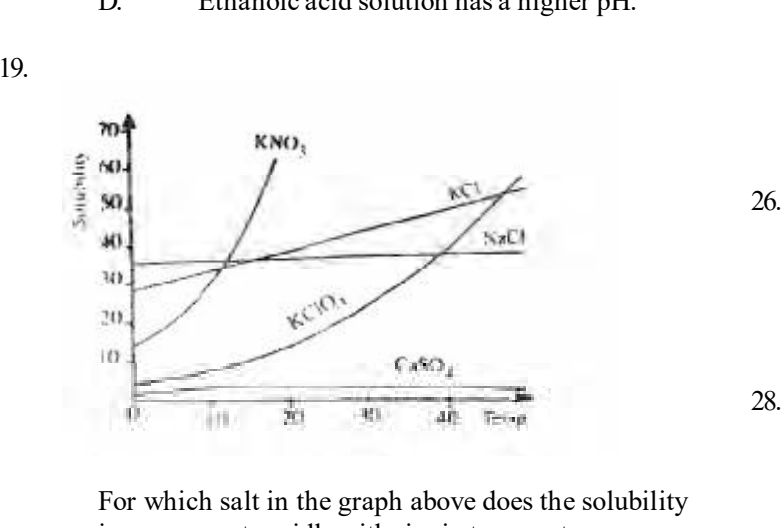
    18. For which salt in the graph above does the solubility increase most rapidly with rise in temperature
    Figure for: For which salt in the graph above does the solubility increase most rapidly with rise in temperature
    1. A.CaSO4\mathrm{CaSO_4}
    2. B.KNO3\mathrm{KNO_3}
    3. C.NaCl
    4. D.KCl
  19. Chemistry1993Acids, Bases and Salts
    19. NH3+H3O+→NH4++H2O\mathrm{NH_3 + H_3O^+ \rightarrow NH_4^+ + H_2O}. it may be deduced from the reaction above that
    1. A.a redox reaction has occurred
    2. B.H3O+\mathrm{H_3O^+} acts as an oxidizing agent
    3. C.H3O+\mathrm{H_3O^+} acts as an acid
    4. D.Water acts as an acid
  20. Chemistry1993Stoichiometry
    20. 4.0 g of sodium hydroxide in 250 cm3250\,\mathrm{cm^3} of solution contains
    1. A.0.40 moles per dm3\mathrm{dm^3}
    2. B.0.10 moles per dm3\mathrm{dm^3}
    3. C.0.04 moles per dm3\mathrm{dm^3}
    4. D.0.02 moles per dm3\mathrm{dm^3}

Other JAMB Chemistry papers