JAMB Chemistry 1990 past questions

42 questions from the 1990 paper, showing 1–20. Try each one, then open the solution to check your answer. Sign in to see the worked explanations.

  1. Chemistry1990Separation Techniques
    1. Which of the following is a physical change?
    1. A.The bubbling of chlorine into water
    2. B.The bubbling of chlorine into jar containing hydrogen
    3. C.The dissolution of sodium chloride in water
    4. D.The passing of steam over heated iron.
  2. Chemistry1990Stoichiometry
    2. The Avogadro's number of 24 g of magnesium is same as that of
    1. A.1 g of hydrogen molecules
    2. B.16 g of oxygen molecules
    3. C.32 g of oxygen molecules
    4. D.35.5 g of chlorine molecules.
  3. Chemistry1990Gas Laws
    3. If a gas occupies a container of volume 146 cm3\mathrm{cm^3} at 18∘18^\circC and 0.971 atm, its volume in cm3\mathrm{cm^3} at s.t.p is
    1. A.133
    2. B.146
    3. C.266
    4. D.292
  4. Chemistry1990Gas Laws
    4. The volume occupied by 1.58 g of gas at s.t.p is 500 cm3\mathrm{cm^3}. What is the relative molecular mass of the gas? [G.M.V at s.t.p = 22.40 dm3\mathrm{dm^3}]
    1. A.28
    2. B.32
    3. C.344
    4. D.71
  5. Chemistry1990Gas Laws
    5. Equal volumes of CO,SO2,NO2\mathrm{CO, SO_2, NO_2} and H2S\mathrm{H_2S} were released into a room at the same point and time. Which of the following gives the order in which they would be detected in the room (fastest first)? [S = 32, C = 12, O = 16, N = 14, H = 1]
    1. A.CO2,SO2,NO,H2S\mathrm{CO_2, SO_2, NO, H_2S}
    2. B.SO2,NO2,H2S,CO\mathrm{SO_2, NO_2, H_2S, CO}
    3. C.CO,H2S,SO2,NO2\mathrm{CO, H_2S, SO_2, NO_2}
    4. D.CO,H2S,NO2,SO2\mathrm{CO, H_2S, NO_2, SO_2}
  6. Chemistry1990Gas Laws
    6. A basic postulate of the kinetic theory of gases is that the molecules of a gas move in straight lines between collisions. This implies that.
    1. A.collisions are perfectly elastic
    2. B.forces of repulsion exist
    3. C.forces of repulsion and attraction are in equilibrium
    4. D.collisions are inelastic.
  7. Chemistry1990Atomic Structure
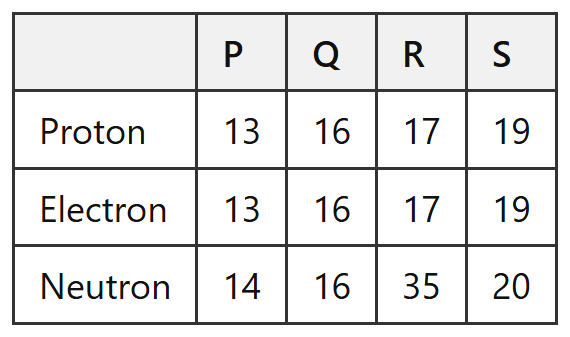
    7. Which of the four atoms P, Q, R and S in the above data can be described by the following properties: relative atomic mass is greater than 30 but less than 40; it has an odd atomic number and forms a unipositive ion in solution?
    Figure for: Which of the four atoms P, Q, R and S in the above data can be described by the following…
    1. A.P
    2. B.Q
    3. C.R
    4. D.S
  8. Chemistry1990Chemical Bonding
    8. Which of the following terms indicates the number of bonds that can be formed by atom?
    1. A.Oxidation number
    2. B.Valence
    3. C.Atomic number
    4. D.Electronegativity.
  9. Chemistry1990Atomic Structure
    9. X(g)→X−(g)\mathrm{X(g) \rightarrow X^-(g)}. The type of energy involved in the above transformation is
    1. A.ionization energy
    2. B.sublimation energy
    3. C.lattice energy
    4. D.electron affinity
  10. Chemistry1990Atomic Structure
    10. Chlorine, consisting of two isotope of mass numbers 35 and 37, has an atomic of 35.5. The relative abundance of the isotope of mass number 37 is.
    1. A.20
    2. B.25
    3. C.50
    4. D.75
  11. Chemistry1990Stoichiometry
    11. 10.0 dm3\mathrm{dm^3} of air containing H2S\mathrm{H_2S} as an impurity was passed through a solution of Pb(NO3)2\mathrm{Pb(NO_3)_2} until all the H2S\mathrm{H_2S} had reacted. The precipitate of PbS was found weight 5.02 g. According to the equation: Pb(NO3)2+H2S→PbS+2HNO3\mathrm{Pb(NO_3)_2 + H_2S \rightarrow PbS + 2HNO_3} the percentage by volume of hydrogen sulphides in the air is. [Pb = 207, S = 32, GMV at s.t.p = 22.4 dm3\mathrm{dm^3}]
    1. A.50.2
    2. B.47.0
    3. C.4.70
    4. D.0.47
  12. Chemistry1990Water, Solutions and Solubility
    12. A blue solid, T, which weighted 5.0 g was placed on a table. After 8 hours, the resulting pink solid was found to weight 5.5 g. It can be inferred that substance T
    1. A.is deliquescent
    2. B.is hygroscopic
    3. C.has some molecules of water of crystallization
    4. D.is efflorescent
  13. Chemistry1990Electrochemistry
    13. The effluent of an industrial plant used in the electrolysis of concentrated brine, with a flowing mercury cathode may contain impurities like.
    1. A.oxygen
    2. B.hydrogen
    3. C.mercury(II) chloride
    4. D.hydrogen chloride
  14. Chemistry1990Water, Solutions and Solubility
    14. The solubility in moles per dm3\mathrm{dm^3} of 20 g of CuSO4\mathrm{CuSO_4} dissolved in 100 g of water at 180∘C180^\circ\mathrm{C} is [Cu = 63.5, S = 32, O = 16]
    1. A.0.13
    2. B.0.25
    3. C.1.25
    4. D.2.00
  15. Chemistry1990Water, Solutions and Solubility
    15. Smoke consists of
    1. A.solid particles dispersed in liquid
    2. B.solid or liquid particles dispersed in gas
    3. C.gas or liquid particles dispersed in liquid
    4. D.liquid particles dispersed in liquid.
  16. Chemistry1990Stoichiometry
    16. Na2C2O4+CaCl2→CaC2O4+2NaCl\mathrm{Na_2C_2O_4 + CaCl_2 \rightarrow CaC_2O_4 + 2NaCl}. Given a solution of 1.9 g of sodium oxalate in 50 g of water at room temperature, calculate the minimum volume of 0.1 M calcium chloride required to produce maximum calcium oxalate using the above equation.
    1. A.1.40×102 dm31.40\times10^2\,\mathrm{dm^3}
    2. B.1.40×102 cm31.40\times10^2\,\mathrm{cm^3}
    3. C.1.40×10−2 dm31.40\times10^{-2}\,\mathrm{dm^3}
    4. D.1.40×10−2 cm31.40\times10^{-2}\,\mathrm{cm^3}
  17. Chemistry1990Acids, Bases and Salts
    17. 2.0 g of monobasic acid was made up to 250 cm3\mathrm{cm^3} with distilled water. 25.00 cm3\mathrm{cm^3} of this solution required 20.00 cm3\mathrm{cm^3} of 0.1 M NaOH solution for complete neutralization. The molar mass of the acid is
    1. A.200 g
    2. B.160 g
    3. C.100 g
    4. D.50 g
  18. Chemistry1990Acids, Bases and Salts
    18. What is concentration of H+\mathrm{H^+} ions in moles per dm3\mathrm{dm^3} of a solution of pH 4.398?
    1. A.4.0×10−54.0\times10^{-5}
    2. B.0.4×10−50.4\times10^{-5}
    3. C.4.0×10−34.0\times10^{-3}
    4. D.0.4×10−30.4\times10^{-3}
  19. Chemistry1990Electrochemistry
    19. If 10.8 g of silver is deposited in a silver coulometer connected in series with a copper coulometer, the volume of oxygen liberated is [Ag = 108, Cu = 64, GMV at s.t.p = 22.40 dm3\mathrm{dm^3}].
    1. A.0.56 dm30.56\,\mathrm{dm^3}
    2. B.5.50 dm35.50\,\mathrm{dm^3}
    3. C.11.20 dm311.20\,\mathrm{dm^3}
    4. D.22.40 dm322.40\,\mathrm{dm^3}
  20. Chemistry1990Electrochemistry
    20. 0.1 faraday of electricity deposited 2.95 g of nickel during electrolysis is an aqueous solution. Calculate the number of moles of nickel that will be deposited by 0.4 faraday [Ni = 58.7]
    1. A.0.20
    2. B.0.30
    3. C.0.034
    4. D.5.87

Other JAMB Chemistry papers