JAMB Chemistry 1999 past questions

46 questions from the 1999 paper, showing 1–20. Try each one, then open the solution to check your answer. Sign in to see the worked explanations.

  1. Chemistry1999Stoichiometry
    1. 200 cm3\mathrm{cm^3} each of 0.1 M solution of lead (II) trioxonitrate (V) and hydrochloric acid were mixed. Assuming that lead (II) chloride is completely insoluble, calculate the mass of lead (II) chloride that will be precipitated. [Pb = 207, Cl = 35.5, N = 14, O = 16]
    1. A.2.78 g
    2. B.5.56 g
    3. C.8.34 g
    4. D.11.12 g
  2. Chemistry1999Gas Laws
    2. 56.00 cm3\mathrm{cm^3} of a gas at s.t.p weighed 0.11 g. What is the vapour density of the gas? [Molar volume of a gas at s.t.p = 22.4 dm3\mathrm{dm^3}]
    1. A.11.00
    2. B.22.00
    3. C.33.00
    4. D.44.00
  3. Chemistry1999Gas Laws
    3. Which of the following gases will diffuse fastest when passed through a porous plug? [H = 1, C = 12, N = 14, O = 16]
    1. A.Propane
    2. B.Oxygen
    3. C.Methane
    4. D.Ammonia
  4. Chemistry1999Metals and Non-metals
    4. Which of the following will have its mass increased when heated in air?
    1. A.Helium
    2. B.Magnesium
    3. C.Copper pyrites
    4. D.Glass
  5. Chemistry1999Gas Laws
    5. What is the temperature of a given mass of a gas initially 0∘0^\circC and 9 atm, if the pressure is reduced to 3 atmosphere at constant volume?
    1. A.91 K
    2. B.182 K
    3. C.273 K
    4. D.819 K
  6. Chemistry1999Stoichiometry
    6. Mg(s)+2HCl(aq)→MgCl2(aq)+H2(g)\mathrm{Mg(s)} + 2\mathrm{HCl(aq)} \rightarrow \mathrm{MgCl_2(aq)} + \mathrm{H_2(g)}. From the equation above, the mass of magnesium required to react with 250 cm3\mathrm{cm^3} of 0.5 M HCl is [Mg = 24, Cl = 35.5]
    1. A.0.3 g
    2. B.1.5 g
    3. C.2.4 g
    4. D.3.0 g
  7. Chemistry1999Stoichiometry
    7. A gaseous metallic chloride MClx\mathrm{MCl_x} consists of 20.22% of M by mass. The formula of the chloride is [M = 27, Cl = 35.5]
    1. A.MCl
    2. B.MCl2\mathrm{MCl_2}
    3. C.MCl3\mathrm{MCl_3}
    4. D.M2Cl6\mathrm{M_2Cl_6}
  8. Chemistry1999Energy Changes
    8. In which of the following are water molecules in the most disorderly arrangement?
    1. A.Ice at −10∘-10^\circC
    2. B.Ice at 0∘0^\circC
    3. C.Water at 100∘100^\circC
    4. D.Steam at 100∘100^\circC
  9. Chemistry1999Atomic Structure
    9. In order to remove one electron from 3s-orbital of gaseous sodium atom, about 496 kJ mol−1496\,\mathrm{kJ\,mol^{-1}} of energy is required. This energy is referred to as
    1. A.electron affinity
    2. B.ionization energy
    3. C.activation energy
    4. D.electronegativity
  10. Chemistry1999Gas Laws
    10. Nitrogen obtained from the liquefaction of air has a higher density than that obtained from nitrogen containing compounds because the former contains
    1. A.Water vapour
    2. B.Oxygen
    3. C.Carbon (IV) oxide
    4. D.Rare gases
  11. Chemistry1999Water, Solutions and Solubility
    11. The method that can be used to convert hard water to soft water is
    1. A.Chlorination
    2. B.Passage over activated charcoal
    3. C.the use of an ion exchange resin
    4. D.aeration
  12. Chemistry1999Periodic Table
    12. 1s22s22p63s23p63d74s21s^22s^22p^63s^23p^63d^74s^2. An element with the electron configuration above is a
    1. A.non-metal
    2. B.metal
    3. C.transition element
    4. D.group two element
  13. Chemistry1999Chemical Bonding
    13. Given that electronegativity increases across a period and decreases down a group in the periodic table, in which of the following compounds will the molecules be held together by the strongest hydrogen bond?
    1. A.HF(g)
    2. B.NH3\mathrm{NH_3}(g)
    3. C.CH4\mathrm{CH_4}(g)
    4. D.HCl(g)
  14. Chemistry1999Acids, Bases and Salts
    14. 0.25 mole of hydrogen chloride was dissolved in distilled water and the volume made up to 0.50 dm3\mathrm{dm^3}. If 15.00 cm3\mathrm{cm^3} of the solution requires 12.50 cm3\mathrm{cm^3} of aqueous sodium trioxocarbonate (IV) for neutralization, calculate the concentration of the alkaline solution.
    1. A.0.30 mol dm−30.30\,\mathrm{mol\,dm^{-3}}
    2. B.0.40 mol dm−30.40\,\mathrm{mol\,dm^{-3}}
    3. C.0.50 mol dm−30.50\,\mathrm{mol\,dm^{-3}}
    4. D.0.60 mol dm−30.60\,\mathrm{mol\,dm^{-3}}
  15. Chemistry1999Redox Reactions
    15. The correct order of increasing oxidation number of the transition metal ions for the compounds K2Cr2O7\mathrm{K_2Cr_2O_7}, V2O5\mathrm{V_2O_5} and KMnO4\mathrm{KMnO_4} is
    1. A.V2O5<K2Cr2O7<KMnO4\mathrm{V_2O_5} < \mathrm{K_2Cr_2O_7} < \mathrm{KMnO_4}
    2. B.K2Cr2O7<KMnO4<V2O5\mathrm{K_2Cr_2O_7} < \mathrm{KMnO_4} < \mathrm{V_2O_5}
    3. C.KMnO4<K2Cr2O7<V2O5\mathrm{KMnO_4} < \mathrm{K_2Cr_2O_7} < \mathrm{V_2O_5}
    4. D.KMnO4<V2O5<K2Cr2O7\mathrm{KMnO_4} < \mathrm{V_2O_5} < \mathrm{K_2Cr_2O_7}
  16. Chemistry1999Organic Chemistry
    16. The set of pollutants that is most likely to be produced when petrol is accidentally spilled on plastic materials and ignited is
    1. A.CO, CO2\mathrm{CO_2} and SO2\mathrm{SO_2}
    2. B.CO, HCl and SO2\mathrm{SO_2}
    3. C.CO, CO2\mathrm{CO_2} and HCl
    4. D.SO2\mathrm{SO_2}, CO2\mathrm{CO_2} and HCl
  17. Chemistry1999Redox Reactions
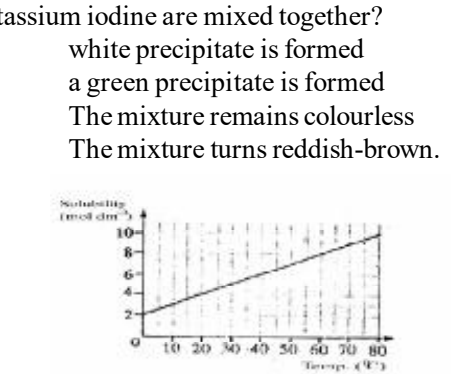
    17. What is observed when aqueous solution of each of tetraoxosulphate (VI) acid, potassium trioxoiodate (V) and potassium iodide are mixed together?
    1. A.white precipitate is formed
    2. B.a green precipitate is formed
    3. C.The mixture remains colourless
    4. D.The mixture turns reddish-brown.
  18. Chemistry1999Water, Solutions and Solubility
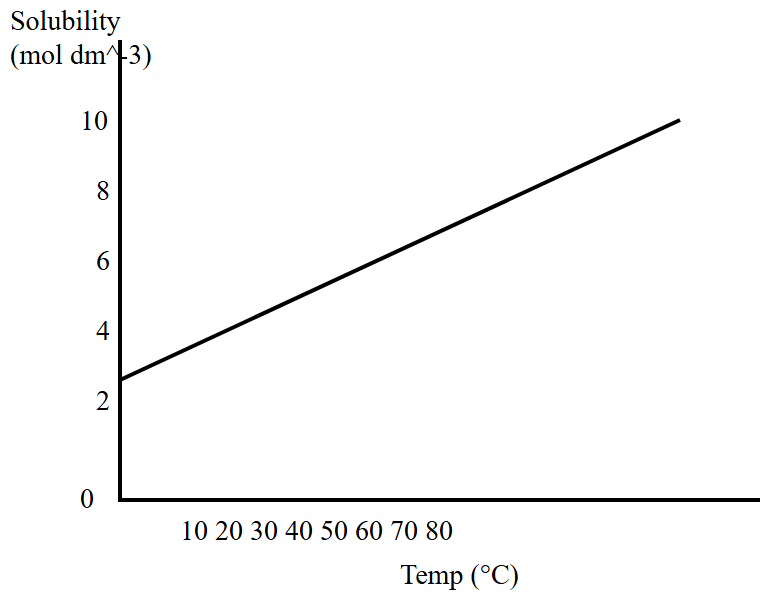
    18. From the diagram above, the mass of crystals deposited when 1 dm3\mathrm{dm^3} of a saturated solution of NaCl is cooled from 80∘80^\circC to 60∘60^\circC is [Na = 23, Cl = 35.5]
    Figure for: From the diagram above, the mass of crystals deposited when 1 dm^3 of a saturated solution of NaCl…
    1. A.117.00 g
    2. B.58.50 g
    3. C.11.70 g
    4. D.5.85 g
  19. Chemistry1999Water, Solutions and Solubility
    19. From the diagram above, the mass of crystals deposited when 1 dm3^3 of a saturated solution of NaCl is cooled from 80∘80^\circC to 60∘60^\circC is [Na = 23, Cl = 35.5]
    Figure for: From the diagram above, the mass of crystals deposited when 1 dm ^3 of a saturated solution of…
    1. A.117.00 g
    2. B.58.50 g
    3. C.11.70 g
    4. D.5.85 g
  20. Chemistry1999Equilibrium
    20. The solubility product of Cu(IO3)2\mathrm{Cu(IO_3)_2} is 1.08×10−71.08 \times 10^{-7}. Assuming that neither ions react appreciably with water to form H+\mathrm{H^+} and OH−\mathrm{OH^-}, what is the solubility of this salt?
    1. A.2.7×10−82.7 \times 10^{-8} mol dm−3^{-3}
    2. B.9.0×10−89.0 \times 10^{-8} mol dm−3^{-3}
    3. C.3.0×10−33.0 \times 10^{-3} mol dm−3^{-3}
    4. D.9.0×10−49.0 \times 10^{-4} mol dm−3^{-3}

Other JAMB Chemistry papers