JAMB Chemistry 1988 past questions

43 questions from the 1988 paper, showing 1–20. Try each one, then open the solution to check your answer. Sign in to see the worked explanations.

  1. Chemistry1988Separation Techniques
    1. In the experiment above, ammonium chloride crystals deposit on the walls of the tube as a result of
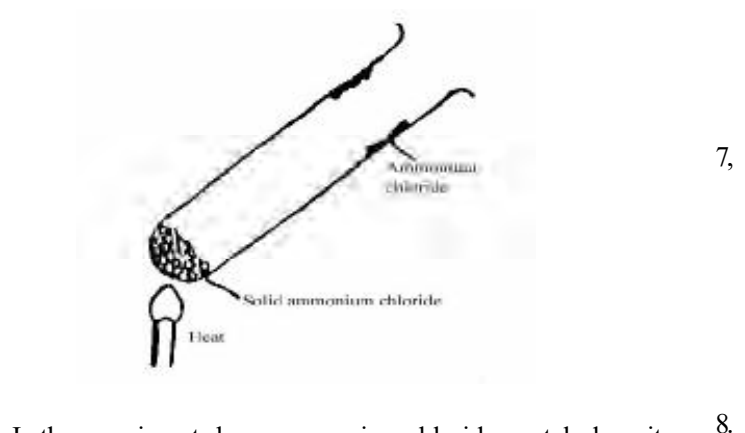
    Figure for: In the experiment above, ammonium chloride crystals deposit on the walls of the tube as a result of
    1. A.Evaporation
    2. B.Recrystallization
    3. C.Sublimation
    4. D.Fractional precipitation.
  2. Chemistry1988Chemical Bonding
    2. The formula of the compound formed in a reaction between a trivalent metal M and a tetravalent non-metal X is.
    1. A.MX\mathrm{MX}
    2. B.M3X4\mathrm{M_3X_4}
    3. C.M4X3\mathrm{M_4X_3}
    4. D.M3X2\mathrm{M_3X_2}
  3. Chemistry1988Stoichiometry
    3. 2.25 g of a sample of an oxide of copper and 2.50 g of another oxide of copper on reduction also gave 2.0 g of copper. These results are in accordance with the law of
    1. A.constant composition
    2. B.conservation of matter
    3. C.multiple proportions
    4. D.definite proportions.
  4. Chemistry1988Stoichiometry
    4. One mole of propane is mixed with five moles of oxygen. The mixture is ignited and the propane burns completely. What is the volume of the products at s.t.p.? [G.M.V = 22.4 dm3 mol−1\mathrm{dm^3\,mol^{-1}}]
    1. A.112.0 dm3112.0\,\mathrm{dm^3}
    2. B.67.2 dm367.2\,\mathrm{dm^3}
    3. C.56.0 dm356.0\,\mathrm{dm^3}
    4. D.44.8 dm344.8\,\mathrm{dm^3}
  5. Chemistry1988Gas Laws
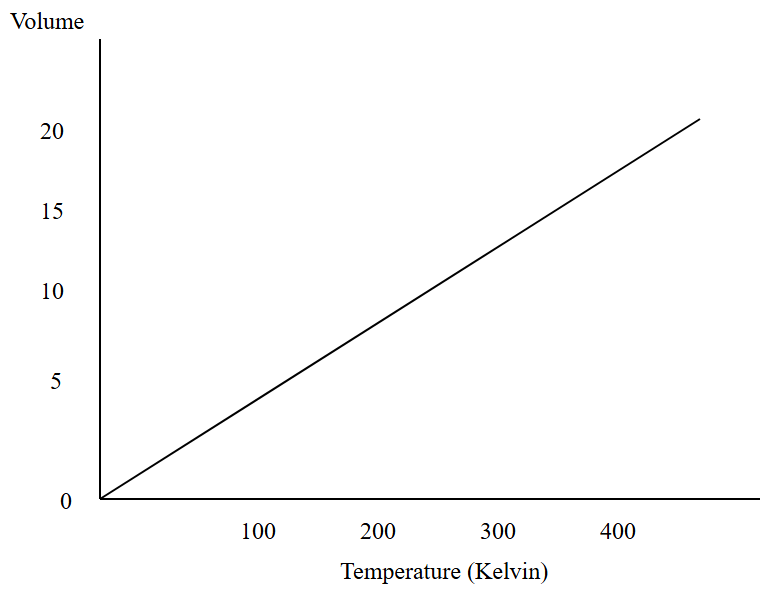
    5. Which of the gas laws does the above graph illustrate?
    Figure for: Which of the gas laws does the above graph illustrate?
    1. A.Boyle
    2. B.Charles
    3. C.Graham
    4. D.Gay-Lussac
  6. Chemistry1988Gas Laws
    6. An increase in temperature causes an increase in the pressure in the gas because of an increase in the
    1. A.average velocity of the molecules
    2. B.number of collisions between the molecules
    3. C.density of the molecules
    4. D.free mean path between each molecules and other.
  7. Chemistry1988Chemical Bonding
    7. The forces holding naphthalene crystal together can be overcome when naphthalene is heated to a temperature of 354 K resulting in the crystals melting. These forces are known as.
    1. A.coulombic
    2. B.ionic
    3. C.covalent
    4. D.van der Waals
  8. Chemistry1988Atomic Structure
    8. A metallic ion X2+\mathrm{X^{2+}} with an inert gas structure contains 18 electrons. How many protons are there in this ion?
    1. A.20
    2. B.18
    3. C.16
    4. D.2
  9. Chemistry1988Periodic Table
    9. Which of the following physical properties decreases across the periodic table.
    1. A.Ionization potential
    2. B.Electron affinity
    3. C.Electronegativity
    4. D.Atomic radius
  10. Chemistry1988Redox Reactions
    10. What are the possible oxidation numbers for an element if its atomic number is 17?
    1. A.-1 and 7
    2. B.-1 and 6
    3. C.-3 and 5
    4. D.-2 and 6
  11. Chemistry1988Atomic Structure
    11. The energy change accompanying the addition of an electron to a gaseous atom is called
    1. A.first ionization energy
    2. B.second ionization energy
    3. C.electron affinity
    4. D.electronegativity
  12. Chemistry1988Redox Reactions
    12. An eruption polluted an environment with a gas suspected to be H2S\mathrm{H_2S}, a poisonous gas. A rescue team should spray the environment with
    1. A.water
    2. B.moist SO2\mathrm{SO_2}
    3. C.acidified KMnO4\mathrm{KMnO_4} and water
    4. D.water, acidified KMnO4\mathrm{KMnO_4} and oxygen.
  13. Chemistry1988Stoichiometry
    13. 1.34 g of hydrated sodium tetraoxosulphate (VI) was heated to give an anhydrous salt weighing 0.71 g. The formula of the hydrated salt is [Na = 23, S = 32, O = 16, H = 1].
    1. A.Na2SO4.7H2O\mathrm{Na_2SO_4.7H_2O}
    2. B.Na2SO4.3H2O\mathrm{Na_2SO_4.3H_2O}
    3. C.Na2SO4.2H2O\mathrm{Na_2SO_4.2H_2O}
    4. D.Na2SO4.H2O\mathrm{Na_2SO_4.H_2O}
  14. Chemistry1988Water, Solutions and Solubility
    14. The ion that may be assumed to have negligible concentration in a sample of water that lathers readily with soap is
    1. A.Mg2+\mathrm{Mg^{2+}}
    2. B.K+\mathrm{K^+}
    3. C.CO32−\mathrm{CO_3^{2-}}
    4. D.HCO3−\mathrm{HCO_3^-}
  15. Chemistry1988Water, Solutions and Solubility
    15. A substance S is isomorphous with another substance R. When a tiny crystal of R is added to a saturated solution of S,
    1. A.S dissolves in the solution
    2. B.Crystals of R are precipitated
    3. C.There is no observable change
    4. D.R and S react to generate heat.
  16. Chemistry1988Acids, Bases and Salts
    16. Which of the following dilute solutions has the lowest pH value?
    1. A.Calcium trioxocarbonate(IV)
    2. B.Sodium trioxocarbonate(IV)
    3. C.hydrochloric acid
    4. D.ethanoic acid
  17. Chemistry1988Acids, Bases and Salts
    17. Which of the following in aqueous solution does not change the colour of litmus?
    1. A.NH4Cl\mathrm{NH_4Cl}
    2. B.Na2CO3\mathrm{Na_2CO_3}
    3. C.FeCl3\mathrm{FeCl_3}
    4. D.NaCl.
  18. Chemistry1988Stoichiometry
    18. What volume of a 0.1 M H3PO4\mathrm{H_3PO_4} will be required to neutralize 45.0 cm345.0\,\mathrm{cm^3} of a 0.2 M NaOH?
    1. A.10.0 cm310.0\,\mathrm{cm^3}
    2. B.20.0 cm320.0\,\mathrm{cm^3}
    3. C.27.0 cm327.0\,\mathrm{cm^3}
    4. D.30.0 cm330.0\,\mathrm{cm^3}
  19. Chemistry1988Acids, Bases and Salts
    19. Which of the following substances is a basic salt?
    1. A.Na2CO3\mathrm{Na_2CO_3}
    2. B.Mg(OH)Cl
    3. C.NaHCO3\mathrm{NaHCO_3}
    4. D.K2SO4.Al2(SO4)3.24H2O\mathrm{K_2SO_4.Al_2(SO_4)_3.24H_2O}.
  20. Chemistry1988Redox Reactions
    20. Which of the following acts both as reducing and an oxidizing agent?
    1. A.H2\mathrm{H_2}
    2. B.SO2\mathrm{SO_2}
    3. C.H2S\mathrm{H_2S}
    4. D.C

Other JAMB Chemistry papers