JAMB Chemistry 2001 past questions

43 questions from the 2001 paper, showing 1–20. Try each one, then open the solution to check your answer. Sign in to see the worked explanations.

  1. Chemistry2001Gas Laws
    1. 25cm3\mathrm{cm^3} of a gas X contains Z molecules at 15°C and 75 mm Hg. How many molecules will 25cm3\mathrm{cm^3} of another gas Y contain at the same temperature and pressure?
    1. A.2Y
    2. B.2Z
    3. C.Y
    4. D.Z
  2. Chemistry2001Stoichiometry
    2. What mass of water is produced when 8.0g of hydrogen reacts with excess oxygen?
    1. A.72.0g
    2. B.36.0g
    3. C.16.0g
    4. D.8.0g
  3. Chemistry2001Separation Techniques
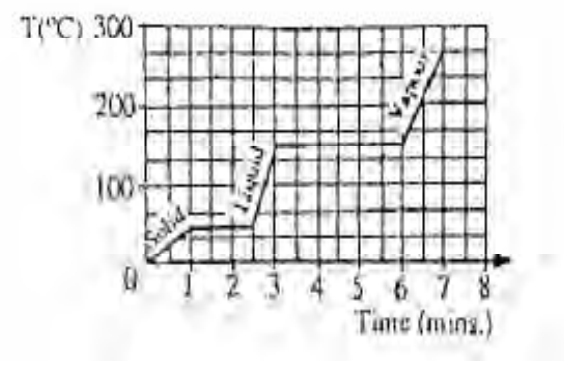
    3. If the gas is cooled, at what temperature will it start to condense?
    Figure for: If the gas is cooled, at what temperature will it start to condense?
    1. A.175°C
    2. B.250°C
    3. C.125°C
    4. D.150°C
  4. Chemistry2001Periodic Table
    4. Four elements W, X, Y and Z have atomic numbers 2, 6, 16 and 20 respectively. Which of these elements is a metal?
    1. A.X
    2. B.Z
    3. C.W
    4. D.Y
  5. Chemistry2001Atomic Structure
    5. An element X with relative atomic mass 16.2 contains two isotopes 816X^{16}_{8}X with relative abundance of 90% and 8mX^{m}_{8}X with relative abundance of 10%. The value of m is
    1. A.14
    2. B.12
    3. C.18
    4. D.16
  6. Chemistry2001Atomic Structure
    6. Cancerous growth are cured by exposure to
    1. A.x-rays
    2. B.beta-rays
    3. C.alpha-rays
    4. D.gamma-rays
  7. Chemistry2001Gas Laws
    7. Which of the following statement is correct about the average kinetic energy of the molecules of a gas?
    1. A.it increases with increase in pressure
    2. B.it increases with increase in temperature
    3. C.It increases with increase in volume
    4. D.It increases at constant pressure.
  8. Chemistry2001Atomic Structure
    8. Millikan's contribution to the development of atomic theory is the determination of
    1. A.positive rays
    2. B.cathode rays
    3. C.charge to mass ratio
    4. D.charge on electron.
  9. Chemistry2001Atomic Structure
    9. A particle that contains 9 protons, 10 neutrons and 10 electrons is
    1. A.positive ion
    2. B.neutral atom of a metal
    3. C.neutral atom of a non-metal
    4. D.negative ion.
  10. Chemistry2001Stoichiometry
    10. An oxide XO2\mathrm{XO_2} has a vapour density of 32. What is the atomic mass of X?
    1. A.20
    2. B.32
    3. C.14
    4. D.12
  11. Chemistry2001Water, Solutions and Solubility
    11. The chemical used for coagulation in water purification is
    1. A.copper tetraoxosulphate (VI)
    2. B.sodium tetraoxosulphate (VI)
    3. C.aluminium tetraoxosulphate (VI)
    4. D.calcium tetraoxosulphate (VI)
  12. Chemistry2001Water, Solutions and Solubility
    12. Environment pollution is worsened by the release from automobile exhausts of
    1. A.heavy metals
    2. B.water vapour
    3. C.smoke
    4. D.steam
  13. Chemistry2001Metals and Non-metals
    13. Phosphorus is stored under water to prevent it from
    1. A.smelling
    2. B.dehydrating
    3. C.catching fire
    4. D.becoming inert
  14. Chemistry2001Separation Techniques
    14. Pure solvents are obtained by
    1. A.evaporation
    2. B.extraction
    3. C.condensation
    4. D.distillation
  15. Chemistry2001Water, Solutions and Solubility
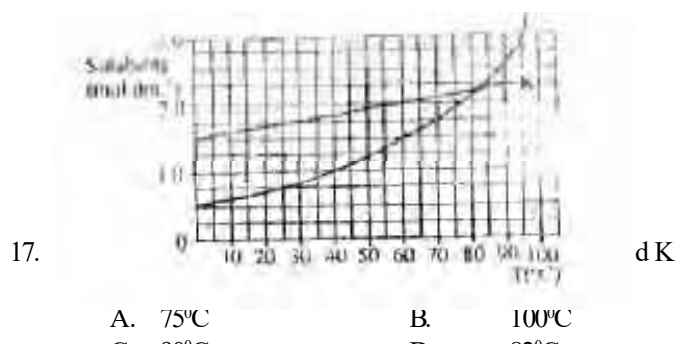
    15. At what temperature are the solubilities of L and K the same?
    Figure for: At what temperature are the solubilities of L and K the same?
    1. A.75∘C75^\circ\mathrm{C}
    2. B.100∘C100^\circ\mathrm{C}
    3. C.90∘C90^\circ\mathrm{C}
    4. D.82∘C82^\circ\mathrm{C}
  16. Chemistry2001Water, Solutions and Solubility
    16. Deliquescent substance are used for
    1. A.drying
    2. B.melting
    3. C.wetting
    4. D.cooling
  17. Chemistry2001Gas Laws
    17. What is the decrease in volume of air when pyrogallol is shaken with 30.00 cm330.00\,\mathrm{cm^3} of air?
    1. A.0.63 cm30.63\,\mathrm{cm^3}
    2. B.0.06 cm30.06\,\mathrm{cm^3}
    3. C.15.00 cm315.00\,\mathrm{cm^3}
    4. D.6.30 cm36.30\,\mathrm{cm^3}
  18. Chemistry2001Water, Solutions and Solubility
    18. The pollution from petroleum spillage in rivers and lakes can best be dispersed by
    1. A.passing of ships through the area
    2. B.pouring detergents
    3. C.pouring organic solvents
    4. D.evaporation
  19. Chemistry2001Redox Reactions
    19. 3Cu(s)+8HNO3(aq)→3Cu(NO3)2(aq)+4H2O(l)+2NO(g)3\mathrm{Cu(s)} + 8\mathrm{HNO_3(aq)} \rightarrow 3\mathrm{Cu(NO_3)_2(aq)} + 4\mathrm{H_2O(l)} + 2\mathrm{NO(g)} In the equation above, copper is
    1. A.a base
    2. B.an oxidizing agent
    3. C.a reducing agent
    4. D.an electron acceptor.
  20. Chemistry2001Energy Changes
    20. NH3(g)+HCl(g)→NH4Cl(s)\mathrm{NH_3(g)} + \mathrm{HCl(g)} \rightarrow \mathrm{NH_4Cl(s)} The entropy change in the system above is
    1. A.zero
    2. B.indeterminate
    3. C.positive
    4. D.negative

Other JAMB Chemistry papers