JAMB Chemistry 1994 past questions

44 questions from the 1994 paper, showing 1–20. Try each one, then open the solution to check your answer. Sign in to see the worked explanations.

  1. Chemistry1994Separation Techniques
    1. A mixture of sand, ammonium chloride and sodium chloride is best separated by
    1. A.sublimation followed by addition of water and filtration
    2. B.sublimation followed by addition of water and evaporation
    3. C.addition of water followed by filtration and sublimation
    4. D.addition of water followed by crystallization and sublimation.
  2. Chemistry1994Separation Techniques
    2. A pure solid usually melts
    1. A.over a wide range of temperature
    2. B.over a narrow range of temperature
    3. C.at a lower temperature than the impure one
    4. D.at the same temperature as the impure one.
  3. Chemistry1994Gas Laws
    3. At the same temperature and pressure, 50 cm3\mathrm{cm^3} of nitrogen gas contains the same number of molecules as
    1. A.25 cm3\mathrm{cm^3} of methane
    2. B.40 cm3\mathrm{cm^3} of hydrogen
    3. C.50 cm3\mathrm{cm^3} of ammonia
    4. D.100 cm3\mathrm{cm^3} of chlorine
  4. Chemistry1994Gas Laws
    4. 8 g CH4\mathrm{CH_4} occupies 11.2 dm3\mathrm{dm^3} at s.t.p. What volume would 22 g of CH3CH2CH3\mathrm{CH_3CH_2CH_3} occupy under the same condition? [C = 12, H = 1]
    1. A.3.7 dm3\mathrm{dm^3}
    2. B.11.2 dm3\mathrm{dm^3}
    3. C.22.4 dm3\mathrm{dm^3}
    4. D.33.6 dm3\mathrm{dm^3}
  5. Chemistry1994Gas Laws
    5. To what temperature must a gas at 273 K be heated in order to double both its volume and pressure?
    1. A.298 K
    2. B.546 K
    3. C.819 K
    4. D.1092 K
  6. Chemistry1994Gas Laws
    6. For a gas, the relative molecular mass is equal to 2Y. What is Y?
    1. A.The mass of the gas
    2. B.The vapour density of the gas
    3. C.The volume of the gas
    4. D.The temperature of the gas
  7. Chemistry1994Gas Laws
    7. The densities of two gases, X and Y are 0.5 g dm−3\mathrm{g\,dm^{-3}} and 2.0 g dm−3\mathrm{g\,dm^{-3}} respectively. What is the rate of diffusion of X relative to Y?
    1. A.0.1
    2. B.0.5
    3. C.2.0
    4. D.4.0
  8. Chemistry1994Gas Laws
    8. An increase in temperature causes an increase in the pressure of a gas because
    1. A.it decreases the number of collision between the molecules
    2. B.the molecules of the gas bombard the walls of the container more frequently
    3. C.it increase the number of collision between the molecules
    4. D.it causes the molecules to combine
  9. Chemistry1994Chemical Bonding
    9. The shape of ammonia molecules is
    1. A.trigonal planar
    2. B.octahedral
    3. C.square planar
    4. D.tetrahedral.
  10. Chemistry1994Atomic Structure
    10. The number of electrons in the valence shell of an element of atomic number 14 is
    1. A.1
    2. B.2
    3. C.3
    4. D.4
  11. Chemistry1994Periodic Table
    11. Which of the following physical properties decreases down a group in the periodic table?
    1. A.Atomic radius
    2. B.Ionic radius
    3. C.Electropositivity
    4. D.Electronegativity.
  12. Chemistry1994Atomic Structure
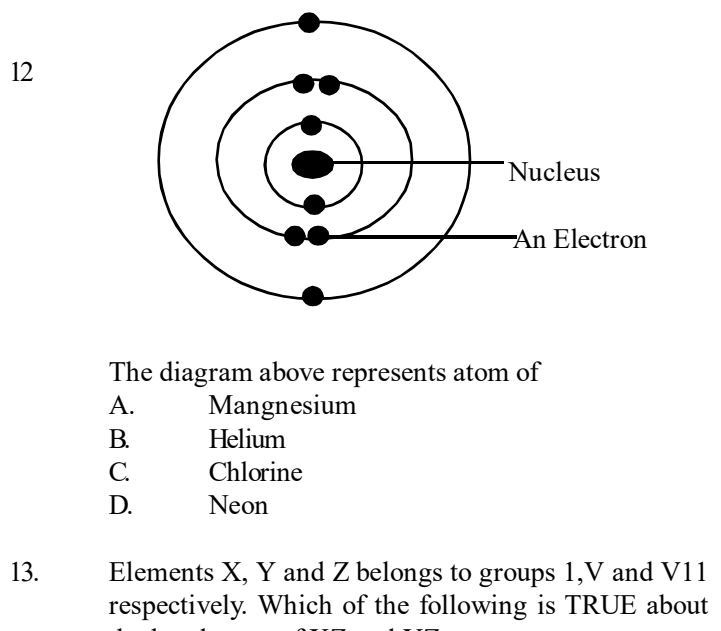
    12. The diagram above represents atom of
    Figure for: The diagram above represents atom of
    1. A.Magnesium
    2. B.Helium
    3. C.Chlorine
    4. D.Neon
  13. Chemistry1994Chemical Bonding
    13. Elements X, Y and Z belongs to groups I, V and VII respectively. Which of the following is TRUE about the bond types of XZ and YZ3\mathrm{YZ_3}
    1. A.Both are electrovalent
    2. B.Both are covalent
    3. C.XZ is electrovalent and YZ3\mathrm{YZ_3} is covalent
    4. D.XZ is covalent and YZ3\mathrm{YZ_3} is electrovalent.
  14. Chemistry1994Atomic Structure
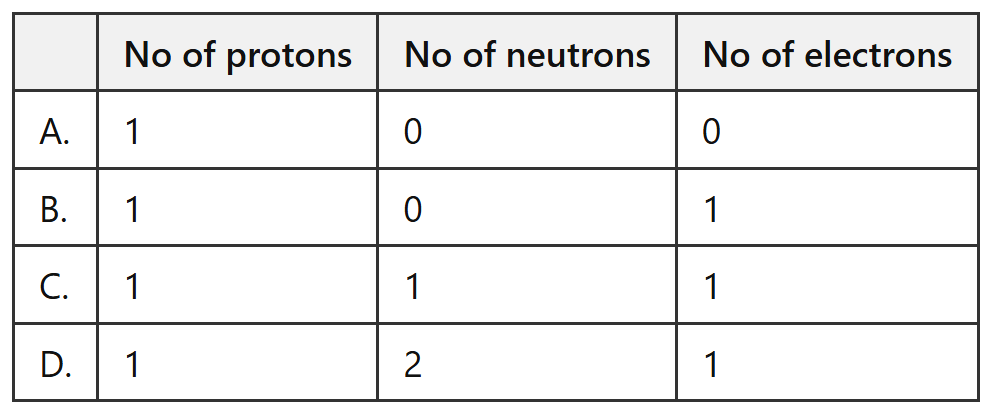
    14. Which of the following atoms represents deuterium?
    Figure for: Which of the following atoms represents deuterium?
    1. A.1 proton, 0 neutrons, 0 electrons
    2. B.1 proton, 0 neutrons, 1 electron
    3. C.1 proton, 1 neutron, 1 electron
    4. D.1 proton, 2 neutrons, 1 electron
  15. Chemistry1994Water, Solutions and Solubility
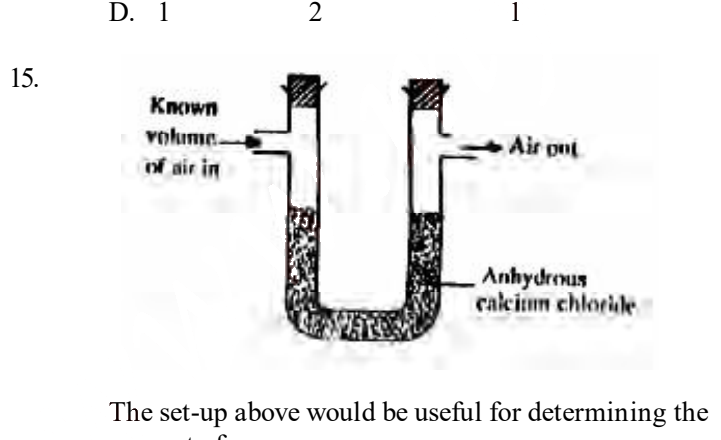
    15. The set-up above would be useful for determining the amount of
    Figure for: The set-up above would be useful for determining the amount of
    1. A.Oxygen in air
    2. B.Water vapour in air
    3. C.CO2\mathrm{CO_2} in air
    4. D.Argon in air.
  16. Chemistry1994Water, Solutions and Solubility
    16. A solid that absorbs water from the atmosphere and forms an aqueous solution is
    1. A.hydrophilic
    2. B.efflorescent
    3. C.deliquescent
    4. D.hygroscopic
  17. Chemistry1994Water, Solutions and Solubility
    17. A major effect of oil pollution in coastal water is the
    1. A.destruction of marine life
    2. B.desalination of water
    3. C.increase in the acidity of the water
    4. D.detoxification of the water.
  18. Chemistry1994Water, Solutions and Solubility
    18. Sodium chloride has no solubility product value because of its.
    1. A.saline nature
    2. B.high solubility
    3. C.low solubility
    4. D.insolubility
  19. Chemistry1994Stoichiometry
    19. The solubility in moles per dm3\mathrm{dm^3} of 20.2 g of potassium trioxonitrate (V) dissolved in 100 g of water at room temperature is [K = 39, O = 16, N = 14]
    1. A.0.10
    2. B.0.20
    3. C.1.00
    4. D.2.00
  20. Chemistry1994Acids, Bases and Salts
    20. A few drops of concentrated HCl are added to about 10 cm3\mathrm{cm^3} of a solution of pH 3.4. The pH of the resulting mixture is
    1. A.less than 3.4
    2. B.greater than 3.4
    3. C.unaltered
    4. D.the same as that of pure water

Other JAMB Chemistry papers