JAMB Chemistry 2004 past questions

46 questions from the 2004 paper, showing 1–20. Try each one, then open the solution to check your answer. Sign in to see the worked explanations.

  1. Chemistry2004Electrochemistry
    1. In the electrolysis of brine, the anode is
    1. A.Zinc
    2. B.Platinum
    3. C.Carbon
    4. D.Copper.
  2. Chemistry2004Equilibrium
    2. N2O4(g)⇌2NO2(g)N_2O_{4(g)} \rightleftharpoons 2NO_{2(g)} In the endothermic reaction above, more product formation will be favoured by
    1. A.a decrease in pressure
    2. B.a decrease in volume
    3. C.an increase in pressure
    4. D.a constant volume
  3. Chemistry2004Redox Reactions
    3. The oxidation state of Chlorine in HClO4HClO_4 is
    1. A.-1
    2. B.–5
    3. C.+7
    4. D.+1
  4. Chemistry2004Energy Changes
    4. Which of the following hydrogen halides has the highest entropy value?
    1. A.HBr
    2. B.HF
    3. C.HI
    4. D.HCl
  5. Chemistry2004Electrochemistry
    5. The mass of silver deposited when a current of 10A is passed through a solution of silver salt for 4830s is [Ag = 108, F = 96500 C mol−1^{-1}]
    1. A.54.0 g
    2. B.27.0 g
    3. C.13.5 g
    4. D.108.0 g
  6. Chemistry2004Redox Reactions
    6. Which of the following acts as both a reducing and an oxidizing agent?
    1. A.H2SH_2S
    2. B.CO2CO_2
    3. C.H2H_2
    4. D.SO2SO_2
  7. Chemistry2004Equilibrium
    7. Which of the following shows little or not net reaction when the volume of the system is decreased?
    1. A.2O3(g)⇌3O2(g)2O_{3(g)} \rightleftharpoons 3O_{2(g)}
    2. B.H2(g)+I2(g)⇌2HI(g)H_{2(g)} + I_{2(g)} \rightleftharpoons 2HI_{(g)}
    3. C.2NO2(g)⇌N2O4(g)2NO_{2(g)} \rightleftharpoons N_2O_{4(g)}
    4. D.PCl5(g)⇌PCl3(g)+Cl2(g)PCl_{5(g)} \rightleftharpoons PCl_{3(g)} + Cl_{2(g)}
  8. Chemistry2004Redox Reactions
    8. ZnO+CO→Zn+CO2ZnO + CO \rightarrow Zn + CO_2 In the reaction above, Zinc has been
    1. A.displaced
    2. B.oxidized
    3. C.reduced
    4. D.decomposed.
  9. Chemistry2004Stoichiometry
    9. What volume of gas is evolved at s.t.p. if 2g of Calcium trioxocarbonate(IV) is added to a solution of hydrochloric acid? [Ca = 40, C=12, O=16, Cl =35.5, H= 1, Molar volume of a gas at s.t.p =22.4 dm3^3]
    1. A.224 cm3^3
    2. B.112 cm3^3
    3. C.2240 cm3^3
    4. D.448 cm3^3
  10. Chemistry2004Stoichiometry
    10. A chemical reaction is always associated with
    1. A.a change in the nature of the reactants
    2. B.the formation of new substances
    3. C.a change in the volume of the reactants
    4. D.an increase in the composition of one of the substances,
  11. Chemistry2004Separation Techniques
    11. When a solid substance disappears completely as a gas on heating, the substance is said to have undergone.
    1. A.sublimation
    2. B.crystallization
    3. C.distillation
    4. D.evaporation
  12. Chemistry2004Stoichiometry
    12. If a solution contains 4.9g of tetraoxosulphate (VI) acid, calculate the amount of copper (II) oxide that will react with it [Cu = 64, O =16, S =32, H=1]
    1. A.40.0 g
    2. B.80.0 g
    3. C.0.8 g
    4. D.4.0 g
  13. Chemistry2004Organic Chemistry
    13. Vulcanization involves the removal of
    1. A.the single bond
    2. B.a double bond
    3. C.a polymer
    4. D.a monomer
  14. Chemistry2004Organic Chemistry
    14. The alkyl group can be represented by the general formula.
    1. A.CnH2nC_nH_{2n}
    2. B.CnH2n−2C_nH_{2n-2}
    3. C.CnH2n+1C_nH_{2n+1}
    4. D.CnH2n+2C_nH_{2n+2}
  15. Chemistry2004Organic Chemistry
    15. C2H5OH(aq)→180∘CConc. H2SO4YC_2H_5OH_{(aq)} \xrightarrow[180^\circ C]{Conc.\ H_2SO_4} Y In the reaction above, Y represent
    1. A.C2H5COOHC_2H_5COOH
    2. B.CH4CH_4
    3. C.CH3OCH3CH_3OCH_3
    4. D.C2H4C_2H_4
  16. Chemistry2004Organic Chemistry
    16. In the production of soap, concentrated sodium chloride is added to
    1. A.saponify the soap
    2. B.emulsify the soap
    3. C.decrease the solubility of the soap
    4. D.increase the solubility of the soap
  17. Chemistry2004Energy Changes
    17. Oxyacetylene flame is used for iron-welding because it
    1. A.evolves a lot of heat when burnt
    2. B.dissociates to produce carbon (IV) oxide and oxygen
    3. C.makes the iron metal solidify very quickly
    4. D.combines with oxygen give a pop sound.
  18. Chemistry2004Organic Chemistry
    18. Which of these reagents can confirm the presence of a triple bond?
    1. A.Bromine gas
    2. B.Bromine water
    3. C.Acidified KMnO4KMnO_4
    4. D.Copper (I) chloride
  19. Chemistry2004Organic Chemistry
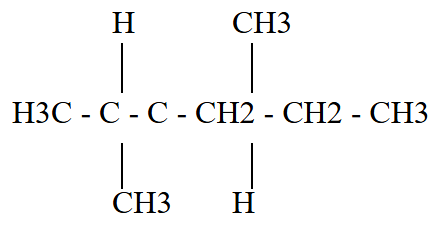
    19. The structure is H3C−CH(CH3)−CH(CH3)−CH2−CH2−CH3H_3C-CH(CH_3)-CH(CH_3)-CH_2-CH_2-CH_3 (a CH3_3 on each of carbons 2 and 3 of the main chain). The IUPAC nomenclature of the compound above is
    Figure for: The structure is H3C-CH(CH3)-CH(CH3)-CH2-CH2-CH3 (a CH _3 on each of carbons 2 and 3 of the main…
    1. A.3,4 -dimethylhexane
    2. B.2,3 –dimethylhexane
    3. C.2 – ethylhexane
    4. D.2 – ethylpentane
  20. Chemistry2004Organic Chemistry
    20. An isomer of C5H12C_5H_{12} is
    1. A.2 –ethyl butane
    2. B.butane
    3. C.2- methyl butane
    4. D.2- methyl propane

Other JAMB Chemistry papers