JAMB Chemistry 1995 past questions

47 questions from the 1995 paper, showing 1–20. Try each one, then open the solution to check your answer. Sign in to see the worked explanations.

  1. Chemistry1995Separation Techniques
    1. Chromatography is used to separate components of mixtures which differ in their rates of
    1. A.diffusion
    2. B.migration
    3. C.reaction
    4. D.sedimentation.
  2. Chemistry1995Energy Changes
    2. Which of the following is an example of chemical change?
    1. A.Dissolution of salt in water.
    2. B.Rusting of iron
    3. C.Melting of ice.
    4. D.Separating a mixture by distillation.
  3. Chemistry1995Stoichiometry
    3. What volume of oxygen will remain after reacting 8 cm3\mathrm{cm^3} of hydrogen with 20 cm3\mathrm{cm^3} of oxygen?
    1. A.10 cm3\mathrm{cm^3}
    2. B.12 cm3\mathrm{cm^3}
    3. C.14 cm3\mathrm{cm^3}
    4. D.16 cm3\mathrm{cm^3}.
  4. Chemistry1995Gas Laws
    4. A gas sample with initial volume of 3.25 dm3\mathrm{dm^3} is heated and allowed to expand to 9.75 dm3\mathrm{dm^3} at constant pressure. What is the ratio of the final absolute temperature to the initial absolute temperature?
    1. A.3:1
    2. B.5:2
    3. C.5:4
    4. D.8:3
  5. Chemistry1995Gas Laws
    5. Two cylinders A and B each contain 30 cm3\mathrm{cm^3} of oxygen and nitrogen respectively at the same temperature and pressure. If there are 5.0 moles of nitrogen, then the mass of oxygen is
    1. A.3.2 g
    2. B.6.4 g
    3. C.80.0 g
    4. D.160.0 g.
  6. Chemistry1995Water, Solutions and Solubility
    6. A liquid begins to boil when
    1. A.its vapour pressure is equal to vapour pressure of its solid at the given temperature
    2. B.molecules start escaping from its surface
    3. C.its vapour pressure equals the atmospheric pressure
    4. D.its volume is slightly increased.
  7. Chemistry1995Atomic Structure
    7. A particle that contains 8 protons, 9 neutrons and 7 electrons could be written as
    1. A.816O^{16}_{8}\mathrm{O}
    2. B.817O+^{17}_{8}\mathrm{O}^+
    3. C.917O+^{17}_{9}\mathrm{O}^+
    4. D.817O^{17}_{8}\mathrm{O}.
  8. Chemistry1995Periodic Table
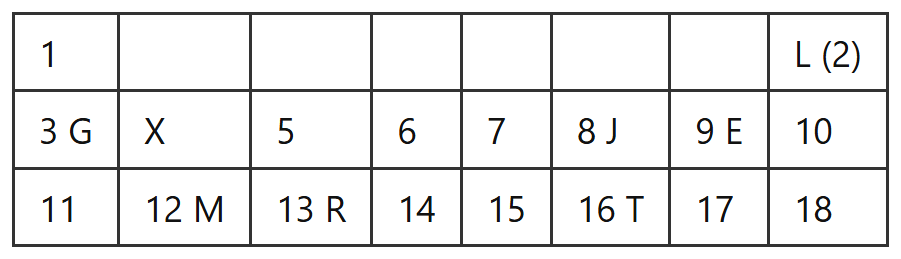
    8. Use the section of the periodic table below to answer questions 9 and 10. Which of the letters indicate an alkali metal and a noble gas respectively?
    Figure for: Use the section of the periodic table below to answer questions 9 and 10. Which of the letters…
    1. A.M and E.
    2. B.G and E.
    3. C.R and L.
    4. D.G and L.
  9. Chemistry1995Periodic Table
    9. Which letter represents a non-metal that is a solid at room temperature?
    Figure for: Which letter represents a non-metal that is a solid at room temperature?
    1. A.T
    2. B.R.
    3. C.J.
    4. D.X.
  10. Chemistry1995Atomic Structure
    10. In the oil drop experiment, Millikan determined the
    1. A.charge to mass ratio of the electron
    2. B.mass of the electron
    3. C.charge of the electron
    4. D.mass of the proton.
  11. Chemistry1995Chemical Bonding
    11. The stability of ionic solids is generally due to the
    1. A.negative electron affinity of most atoms
    2. B.crystal lattice forces
    3. C.electron pair sharing
    4. D.positive ionization potentials.
  12. Chemistry1995Atomic Structure
    12. Which of the following statements is FALSE about isotopes of the same element?
    1. A.They have the same number of electrons in their outermost shells.
    2. B.they have different atomic masses.
    3. C.They have the same atomic number and the same number of electrons.
    4. D.they have the same atomic number but different number of electrons.
  13. Chemistry1995Periodic Table
    13. Helium is often used in observation balloons because it is
    1. A.light and combustible
    2. B.light and non-combustible
    3. C.heavy and combustible
    4. D.heavy and non-combustible.
  14. Chemistry1995Water, Solutions and Solubility
    14. Deliquescent substances are also
    1. A.efflorescent
    2. B.anhydrous
    3. C.hygroscopic
    4. D.insoluble.
  15. Chemistry1995Water, Solutions and Solubility
    15. The difference between colloids and suspensions is brought out clearly by the fact that while colloids
    1. A.do not scatter light, suspensions cannot be so separated
    2. B.can be separated by filtration, suspension cannot be separated
    3. C.can be separated by a membrane, suspensions cannot
    4. D.do not settle out on standing, suspensions do.
  16. Chemistry1995Water, Solutions and Solubility
    16. In general, an increase in temperature increases the solubility of a solute in water because
    1. A.more solute molecules collide with each other
    2. B.most solutes dissolve with the evolution of heat
    3. C.more solute molecules dissociate at higher temperature
    4. D.most solutes dissolve with absorption of heat.
  17. Chemistry1995Acids, Bases and Salts
    17. Neutralization involves a reaction between H3O+\mathrm{H_3O^+} and
    1. A.Cl−\mathrm{Cl^-}
    2. B.OH−\mathrm{OH^-}
    3. C.NO3−\mathrm{NO_3^-}
    4. D.CO32−\mathrm{CO_3^{2-}}.
  18. Chemistry1995Acids, Bases and Salts
    18. Which of the following solutions will have a pH < 7?
    1. A.Na2SO4(aq)\mathrm{Na_2SO_4(aq)}
    2. B.NaCl(aq)
    3. C.Na2CO3(aq)\mathrm{Na_2CO_3(aq)}
    4. D.NH4Cl(aq)\mathrm{NH_4Cl(aq)}.
  19. Chemistry1995Acids, Bases and Salts
    19. What is the pH of a 2.50×10−52.50\times10^{-5} M solution of sodium hydroxide?
    1. A.3.6
    2. B.5.0
    3. C.9.4
    4. D.12.0.
  20. Chemistry1995Acids, Bases and Salts
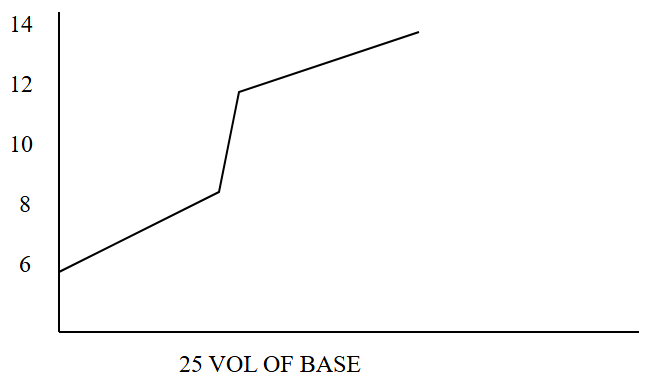
    20. The graph above shows the pH changes for the titration of a
    Figure for: The graph above shows the pH changes for the titration of a
    1. A.strong acid versus strong base
    2. B.weak acid versus strong base
    3. C.strong acid versus weak base.
    4. D.weak acid versus weak base.

Other JAMB Chemistry papers