JAMB Chemistry 1986 past questions

42 questions from the 1986 paper, showing 1–20. Try each one, then open the solution to check your answer. Sign in to see the worked explanations.

  1. Chemistry1986Gas Laws
    1. The movement of liquid molecules from the surface of the liquid to the gaseous phase above it is known as
    1. A.Brownian movement
    2. B.Condensation
    3. C.Evaporation
    4. D.Liquefaction
  2. Chemistry1986Gas Laws
    2. 10 cm3\mathrm{cm^3} of hydrogen fluoride gas reacts with 5 cm3\mathrm{cm^3} of dinitrogen difluoride gas (N2F2\mathrm{N_2F_2}) to form 10 cm3\mathrm{cm^3} of a single gas. Which of the following is the most likely equation for the reaction?
    1. A.HF+N2F2→N2HF3\mathrm{HF + N_2F_2 \rightarrow N_2HF_3}
    2. B.2HF+N2F2→2NHF2\mathrm{2HF + N_2F_2 \rightarrow 2NHF_2}
    3. C.2HF+N2F2→N2H2F4\mathrm{2HF + N_2F_2 \rightarrow N_2H_2F_4}
    4. D.HF+2N2F2→N4HF4\mathrm{HF + 2N_2F_2 \rightarrow N_4HF_4}
  3. Chemistry1986Stoichiometry
    3. The number of atoms of chlorine present in 5.85 g of NaCl is [Na = 23, Cl = 35.5, Avogadro's Number = 6.02×10236.02\times10^{23}]
    1. A.6.02×10226.02\times10^{22}
    2. B.5.85×10235.85\times10^{23}
    3. C.6.02×10236.02\times10^{23}
    4. D.5.85×10245.85\times10^{24}
  4. Chemistry1986Stoichiometry
    4. How much of magnesium is required to react with 250 cm3\mathrm{cm^3} of 0.5 M HCl? [Mg = 24]
    1. A.0.3 g
    2. B.1.5 g
    3. C.2.4 g
    4. D.3.0 g
  5. Chemistry1986Gas Laws
    5. 200 cm3\mathrm{cm^3} of oxygen diffuse through a porous plug in 50 seconds. How long will 80 cm3\mathrm{cm^3} of methane (CH4\mathrm{CH_4}) take to diffuse through the same porous plug under the same conditions? [C = 12, O = 16, H = 1]
    1. A.A. 20 sec
    2. B.B. 40 sec
    3. C.C. 14 sec
    4. D.D. 7 sec
  6. Chemistry1986Gas Laws
    6. The relationship between the velocity (U) of gas molecules and their relative molecule mass (M) is shown by the equation
    1. A.U^=(kM)1/2\hat U = (kM)^{1/2}
    2. B.U^=(kM)2\hat U = (kM)^2
    3. C.U^=k/M\hat U = k/M
    4. D.U^=(k/M)1/2\hat U = (k/M)^{1/2}
  7. Chemistry1986Chemical Bonding
    7. An element with atomic number twelve is likely to be
    1. A.electrovalent with a valency of 1
    2. B.electrovalent with a valency of 2
    3. C.covalent with a valency of 2
    4. D.covalent with a valency of 4
  8. Chemistry1986Periodic Table
    8. Which of the following group of physical properties increases from left to right of the periodic table? 1 Ionization energy 2 Atomic radius 3 Electronegativity 4 Electron affinity
    1. A.1 and 2
    2. B.1, 2 and 3
    3. C.3 and 4
    4. D.1, 2, 3 and 4
  9. Chemistry1986Acids, Bases and Salts
    9. Which of the following is an acid salt?
    1. A.NaHSO4\mathrm{NaHSO_4}
    2. B.Na2SO4\mathrm{Na_2SO_4}
    3. C.CH3CO2Na\mathrm{CH_3CO_2Na}
    4. D.Na2S\mathrm{Na_2S}
  10. Chemistry1986Electrochemistry
    10. Which of the following solution will conduct the least amount of electricity?
    1. A.2.00 M aqueous solution of NaOH
    2. B.0.01 M aqueous solution of NaOH
    3. C.0.01 M aqueous solution of hexanoic acid
    4. D.0.01 M aqueous solution of sugar.
  11. Chemistry1986Electrochemistry
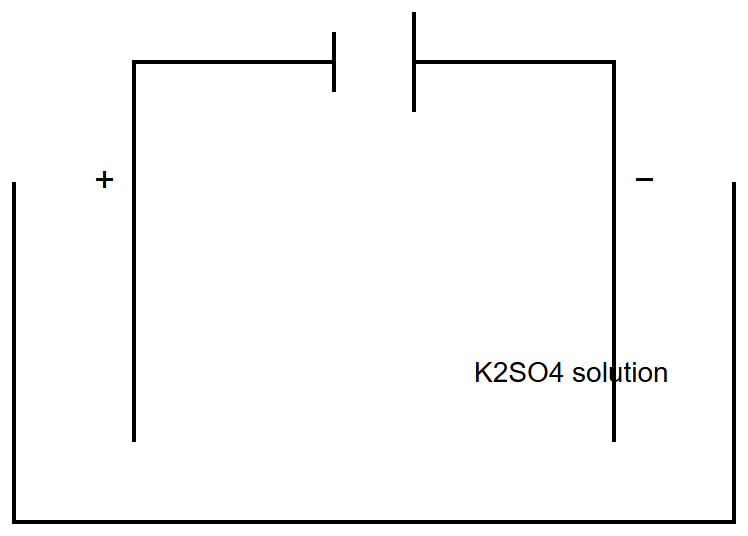
    11. In the electrolysis of aqueous solution of K2SO4\mathrm{K_2SO_4} in the above cell, which species migrate to the anode?
    Figure for: In the electrolysis of aqueous solution of K2SO4 in the above cell, which species migrate to the…
    1. A.SO42−\mathrm{SO_4^{2-}} and OH−\mathrm{OH^-}
    2. B.K+\mathrm{K^+} and SO42−\mathrm{SO_4^{2-}}
    3. C.OH−\mathrm{OH^-} and H3O+\mathrm{H_3O^+}
    4. D.H3O+\mathrm{H_3O^+} and K+\mathrm{K^+}
  12. Chemistry1986Electrochemistry
    12. How many coulombs of electricity are passed through a solution in which 6.5 amperes are allowed to run for 1.0 hour?
    1. A.3.90×1023.90\times10^2 coulombs
    2. B.5.50×1035.50\times10^3 coulombs
    3. C.6.54×1036.54\times10^3 coulombs
    4. D.2.34×1042.34\times10^4 coulombs
  13. Chemistry1986Redox Reactions
    13. Which of these represents a redox reaction?
    1. A.AgNO3+NaCl→AgCl+NaNO3\mathrm{AgNO_3 + NaCl \rightarrow AgCl + NaNO_3}
    2. B.H2S+Pb(NO3)2→PbS+2HNO3\mathrm{H_2S + Pb(NO_3)_2 \rightarrow PbS + 2HNO_3}
    3. C.CaCO3→CaO+CO2\mathrm{CaCO_3 \rightarrow CaO + CO_2}
    4. D.Zn+2HCl→ZnCl2+H2\mathrm{Zn + 2HCl \rightarrow ZnCl_2 + H_2}
  14. Chemistry1986Redox Reactions
    14. How many electrons are transferred in reducing one atom of Mn in the reaction MnO2+4HCl→MnCl2+2H2O+Cl2\mathrm{MnO_2 + 4HCl \rightarrow MnCl_2 + 2H_2O + Cl_2}
    1. A.2
    2. B.3
    3. C.4
    4. D.5
  15. Chemistry1986Energy Changes
    15. 20 cm3\mathrm{cm^3} of 0.1 molar NH4OH\mathrm{NH_4OH} solution when neutralized with 20.05 cm3\mathrm{cm^3} of 0.1 molar HCl liberated 102 Joules of heat. Calculate the heat of neutralization of NH4OH\mathrm{NH_4OH}
    1. A.−51.0 kJ mol−1-51.0\,\mathrm{kJ\,mol^{-1}}
    2. B.+57.3 kJ mol−1+57.3\,\mathrm{kJ\,mol^{-1}}
    3. C.+57.0 kJ mol−1+57.0\,\mathrm{kJ\,mol^{-1}}
    4. D.+51.0 kJ mol−1+51.0\,\mathrm{kJ\,mol^{-1}}
  16. Chemistry1986Equilibrium
    16. What is the consequence of increasing pressure on the equilibrium reaction ZnO(s)+H2(g)⇌Zn(s)+H2O(l)\mathrm{ZnO_{(s)} + H_{2(g)} \rightleftharpoons Zn_{(s)} + H_2O_{(l)}}
    1. A.The equilibrium is driven to the left
    2. B.The equilibrium is driven to the right
    3. C.There is no effect
    4. D.More ZnO(s)\mathrm{ZnO_{(s)}} is produced
  17. Chemistry1986Gas Laws
    17. The approximate volume of air containing 10 cm3\mathrm{cm^3} of oxygen is
    1. A.20 cm3\mathrm{cm^3}
    2. B.25 cm3\mathrm{cm^3}
    3. C.50 cm3\mathrm{cm^3}
    4. D.100 cm3\mathrm{cm^3}
  18. Chemistry1986Metals and Non-metals
    18. The reaction Mg+H2O→MgO+H2\mathrm{Mg + H_2O \rightarrow MgO + H_2} takes place only in the presence of
    1. A.excess Mg ribbon
    2. B.excess cold water
    3. C.very hot water
    4. D.steam
  19. Chemistry1986Metals and Non-metals
    19. When steam is passed through red hot carbon, which of the following are produced?
    1. A.Hydrogen and oxygen and carbon(IV) oxide
    2. B.Hydrogen and carbon (IV) oxide
    3. C.Hydrogen and carbon (II) oxide
    4. D.Hydrogen and trioxocarbonate(IV) acid
  20. Chemistry1986Water, Solutions and Solubility
    20. Which of the following contains an efflorescent, a deliquescent and a hygroscopic substance respectively?
    1. A.Na2SO4\mathrm{Na_2SO_4}, concentrated H2SO4\mathrm{H_2SO_4}, CaCl2\mathrm{CaCl_2}
    2. B.Na2CO3.H2O\mathrm{Na_2CO_3.H_2O}, FeSO4.7H2O\mathrm{FeSO_4.7H_2O}, concentrated H2SO4\mathrm{H_2SO_4}
    3. C.Na2CO3.10H2O\mathrm{Na_2CO_3.10H_2O}, FeCl3\mathrm{FeCl_3}, concentrated H2SO4\mathrm{H_2SO_4}
    4. D.Concentrated H2SO4\mathrm{H_2SO_4}, FeSO4.7H2O\mathrm{FeSO_4.7H_2O}, MgCl2\mathrm{MgCl_2}

Other JAMB Chemistry papers