JAMB Chemistry 1987 past questions

46 questions from the 1987 paper, showing 21–40. Try each one, then open the solution to check your answer. Sign in to see the worked explanations.

  1. Chemistry1987Electrochemistry
    21. What mass of magnesium would be obtained by passing a current of 2 amperes for 2 hrs. 30 mins through molten magnesium chloride? [1 faraday = 96500 coulombs, Mg = 24]
    1. A.1.12 g
    2. B.2.00 g
    3. C.2.24 g
    4. D.4.48 g
  2. Chemistry1987Redox Reactions
    22. In the reaction 3CuO+2NH3→3Cu+3H2O+N2\mathrm{3CuO + 2NH_3 \rightarrow 3Cu + 3H_2O + N_2} how many electrons are transferred for each mole of copper produced?
    1. A.4.0×10−234.0 \times 10^{-23}
    2. B.3.0×10−233.0 \times 10^{-23}
    3. C.1.2×10241.2 \times 10^{24}
    4. D.6.0×10246.0 \times 10^{24}
  3. Chemistry1987Organic Chemistry
    23. Z is a solid substance, which liberates carbon (IV) oxide on treatment with concentrated H2SO4\mathrm{H_2SO_4}, KMnO4\mathrm{KMnO_4}. The solid substance, Z is
    1. A.sodium hydrogen trioxocarbonate(IV)
    2. B.ethanoic acid
    3. C.iron (II) trioxocarbonate (IV)
    4. D.ethanedioic acid (oxalic acid)
  4. Chemistry1987Energy Changes
    24. 5 g of ammonium trioxonitrate (V) on dissolution in water cooled its surrounding water and container by 1.6 kJ. What is the heat of solution of NH4NO3\mathrm{NH_4NO_3}? [N = 14, O = 16, H = 1]
    1. A.+51.4 kJ mol−1\mathrm{kJ\,mol^{-1}}
    2. B.+25.6 kJ mol−1\mathrm{kJ\,mol^{-1}}
    3. C.+12.9 kJ mol−1\mathrm{kJ\,mol^{-1}}
    4. D.-6.4 kJ mol−1\mathrm{kJ\,mol^{-1}}
  5. Chemistry1987Energy Changes
    25. Tetraoxosulphate (VI) acid is prepared using the chemical reaction SO3(g)+H2O(l)→H2SO4(l)\mathrm{SO_3(g) + H_2O(l) \rightarrow H_2SO_4(l)}. Given the heat of formation for SO3(g)\mathrm{SO_3(g)}, H2O(l)\mathrm{H_2O(l)} and H2SO4(l)\mathrm{H_2SO_4(l)} as -395 kJ mol−1\mathrm{kJ\,mol^{-1}}, -286 kJ mol−1\mathrm{kJ\,mol^{-1}} and -811 kJ mol−1\mathrm{kJ\,mol^{-1}} respectively, the heat of reaction is
    1. A.-1032 kJ
    2. B.-130 kJ
    3. C.+130 kJ
    4. D.+1032 kJ
  6. Chemistry1987Chemical Kinetics
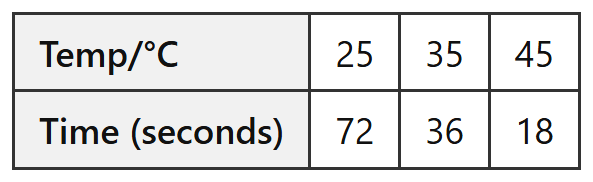
    26. The times taken for iodine to be liberated in the reaction between sodium thiosulphate and hydrochloric acid at various temperatures are as follows. These results suggest that
    Figure for: The times taken for iodine to be liberated in the reaction between sodium thiosulphate and…
    1. A.for a 10∘10^\circ rise in temperature rate of reaction is doubled
    2. B.for a 10∘10^\circ rise in temperature rate of reaction is halved
    3. C.time taken for iodine to appear does not depend on temperature
    4. D.for a 10∘10^\circ rise in temperature, rate of reaction is tripled.
  7. Chemistry1987Equilibrium
    27. The reaction between sulphur (IV) oxide and oxygen is represented by the equilibrium reaction 2SO2(g)+O2(g)⇌2SO3(g)\mathrm{2SO_2(g) + O_2(g) \rightleftharpoons 2SO_3(g)}, ΔH=−196 kJ\Delta H = -196\,\mathrm{kJ}. What factor would influence increased production of SO3(g)\mathrm{SO_3(g)}?
    1. A.Addition of a suitable catalyst
    2. B.Increase in the temperature of the reaction
    3. C.Decrease in the temperature of SO2(g)\mathrm{SO_2(g)}
    4. D.Decrease in the concentration of SO2(g)\mathrm{SO_2(g)}
  8. Chemistry1987Redox Reactions
    28. Which of the following equations correctly represents the action of hot concentrated alkaline solution on chlorine?
    1. A.Cl2(g)+2OH−(aq)→OCl−(aq)+Cl−(aq)+H2O(l)\mathrm{Cl_2(g) + 2OH^-(aq) \rightarrow OCl^-(aq) + Cl^-(aq) + H_2O(l)}
    2. B.3Cl2(g)+6OH−(aq)→ClO3−(aq)+5Cl−(aq)+3H2O(l)\mathrm{3Cl_2(g) + 6OH^-(aq) \rightarrow ClO_3^-(aq) + 5Cl^-(aq) + 3H_2O(l)}
    3. C.3Cl2(g)+6OH−(aq)→ClO3−(s)+5Cl−(aq)+3H2O(l)\mathrm{3Cl_2(g) + 6OH^-(aq) \rightarrow ClO_3^-(s) + 5Cl^-(aq) + 3H_2O(l)}
    4. D.3Cl2(g)+6OH−(aq)→5ClO3−(aq)+Cl−(aq)+3H2O(l)\mathrm{3Cl_2(g) + 6OH^-(aq) \rightarrow 5ClO_3^-(aq) + Cl^-(aq) + 3H_2O(l)}
  9. Chemistry1987Metals and Non-metals
    29. Magnesium ribbon was allowed to burn inside a given gas P leaving a white solid residue Q. Addition of water to Q liberated a gas which produced dense white fumes with a drop of hydrochloric acid. The gas P was
    1. A.nitrogen
    2. B.chlorine
    3. C.oxygen
    4. D.sulphur (IV) oxide
  10. Chemistry1987Acids, Bases and Salts
    30. The best treatment for a student who accidentally poured concentrated tetraoxosulphate(VI) acid on his skin in the laboratory is to wash the skin with
    1. A.cold water
    2. B.sodium trioxocarbonate(IV) solution
    3. C.Iodine solution
    4. D.sodium hydroxide solution
  11. Chemistry1987Periodic Table
    31. In which of the following pairs of elements is allotropy exhibited by each element?
    1. A.Phosphorus and hydrogen
    2. B.Oxygen and chlorine
    3. C.Sulphur and nitrogen
    4. D.Oxygen and sulphur.
  12. Chemistry1987Water, Solutions and Solubility
    32. Which of the following gases can best be used for demonstrating the fountain experiment? (i) Nitrogen (ii) Ammonia (iii) Nitrogen (I) oxide (iv) Hydrogen chloride
    1. A.(ii) and (iii)
    2. B.(i) and (iii)
    3. C.(ii) and (iv)
    4. D.(ii) only.
  13. Chemistry1987Acids, Bases and Salts
    33. When calcium hydroxide is heated with ammonium tetraoxosulphate (VI), the gas given off may be collected by
    1. A.bubbling it through concentrated H2SO4\mathrm{H_2SO_4}.
    2. B.Bubbling it through water and then passing it through calcium oxide
    3. C.Passing it directly through calcium oxide
    4. D.Passing it directly through calcium chloride.
  14. Chemistry1987Metals and Non-metals
    34. Stainless steel is an alloy of
    1. A.iron, carbon and silver
    2. B.iron, carbon and lead
    3. C.iron, carbon and chromium
    4. D.iron and carbon only.
  15. Chemistry1987Metals and Non-metals
    35. Alloys are best prepared by.
    1. A.high temperature arc welding of the metals
    2. B.electrolysis using the major metallic component as cathode
    3. C.reducing a mixture of the oxides of the elements
    4. D.cooling a molten mixture of the necessary elements.
  16. Chemistry1987Redox Reactions
    36. Corrosion is exhibited by.
    1. A.iron only
    2. B.electropositive metals
    3. C.metals below hydrogen in the electrochemical series
    4. D.all metals
  17. Chemistry1987Chemical Bonding
    37. In spite of the electronic configuration, 1s22s22p21s^2 2s^2 2p^2, carbon is tetravalent because
    1. A.the electrons in both 2s and 2p orbital have equal energy
    2. B.the electrons in both 2s and 2p orbital are equivalent
    3. C.both the 2s and 2p orbital hybridize
    4. D.the six orbital hybridize to four.
  18. Chemistry1987Organic Chemistry
    38. Which of the following compounds will give a precipitate with an aqueous ammoniacal solution of copper (I) chloride?
    1. A.CH3CH=CHCH3\mathrm{CH_3CH=CHCH_3}
    2. B.CH3C≡CCH3\mathrm{CH_3C\equiv CCH_3}
    3. C.CH≡C−CH2CH3\mathrm{CH\equiv C-CH_2CH_3}
    4. D.CH2=CH−CH=CH2\mathrm{CH_2=CH-CH=CH_2}
  19. Chemistry1987Organic Chemistry
    39. The efficiency of petrol as a fuel in high compression internal combustion engines improves with an increase in the amount of
    1. A.Branched chain alkanes
    2. B.Straight chain alkanes
    3. C.Cycloalkanes
    4. D.Halogenated hydrocarbons
  20. Chemistry1987Organic Chemistry
    40. A palm wine seller stoppered a bottle of his palm wine in his stall and after a few hours the bottle burst. Which of the following represents the reaction that occurred?
    1. A.C6H12O6→enzymes2C2H5OH+2CO2(g)\mathrm{C_6H_{12}O_6 \xrightarrow{enzymes} 2C_2H_5OH + 2CO_2(g)}
    2. B.C2H5OH→CH2=CH2(g)+H2O\mathrm{C_2H_5OH \rightarrow CH_2=CH_2(g) + H_2O}
    3. C.C2H5OH+dil H2SO4→C2H5OSO2OH\mathrm{C_2H_5OH + dil\ H_2SO_4 \rightarrow C_2H_5OSO_2OH}
    4. D.2C6H12O6→C12H12O13+H2O\mathrm{2C_6H_{12}O_6 \rightarrow C_{12}H_{12}O_{13} + H_2O}

Other JAMB Chemistry papers