JAMB Chemistry 1988 past questions

43 questions from the 1988 paper, showing 21–40. Try each one, then open the solution to check your answer. Sign in to see the worked explanations.

  1. Chemistry1988Electrochemistry
    21. Which of the following reactions takes place in the cathode compartment during the electrolysis of copper (II) chloride solution?
    1. A.Cu(aq)2++2e→Cu(s)\mathrm{Cu^{2+}_{(aq)} + 2e \rightarrow Cu_{(s)}}
    2. B.2Cl−−2e→Cl2\mathrm{2Cl^- - 2e \rightarrow Cl_2}
    3. C.Cu(s)−2e→Cu(aq)2+\mathrm{Cu_{(s)} - 2e \rightarrow Cu^{2+}_{(aq)}}
    4. D.Cu(aq)2++2Cl(aq)−→CuCl2(aq)\mathrm{Cu^{2+}_{(aq)} + 2Cl^-_{(aq)} \rightarrow CuCl_{2(aq)}}
  2. Chemistry1988Electrochemistry
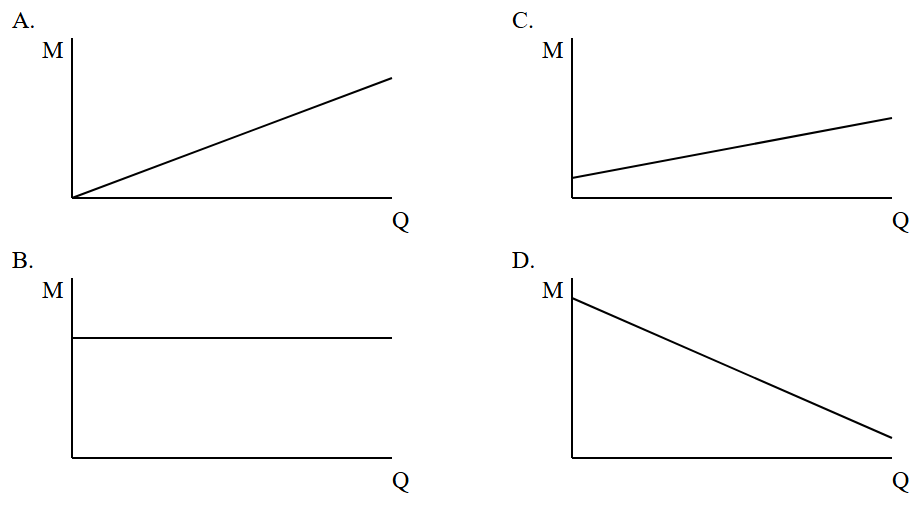
    22. The mass of a substance, M liberated at an electrode during electrolysis is proportional to the quantity of electricity, Q passing through the electrolyte. This is represented graphically by.
    Figure for: The mass of a substance, M liberated at an electrode during electrolysis is proportional to the…
    1. A.Figure A
    2. B.Figure B
    3. C.Figure C
    4. D.Figure D
  3. Chemistry1988Redox Reactions
    23. A mixture of starch solution and potassium iodide was placed in a test tube. On adding dilute tetraoxosulphate (VI) acid and then K2Cr2O7\mathrm{K_2Cr_2O_7} solutions, a blue-black colour was produced. In this reaction, the
    1. A.iodine ion is oxidized
    2. B.tetraoxosulphate(VI) acid acts as an oxidizing agent
    3. C.starch has been oxidized
    4. D.K2Cr2O7\mathrm{K_2Cr_2O_7} is oxidized.
  4. Chemistry1988Energy Changes
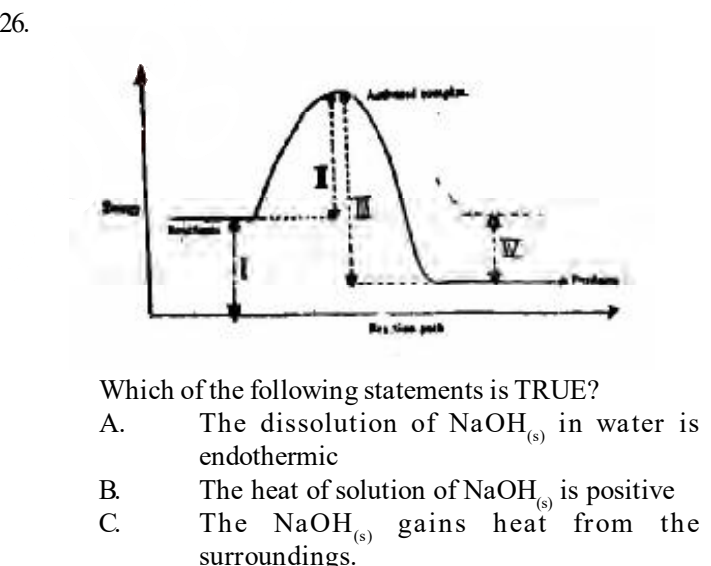
    24. Which of the following statements is TRUE?
    Figure for: Which of the following statements is TRUE?
    1. A.The dissolution of NaOH(s) in water is endothermic
    2. B.The heat of solution of NaOH(s) is positive
    3. C.The NaOH(s) gains heat from the surroundings.
    4. D.The heat of solution of NaOH(s) is negative.
  5. Chemistry1988Chemical Kinetics
    25. Which of the following will produce the greatest increase in the rate of the chemical reaction represented by the equation Na2S2O3(aq)+2HCl(aq)→2NaCl(aq)+H2O(l)+SO2(g)+S(s)\mathrm{Na_2S_2O_{3(aq)} + 2HCl_{(aq)} \rightarrow 2NaCl_{(aq)} + H_2O_{(l)} + SO_{2(g)} + S_{(s)}}?
    1. A.decrease in temperature and an increase in the concentration of the reactants
    2. B.An increase in the temperature and a decrease in the concentration of the reactants
    3. C.An increase in the temperature and an increase in the concentrations of the reactants
    4. D.A decrease in the temperature and a decrease in the concentration of the reactants.
  6. Chemistry1988Chemical Kinetics
    26. Which property of reversible reaction is affected by a catalyst?
    1. A.heat content(enthalpy)
    2. B.energy of activation
    3. C.free energy change
    4. D.equilibrium position.
  7. Chemistry1988Metals and Non-metals
    27. Which of the following is used in fire extinguishers?
    1. A.Carbon (II) oxide
    2. B.Carbon (IV) oxide
    3. C.Sulphur (IV) oxide
    4. D.Ammonia
  8. Chemistry1988Redox Reactions
    28. When H2S\mathrm{H_2S} gas is passed into a solution of iron (III) chloride, the colour changes from yellow to green. This is because
    1. A.H2S\mathrm{H_2S} is reduced to S
    2. B.Fe3+\mathrm{Fe^{3+}} ions are oxidized by H2S\mathrm{H_2S}
    3. C.H2S\mathrm{H_2S} ions are oxidized by Fe3+\mathrm{Fe^{3+}}
    4. D.Fe3+\mathrm{Fe^{3+}} ions are reduced to Fe2+\mathrm{Fe^{2+}} ions
  9. Chemistry1988Separation Techniques
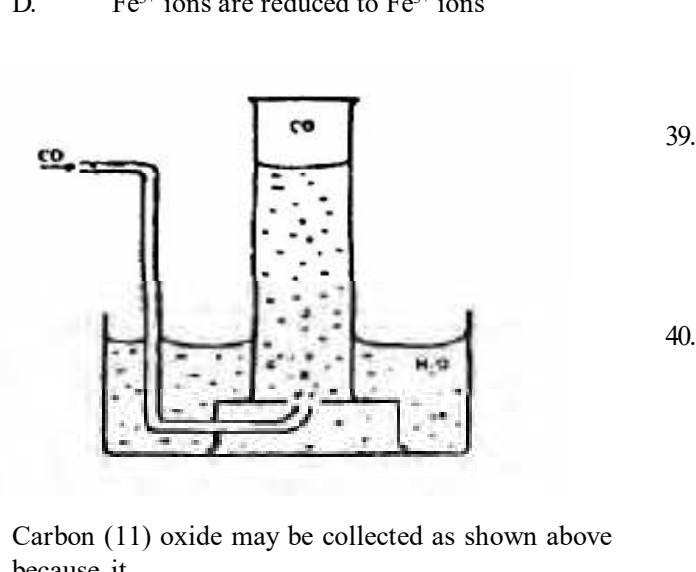
    29. Carbon (II) oxide may be collected as shown above because it
    Figure for: Carbon (II) oxide may be collected as shown above because it
    1. A.is heavier than air
    2. B.is less dense than air
    3. C.is insoluble in water
    4. D.burns in oxygen to form carbon (IV) oxide.
  10. Chemistry1988Acids, Bases and Salts
    30. In the reaction C5H10O5(s)→6C(s)+5H2O\mathrm{C_5H_{10}O_{5(s)} \rightarrow 6C_{(s)} + 5H_2O} concentrated H2SO4\mathrm{H_2SO_4} is acting as
    1. A.a reducing agent
    2. B.an oxidizing agent
    3. C.a dehydrating agent
    4. D.a catalyst
  11. Chemistry1988Metals and Non-metals
    31. Suitable reagents for the laboratory preparation of nitrogen are
    1. A.sodium trioxonitrate (III) and ammonium chloride
    2. B.sodium trioxonitrate (V) and ammonium chloride
    3. C.sodium chloride and ammonium trioxonitrate (V)
    4. D.sodium chloride and ammonium trioxonitrate (III)
  12. Chemistry1988Metals and Non-metals
    32. The thermal decomposition of copper (II) trioxonitrate (V) yields copper (II) oxide, oxygen and
    1. A.nitrogen (I) oxide
    2. B.nitrogen (II) oxide
    3. C.nitrogen (IV) oxide
    4. D.nitrogen
  13. Chemistry1988Electrochemistry
    33. Chlorine is produced commercially by
    1. A.electrolysis of dilute hydrochloric acid
    2. B.electrolysis of brine
    3. C.neutralization of hydrogen chloride
    4. D.heating potassium trioxochlorate (V) catalyst
  14. Chemistry1988Metals and Non-metals
    34. Which of the following is used in the manufacture of glass?
    1. A.Sodium chloride
    2. B.Sodium trioxocarbonate (IV)
    3. C.Sodium tetraoxosulphate (VI)
    4. D.Sodium trioxonitrate (V)
  15. Chemistry1988Metals and Non-metals
    35. Aluminium is extracted commercially from its ore by
    1. A.heating aluminium oxide with coke in a furnace
    2. B.the electrolysis of fused aluminium oxide in cryolite
    3. C.treating cryolite with sodium hydroxide solution under pressure
    4. D.heating sodium aluminium silicate to a high temperature.
  16. Chemistry1988Electrochemistry
    36. Crude copper can be purified by the electrolysis of CuSO4(aq)\mathrm{CuSO_{4(aq)}} if
    1. A.platinum electrodes are used
    2. B.the crude copper is made the anode of the cell
    3. C.the crude copper is made the cathode of the cell
    4. D.crude copper electrodes are used.
  17. Chemistry1988Organic Chemistry
    37. The IUPAC name for CH3CH2CH(CH3)COOH\mathrm{CH_3CH_2CH(CH_3)COOH} is
    1. A.2 – methylbutanoic acid
    2. B.2 – methyl – hydroxyketone
    3. C.2 – methyl – hydroxyl baldheaded
    4. D.2 – methylpentanoic acid
  18. Chemistry1988Organic Chemistry
    38. The four classes of hydrocarbons are
    1. A.ethane, ethene, ethyne and benzene
    2. B.alkanes, alkenes, alkynes and aromatics
    3. C.alkanes, alkenes, alkynes and benzene
    4. D.methane, ethane, propane and butane
  19. Chemistry1988Organic Chemistry
    39. Alkanes →catalyst400−700∘C\xrightarrow[\text{catalyst}]{400-700^\circ C} smaller alkanes + alkenes + hydrogen. The above reaction is known as
    1. A.Photolysis
    2. B.Cracking
    3. C.Isomerization
    4. D.Reforming.
  20. Chemistry1988Organic Chemistry
    40. In the reaction 2(C6H10O5)n+nH2O→diastasenC12H22O112(\mathrm{C_6H_{10}O_5})_n + n\mathrm{H_2O} \xrightarrow{\text{diastase}} n\mathrm{C_{12}H_{22}O_{11}} diastase is functioning as
    1. A.a dehydrating agent
    2. B.a reducing agent
    3. C.an oxidizing agent
    4. D.a catalyst.

Other JAMB Chemistry papers