JAMB Chemistry 1989 past questions

44 questions from the 1989 paper, showing 21–40. Try each one, then open the solution to check your answer. Sign in to see the worked explanations.

  1. Chemistry1989Redox Reactions
    21. An element, Z forms an anion whose formula is [Z(CN)6]y[\mathrm{Z(CN)_6}]^y. If Z has an oxidation number of +2, what is the value of y?
    1. A.-2
    2. B.-3
    3. C.-4
    4. D.-5
  2. Chemistry1989Redox Reactions
    22. Which of the reaction is NOT an example of a redox reaction? I Fe+2Ag+→Fe2++2Ag\mathrm{Fe + 2Ag^+ \rightarrow Fe^{2+} + 2Ag} II 2H2S+SO2→2H2O+3S\mathrm{2H_2S + SO_2 \rightarrow 2H_2O + 3S} III N2+O2⇌2NO\mathrm{N_2 + O_2 \rightleftharpoons 2NO} IV CaCO3⇌CaO+CO2\mathrm{CaCO_3 \rightleftharpoons CaO + CO_2}
    1. A.I, II, III
    2. B.II and III
    3. C.III and IV
    4. D.IV only
  3. Chemistry1989Chemical Kinetics
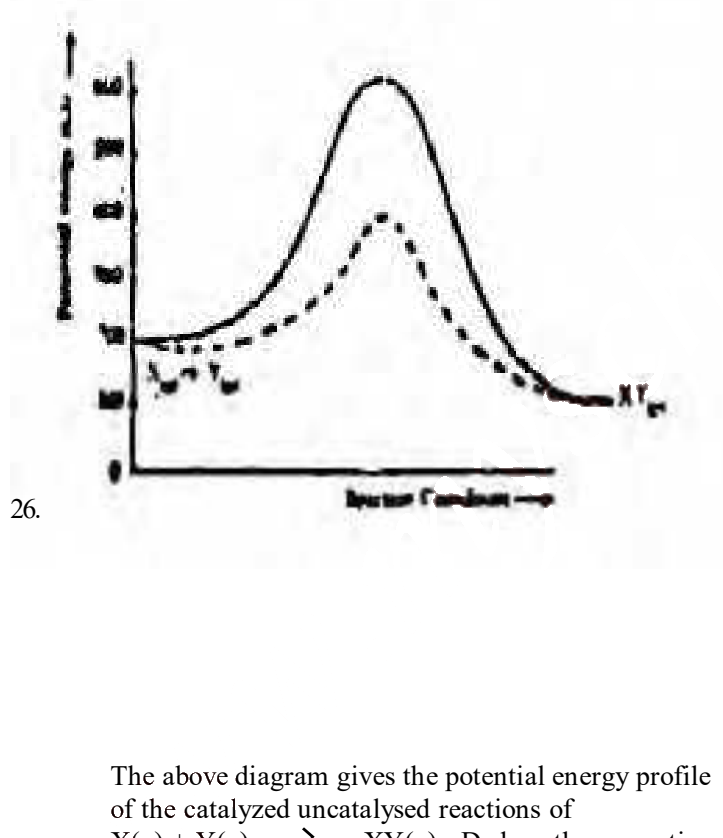
    23. The above diagram gives the potential energy profile of the catalyzed and uncatalysed reactions of X(g)+Y(g)→XY(g)\mathrm{X(g) + Y(g) \rightarrow XY(g)}. Deduce the respective activation energies in kJ of the catalyzed and uncatalysed reverse reactions. XY(g)→X(g)+Y(g)\mathrm{XY(g) \rightarrow X(g) + Y(g)}
    Figure for: The above diagram gives the potential energy profile of the catalyzed and uncatalysed reactions of…
    1. A.300, 500
    2. B.500, 300
    3. C.-300, -500
    4. D.-500
  4. Chemistry1989Energy Changes
    24. The combustion of ethene, C2H4\mathrm{C_2H_4}, is given by the equation C2H4→2CO2+2H2O\mathrm{C_2H_4 \rightarrow 2CO_2 + 2H_2O}; ΔH=−1428\Delta H = -1428 kJ. If the molar heats of formation of water and carbon (IV) oxide are -286 kJ and -396 kJ respectively. Calculate the molar heat of formation of ethane in kJ.
    1. A.-2792
    2. B.+2792
    3. C.-64
    4. D.+64
  5. Chemistry1989Equilibrium
    25. CO(g)+H2O⇌CO2(g)+H2(g)\mathrm{CO(g) + H_2O \rightleftharpoons CO_2(g) + H_2(g)} ΔH=−41000\Delta H = -41000 J. Which of the following factors favour the formation of hydrogen in the above reaction? I high pressure II low pressure III high temperature IV use of excess steam
    1. A.I, III, and IV
    2. B.III only
    3. C.II, III and I
    4. D.IV only
  6. Chemistry1989Separation Techniques
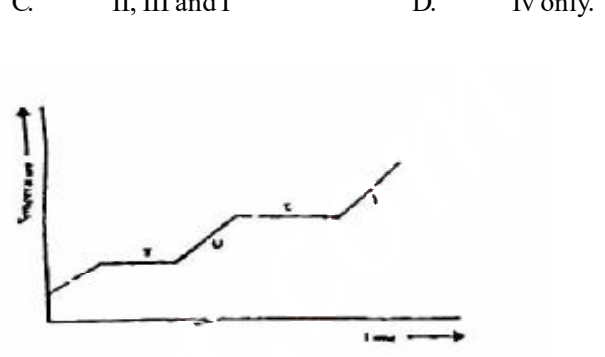
    26. The above graph shows a typical heating curve from the solid phase through the liquid phase to the gaseous phase of a substance. What part of the curve shows solid and liquid in equilibrium?
    Figure for: The above graph shows a typical heating curve from the solid phase through the liquid phase to the…
    1. A.T
    2. B.U
    3. C.X
    4. D.Y
  7. Chemistry1989Acids, Bases and Salts
    27. Which of the following represents the balanced equation for the reaction of copper with concentrated trioxonitrate (V) acid?
    1. A.2HNO3(aq)→Cu(NO3)2(aq)+H2(g)\mathrm{2HNO_3(aq) \rightarrow Cu(NO_3)_2(aq) + H_2(g)}
    2. B.Cu(s)+4HNO3→Cu(NO3)2(aq)+2H2O(l)+2NO2(g)\mathrm{Cu(s) + 4HNO_3 \rightarrow Cu(NO_3)_2(aq) + 2H_2O(l) + 2NO_2(g)}
    3. C.3Cu(s)+8HNO3(aq)→3Cu(NO3)2(aq)+4H2O(l)+2NO(g)\mathrm{3Cu(s) + 8HNO_3(aq) \rightarrow 3Cu(NO_3)_2(aq) + 4H_2O(l) + 2NO(g)}
    4. D.3Cu(s)+4HNO3(aq)→3Cu(NO3)2(aq)+2H2O(l)+2NO(g)\mathrm{3Cu(s) + 4HNO_3(aq) \rightarrow 3Cu(NO_3)_2(aq) + 2H_2O(l) + 2NO(g)}
  8. Chemistry1989Metals and Non-metals
    28. The catalyst used in the contact process for the manufacture of tetraoxosulphate(VI) acid is
    1. A.Manganese (IV) oxide
    2. B.Manganese (II) tetraoxosulphate (IV)
    3. C.Vanadium(V) oxide
    4. D.Iron metal
  9. Chemistry1989Organic Chemistry
    29. Some products of destructive distillation of coal are
    1. A.carbon (IV) oxide and ethanoic acid
    2. B.trioxocarbonate (IV) acid and methanoic acid
    3. C.producer gas and water gas
    4. D.coke and ammonia liquor
  10. Chemistry1989Redox Reactions
    30. Gunpowder is made from charcoal, sulphur and potassium trioxonitrate (V). The salt in the mixture performs the function of
    1. A.an oxidant
    2. B.a reductant
    3. C.a solvent
    4. D.a catalyst
  11. Chemistry1989Redox Reactions
    31. Which of the following reaction is (are) feasible? I Br2(l)+2Cl−(aq)⇌2Br−(aq)+Cl2(aq)\mathrm{Br_2(l) + 2Cl^-(aq) \rightleftharpoons 2Br^-(aq) + Cl_2(aq)} II 2I−(aq)+Br2(l)⇌2Br−(aq)+I2(s)\mathrm{2I^-(aq) + Br_2(l) \rightleftharpoons 2Br^-(aq) + I_2(s)} III 2F−(aq)+Cl2(aq)⇌2Cl−(aq)+F2(g)\mathrm{2F^-(aq) + Cl_2(aq) \rightleftharpoons 2Cl^-(aq) + F_2(g)} IV 2F−(aq)+Br2(l)⇌2Br−(aq)+F2(g)\mathrm{2F^-(aq) + Br_2(l) \rightleftharpoons 2Br^-(aq) + F_2(g)}
    1. A.I
    2. B.II
    3. C.I and III
    4. D.III and IV
  12. Chemistry1989Metals and Non-metals
    32. Bleaching powder, CaOCl2.H2O\mathrm{CaOCl_2.H_2O}, deteriorates on exposure to air because
    1. A.it loses its water of crystallization
    2. B.atmospheric nitrogen displaces chlorine from it
    3. C.carbon (IV) oxide of the atmosphere displaces chlorine from it
    4. D.bleaching agents should be stored in solution
  13. Chemistry1989Acids, Bases and Salts
    33. The product of the thermal decomposition of ammonium trioxonitrate (V) are.
    1. A.NO2\mathrm{NO_2} and oxygen
    2. B.NH3\mathrm{NH_3} and oxygen
    3. C.nitrogen and water
    4. D.N2O\mathrm{N_2O} and water.
  14. Chemistry1989Electrochemistry
    34. The scale of a chemical balance is made of iron plate and coated with copper electrolytically because.
    1. A.iron is less susceptible to corrosion than copper
    2. B.copper is less susceptible corrosion as iron
    3. C.copper is less susceptible to corrosion than iron
    4. D.copper and iron are equally susceptible to corrosion.
  15. Chemistry1989Water, Solutions and Solubility
    35. Mortar is NOT used for under-water construction because.
    1. A.It hardens by loss of water
    2. B.Its hardening does not depend upon evaporation
    3. C.It requires concrete to harden
    4. D.It will be washed away by the flow of water.
  16. Chemistry1989Metals and Non-metals
    36. Which of the following is NOT involved in the extraction of metals from their ores?
    1. A.reduction with carbon
    2. B.reduction with other metals
    3. C.reduction by electrolysis
    4. D.oxidation with oxidizing agent.
  17. Chemistry1989Organic Chemistry
    37. When excess chlorine is mixed with ethene at room temperature, the product is
    1. A.1,2 – dichloroethane
    2. B.1,2 – dichloroethene
    3. C.1, 1- dichloroethane
    4. D.1, 1- dichloroethene.
  18. Chemistry1989Organic Chemistry
    38. Vulcanization of rubber is a process by which
    1. A.Isoprene units are joined to produce rubber
    2. B.Rubber latex is coagulated
    3. C.Sulphur is chemically combined in the rubber
    4. D.Water is removed from the rubber.
  19. Chemistry1989Acids, Bases and Salts
    39. The reaction between ethanoic acid and sodium hydroxide is an example of
    1. A.esterification
    2. B.neutralization
    3. C.hydrosylation
    4. D.hydrolysis
  20. Chemistry1989Chemical Bonding
    40. The bond which joins two ethanoic acid molecules in the liquid state is
    1. A.a covalent bond
    2. B.an ionic bond
    3. C.a dative covalent bond
    4. D.a hydrogen bond

Other JAMB Chemistry papers