JAMB Chemistry 1990 past questions

42 questions from the 1990 paper, showing 21–40. Try each one, then open the solution to check your answer. Sign in to see the worked explanations.

  1. Chemistry1990Redox Reactions
    21. Cr2O72−+6Fe2++14H+→2Cr3++6Fe3++7H2O\mathrm{Cr_2O_7^{2-} + 6Fe^{2+} + 14H^+ \rightarrow 2Cr^{3+} + 6Fe^{3+} + 7H_2O}. In the above chromium change from.
    1. A.+7 to +3
    2. B.+6 to +3
    3. C.+5 to +3
    4. D.–2 to +3
  2. Chemistry1990Redox Reactions
    22. In the reaction IO3−+5I−+6H+→3I2+3H2O\mathrm{IO_3^- + 5I^- + 6H^+ \rightarrow 3I_2 + 3H_2O}, the oxidizing agent is
    1. A.H+\mathrm{H^+}
    2. B.I−\mathrm{I^-}
    3. C.IO3−\mathrm{IO_3^-}
    4. D.I2\mathrm{I_2}
  3. Chemistry1990Electrochemistry
    23. Iron galvanized with zinc is cathodically protected from corrosion. This is because
    1. A.zinc has a more positive oxidation potential than iron
    2. B.zinc has a less positive oxidation potential than iron
    3. C.both have the same oxidation potential
    4. D.zinc is harder than iron.
  4. Chemistry1990Chemical Kinetics
    24. Which of the following samples will react faster with dilute trioxonitrate (V) acid?
    1. A.5 g of lumps of CaCO3\mathrm{CaCO_3} at 25∘C25^\circ\mathrm{C}
    2. B.5 g of powdered CaCO3\mathrm{CaCO_3} at 25∘C25^\circ\mathrm{C}
    3. C.5 g of lumps of CaCO3\mathrm{CaCO_3} at 50∘C50^\circ\mathrm{C}
    4. D.5 g of powdered CaCO3\mathrm{CaCO_3} at 50∘C50^\circ\mathrm{C}
  5. Chemistry1990Equilibrium
    25. In the reaction, 2HI(g)⇌H2(g)+I2(g)\mathrm{2HI(g) \rightleftharpoons H_2(g) + I_2(g)}, ΔH=10\Delta H = 10 kJ; the concentration of iodine in the equilibrium mixture can be increased by
    1. A.A. raising the pressure
    2. B.B. raising the temperature
    3. C.C. adding a catalyst
    4. D.D. lowering the pressure
  6. Chemistry1990Gas Laws
    26. Which of the following gases can be collected by upward displacement of air?
    1. A.NO
    2. B.H2\mathrm{H_2}
    3. C.NH3\mathrm{NH_3}
    4. D.Cl2\mathrm{Cl_2}
  7. Chemistry1990Acids, Bases and Salts
    27. The brown fumes given off when trioxonitrate (V) acid is heated consist of
    1. A.NO2\mathrm{NO_2} and O2\mathrm{O_2}
    2. B.H2O\mathrm{H_2O} and NO2\mathrm{NO_2}
    3. C.NO2\mathrm{NO_2}, O2\mathrm{O_2} and H2O\mathrm{H_2O}
    4. D.NO2\mathrm{NO_2} and H2O\mathrm{H_2O}
  8. Chemistry1990Separation Techniques
    28. Which of the following tests will completely identify any one of sulphur (IV) oxide, hydrogen, carbon (IV) oxide and nitrogen (II) oxide?
    1. A.pass each gas into water and test with blue litmus paper
    2. B.pass each gas into lime water
    3. C.expose each gas to atmospheric air
    4. D.pass each gas to concentrated tetraoxosulphate(VI) acid.
  9. Chemistry1990Equilibrium
    29. In the Haber process for the manufacture of ammonia, the catalyst commonly used is finely divided.
    1. A.vanadium
    2. B.platinum
    3. C.iron
    4. D.copper
  10. Chemistry1990Metals and Non-metals
    30. A metallic oxide which reacts with both HCl and NaOH to give salt and water only can be classified as
    1. A.A. an acidic oxide
    2. B.B. an amphoteric oxide
    3. C.C. a neutral oxide
    4. D.D. an atmospheric oxide
  11. Chemistry1990Metals and Non-metals
    31. Which of the following metals will liberate hydrogen from steam or dilute acid?
    1. A.copper
    2. B.iron
    3. C.lead
    4. D.mercury
  12. Chemistry1990Chemical Bonding
    32. Coal fire should not be used in poorly ventilated rooms because
    1. A.of the accumulation of CO2\mathrm{CO_2} which cause deep sleep
    2. B.it is usually too hot
    3. C.of the accumulation of CO which causes suffocation
    4. D.it removes most of the gases in the room
  13. Chemistry1990Metals and Non-metals
    33. The major component of the slag from the production of iron is
    1. A.an alloy of calcium and iron
    2. B.coke
    3. C.impure iron
    4. D.calcium trioxosilicate (V)
  14. Chemistry1990Acids, Bases and Salts
    34. Sodium hydroxide should be stored in properly closed containers because it
    1. A.readily absorbs water vapour from the air
    2. B.is easily oxidized by atmospheric oxygen
    3. C.turns golden yellow when exposed to light.
    4. D.melts at a low temperature.
  15. Chemistry1990Metals and Non-metals
    35. To make coloured glasses, small quantities of oxides of metals which form coloured silicates are often added to the reaction mixture consisting of Na2CO3\mathrm{Na_2CO_3} and SiO2\mathrm{SiO_2}. Such a metal is
    1. A.potassium
    2. B.barium
    3. C.zinc
    4. D.copper
  16. Chemistry1990Organic Chemistry
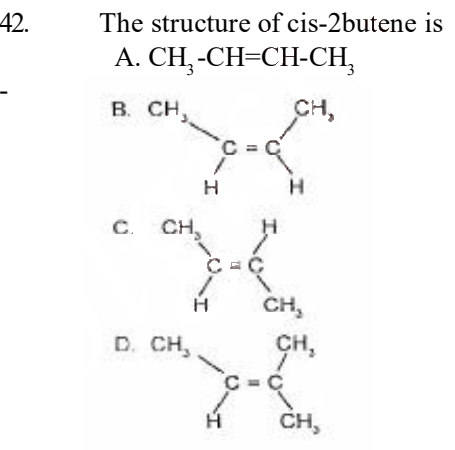
    36. The structure of cis-2-butene is
    Figure for: The structure of cis-2-butene is
    1. A.CH3-CH=CH-CH3\mathrm{CH_3\text{-}CH{=}CH\text{-}CH_3}
    2. B.Figure B
    3. C.Figure C
    4. D.Figure D
  17. Chemistry1990Organic Chemistry
    37. The label on a reagent bottle containing a clear organic liquid dropped off. The liquid was neutral to litmus and gave a colourless gas with metallic sodium. The liquid must be an
    1. A.alkanoate
    2. B.alkene
    3. C.alkanol
    4. D.alkane
  18. Chemistry1990Acids, Bases and Salts
    38. HOOC–COOH + NaOH → HOOC–COO−^-Na+^+ + H2O\mathrm{H_2O}. The above reaction is an example of
    1. A.displacement reaction
    2. B.a neutralization reaction
    3. C.an elimination reaction
    4. D.saponification
  19. Chemistry1990Chemical Bonding
    39. Alkanoic acids have low volatility compared with alkanols because they
    1. A.are more polar than alkanols
    2. B.have two oxygen atoms while alkanols have one
    3. C.form two hydrogen bonds while alkanols do not
    4. D.form two hydrogen bonds while alkanols form one.
  20. Chemistry1990Organic Chemistry
    40. The octane number of a fuel whose performance is the same as that of a mixture of 55 g of 2, 2, 4-trimethylpentane and 45 g of n-heptane is
    1. A.45
    2. B.55
    3. C.80
    4. D.100

Other JAMB Chemistry papers