JAMB Chemistry 1991 past questions

45 questions from the 1991 paper, showing 21–40. Try each one, then open the solution to check your answer. Sign in to see the worked explanations.

  1. Chemistry1991Acids, Bases and Salts
    21. Which of the following equimolar solutions, Na2CO3\mathrm{Na_2CO_3}, Na2SO4\mathrm{Na_2SO_4}, FeCl3\mathrm{FeCl_3}, NH4Cl\mathrm{NH_4Cl} and CH3COONa\mathrm{CH_3COONa}, have pH greater than 7?
    1. A.FeCl3\mathrm{FeCl_3} and NH4Cl\mathrm{NH_4Cl}
    2. B.Na2CO3\mathrm{Na_2CO_3}, CH3COONa\mathrm{CH_3COONa} and Na2SO4\mathrm{Na_2SO_4}
    3. C.Na2CO3\mathrm{Na_2CO_3} and CH3COONa\mathrm{CH_3COONa}
    4. D.FeCl3\mathrm{FeCl_3}, CH3COONa\mathrm{CH_3COONa}, NH4Cl\mathrm{NH_4Cl}
  2. Chemistry1991Redox Reactions
    22. MnO4−+8H++ne−→Mn2++4H2O\mathrm{MnO_4^-} + 8\mathrm{H^+} + n\mathrm{e^-} \rightarrow \mathrm{Mn^{2+}} + 4\mathrm{H_2O}. Which is the value of n in the reaction above?
    1. A.2
    2. B.3
    3. C.4
    4. D.5
  3. Chemistry1991Redox Reactions
    23. 2H2S(g)+SO2(g)→3S(s)+2H2O(l)2\mathrm{H_2S_{(g)}} + \mathrm{SO_{2(g)}} \rightarrow 3\mathrm{S_{(s)}} + 2\mathrm{H_2O_{(l)}}. The above reaction is
    1. A.a redox reaction in which H2S\mathrm{H_2S} is the oxidant and SO2\mathrm{SO_2} is the reductant.
    2. B.a redox reaction in which SO2\mathrm{SO_2} is the oxidant and H2S\mathrm{H_2S} is the reductant.
    3. C.Not a redox reaction because there is no oxidant in the reaction equation
    4. D.Not a redox reaction because there is no reductant in the reaction equation.
  4. Chemistry1991Chemical Kinetics
    24. Manganese (IV) oxide is known to hasten the decomposition of hydrogen peroxide. Its main action is to.
    1. A.increase the surface area of the reactants
    2. B.increase the concentration of the reactants
    3. C.lower the activation energy for the reaction
    4. D.lower the heat of reaction, ΔH\Delta H, for the reaction,
  5. Chemistry1991Equilibrium
    25. NO+CO⇌1/2 N2+CO2\mathrm{NO + CO \rightleftharpoons 1/2\,N_2 + CO_2} ΔH=−89.3 kJ\Delta H = -89.3\,\mathrm{kJ}. What conditions would favour maximum conversion of nitrogen (II) oxide and carbon (II) oxide in the reaction above?
    1. A.low temperature and high pressure
    2. B.high temperature and low pressure
    3. C.high temperature and high pressure
    4. D.low temperature and low pressure.
  6. Chemistry1991Equilibrium
    26. Which of the following equilibria is unaffected by a pressure change?
    1. A.2NaCl⇌2Na+Cl2\mathrm{2NaCl \rightleftharpoons 2Na + Cl_2}
    2. B.H2+I2⇌2HI\mathrm{H_2 + I_2 \rightleftharpoons 2HI}
    3. C.2O3⇌3O2\mathrm{2O_3 \rightleftharpoons 3O_2}
    4. D.2NO2⇌N2O4\mathrm{2NO_2 \rightleftharpoons N_2O_4}
  7. Chemistry1991Chemical Kinetics
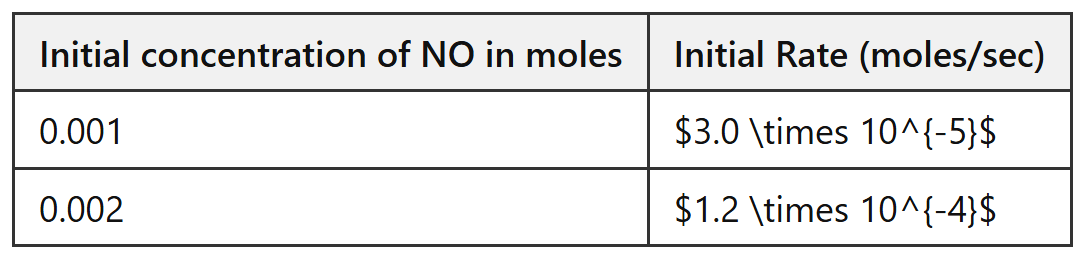
    27. The data in the table above shows the rate of reaction of nitrogen (II) oxide with chlorine at 25∘C25^\circ\mathrm{C}. It can be concluded that doubling the initial concentration of NO increases the rate of reaction by a factor of
    Figure for: The data in the table above shows the rate of reaction of nitrogen (II) oxide with chlorine at…
    1. A.two
    2. B.three
    3. C.four
    4. D.five
  8. Chemistry1991Metals and Non-metals
    28. Which of the following gases will rekindle a brightly glowing splint?
    1. A.NO2\mathrm{NO_2}
    2. B.NO
    3. C.N2O\mathrm{N_2O}
    4. D.Cl2\mathrm{Cl_2}
  9. Chemistry1991Metals and Non-metals
    29. Which of the following salts can be melted without decomposition?
    1. A.Na2CO3\mathrm{Na_2CO_3}
    2. B.CaCO3\mathrm{CaCO_3}
    3. C.MgCO3\mathrm{MgCO_3}
    4. D.ZnCO3\mathrm{ZnCO_3}
  10. Chemistry1991Metals and Non-metals
    30. Oxygen gas can be prepared by heating
    1. A.ammonium trioxonitrate (V)
    2. B.ammonium trioxonitrate (III)
    3. C.potassium trioxonitrate (V)
    4. D.manganese (IV) oxide.
  11. Chemistry1991Acids, Bases and Salts
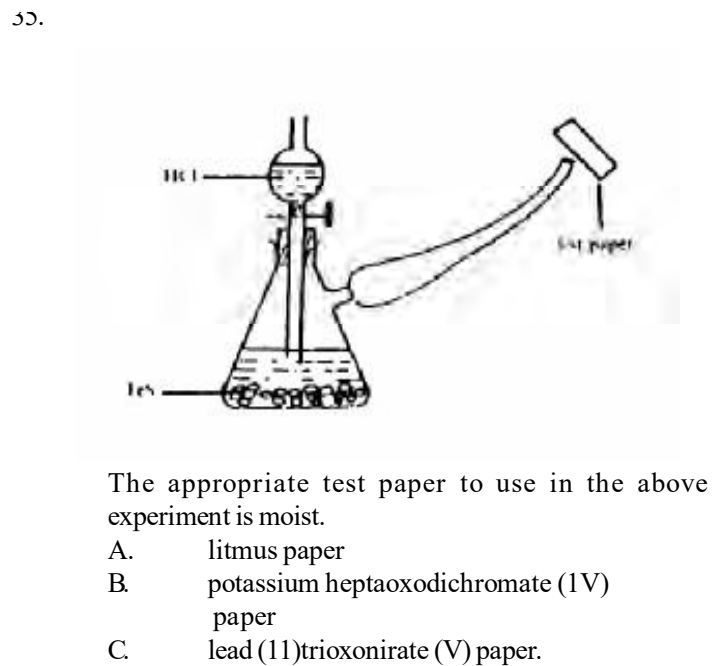
    31. The appropriate test paper to use in the above experiment is moist.
    Figure for: The appropriate test paper to use in the above experiment is moist.
    1. A.litmus paper
    2. B.potassium heptaoxodichromate (VI) paper
    3. C.lead (II) trioxonitrate (V) paper.
    4. D.Universal indicator paper.
  12. Chemistry1991Metals and Non-metals
    32. Addition of aqueous ammonia to a solution of Zn2+\mathrm{Zn^{2+}} gives a white precipitate which dissolves in an excess of ammonia because.
    1. A.zinc is amphoteric
    2. B.zinc hydroxide is readily soluble
    3. C.zinc forms a complex which is readily soluble in excess ammonia
    4. D.ammonia solution is a strong base.
  13. Chemistry1991Acids, Bases and Salts
    33. Which of the following, in clear solution, forms a white precipitate when carbon (IV) oxide is bubbled into it for a short time?
    1. A.KOH
    2. B.NaOH
    3. C.Ca(OH)2\mathrm{Ca(OH)_2}
    4. D.Al(OH)3\mathrm{Al(OH)_3}
  14. Chemistry1991Metals and Non-metals
    34. Copper (II) tetraoxosulphate (VI) is widely used as a
    1. A.Fertilizer
    2. B.Fungicide
    3. C.Disinfectant
    4. D.Purifier
  15. Chemistry1991Metals and Non-metals
    35. Which of the following metals can be prepared in samples by the thermal decomposition of their trioxonitrate (V) salt?
    1. A.Copper and mercury
    2. B.Silver and copper
    3. C.Mercury and silver
    4. D.Magnesium and mercury
  16. Chemistry1991Organic Chemistry
    36. Which of the following compounds can exist as geometric isomers?
    1. A.2-methylbut-2-ene
    2. B.But-2-ene
    3. C.But-1-ene
    4. D.Cl−CH2−Br\mathrm{Cl-CH_2-Br} (carbon bonded to H, H, Cl, Br)
  17. Chemistry1991Organic Chemistry
    37. How many structural isomers can be written for the alkyl bromide C4H9Br\mathrm{C_4H_9Br}?
    1. A.3
    2. B.4
    3. C.6
    4. D.8
  18. Chemistry1991Organic Chemistry
    38. The final products of the reaction of methane and chlorine in the presence of ultraviolet light are hydrogen chloride and
    1. A.chloromethane
    2. B.tetrachloromethane
    3. C.trichloromethane
    4. D.dichloromethane
  19. Chemistry1991Stoichiometry
    39. How many grams of bromine will be required to completely react with 10 g of propyne? [C = 12, H = 1, Br = 80].
    1. A.20 g
    2. B.40 g
    3. C.60 g
    4. D.80 g
  20. Chemistry1991Organic Chemistry
    40. Ethene when passed into concentrated H2SO4\mathrm{H_2SO_4} is rapidly absorbed. The product is diluted with water and then warmed to produce.
    1. A.ethanol
    2. B.diethyl ether
    3. C.ethanal
    4. D.diethyl sulphate.

Other JAMB Chemistry papers