JAMB Chemistry 1992 past questions

49 questions from the 1992 paper, showing 21–40. Try each one, then open the solution to check your answer. Sign in to see the worked explanations.

  1. Chemistry1992Electrochemistry
    21. Copper (II) tetraoxosulphate (VI) solution is electrolyzed using carbon electrodes. Which of the following are produced at the anode and cathode respectively.
    1. A.Copper and oxygen
    2. B.Oxygen and copper
    3. C.Hydrogen and copper
    4. D.Copper and hydrogen
  2. Chemistry1992Electrochemistry
    22. Calculate the mass, in kilograms, of magnesium produced by the electrolysis of magnesium(II) chloride in a cell operating for 24 hours at 500 amperes. [Faraday = 96,500 C mol−1\mathrm{mol^{-1}}, Mg = 24]
    1. A.2.7
    2. B.5.4
    3. C.10.8
    4. D.21.7
  3. Chemistry1992Redox Reactions
    23. MnO2+2Cl−+4H+→Mn2++Cl2+2H2O\mathrm{MnO_2} + 2\mathrm{Cl^-} + 4\mathrm{H^+} \rightarrow \mathrm{Mn^{2+}} + \mathrm{Cl_2} + 2\mathrm{H_2O}. The change in oxidation numbers when the manganese, chlorine and hydrogen ions react according to the above equation are respectively.
    1. A.2, 2, 4
    2. B.-1, -2, 4
    3. C.-2, 1, 0
    4. D.2, 4, 0
  4. Chemistry1992Redox Reactions
    24. S2O32−+I2→S4O62−+2I−\mathrm{S_2O_3^{2-}} + \mathrm{I_2} \rightarrow \mathrm{S_4O_6^{2-}} + 2\mathrm{I^-}. In the reaction above, the oxidizing agent is
    1. A.S2O32−\mathrm{S_2O_3^{2-}}
    2. B.I2\mathrm{I_2}
    3. C.S4O62−\mathrm{S_4O_6^{2-}}
    4. D.I−\mathrm{I^-}
  5. Chemistry1992Energy Changes
    25. In which of the following is the entropy change positive?
    1. A.H2O(l)→H2O(g)\mathrm{H_2O_{(l)}} \rightarrow \mathrm{H_2O_{(g)}}
    2. B.Cu(aq)2++Fe(s)→Fe(aq)2++Cu(s)\mathrm{Cu^{2+}_{(aq)}} + \mathrm{Fe_{(s)}} \rightarrow \mathrm{Fe^{2+}_{(aq)}} + \mathrm{Cu_{(s)}}
    3. C.N2(g)+3H2(g)→2NH3(g)\mathrm{N_{2(g)}} + 3\mathrm{H_{2(g)}} \rightarrow 2\mathrm{NH_{3(g)}}
    4. D.2HCl(s)→N2(g)+Cl2(g)2\mathrm{HCl_{(s)}} \rightarrow \mathrm{N_{2(g)}} + \mathrm{Cl_{2(g)}}
  6. Chemistry1992Equilibrium
    26. In what way is equilibrium constant for the forward reaction related to that of the reverse reaction?
    1. A.The addition of the two is expected to be one
    2. B.The product of the two is expected to be one
    3. C.The two equilibrium constants are identical
    4. D.The product of the two is always greater than one.
  7. Chemistry1992Equilibrium
    27. Which of the following equilibria shows little or no net reaction when the volume of the system is decreased?
    1. A.H2(g)+I2(g)⇌2HI(g)\mathrm{H_{2(g)}} + \mathrm{I_{2(g)}} \rightleftharpoons 2\mathrm{HI_{(g)}}
    2. B.2NO2(g)⇌N2O4(g)2\mathrm{NO_{2(g)}} \rightleftharpoons \mathrm{N_2O_{4(g)}}
    3. C.PCl5(g)⇌PCl3(g)+Cl2(g)\mathrm{PCl_{5(g)}} \rightleftharpoons \mathrm{PCl_{3(g)}} + \mathrm{Cl_{2(g)}}
    4. D.ZnO(s)+CO2(g)⇌ZnCO3(s)\mathrm{ZnO_{(s)}} + \mathrm{CO_{2(g)}} \rightleftharpoons \mathrm{ZnCO_{3(s)}}
  8. Chemistry1992Equilibrium
    28. For a general equation of the nature xP+yQ⇌mR+nSx\mathrm{P} + y\mathrm{Q} \rightleftharpoons m\mathrm{R} + n\mathrm{S}, the expression for the equilibrium constant is
    1. A.k[P]x[Q]yk[P]^x[Q]^y
    2. B.[P]x[Q]y[R]m[S]n\frac{[P]^x[Q]^y}{[R]^m[S]^n}
    3. C.[R]m[S]n[P]x[Q]y\frac{[R]^m[S]^n}{[P]^x[Q]^y}
    4. D.m[R] n[S]x[P] y[Q]\frac{m[R]\,n[S]}{x[P]\,y[Q]}
  9. Chemistry1992Metals and Non-metals
    29. Which of these statements is TRUE about carbon(IV) oxide?
    1. A.It supports combustion
    2. B.It is strong acidic in water
    3. C.It is very soluble in water
    4. D.It supports the burning of magnesium to produce magnesium oxide.
  10. Chemistry1992Metals and Non-metals
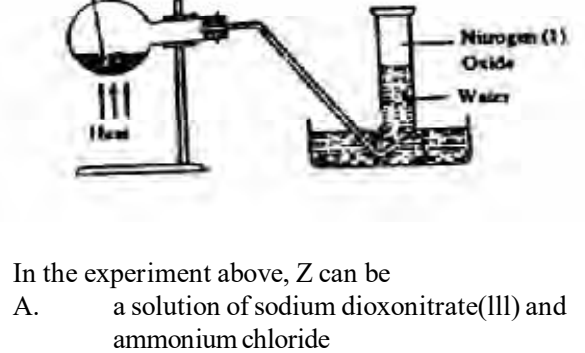
    30. In the experiment above, Z can be
    Figure for: In the experiment above, Z can be
    1. A.a solution of sodium dioxonitrate(III) and ammonium chloride
    2. B.a solution of lead trioxonitrate(V)
    3. C.a solution of sodium trioxonitrate(V) and ammonium chloride
    4. D.concentrated tetraoxosulphate (VI) acid and sodium trioxonitrate(V).
  11. Chemistry1992Metals and Non-metals
    31. Which of the following combination of gases is used for metal welding? I. Oxygen and ethyne. II. Hydrogen and ethyne. III. Hydrogen and oxygen. IV. Ethyne, hydrogen and oxygen.
    1. A.I and II
    2. B.III and IV
    3. C.I and III
    4. D.II and IV
  12. Chemistry1992Metals and Non-metals
    32. Which of the following oxides of nitrogen is unstable in air?
    1. A.NO2\mathrm{NO_2}
    2. B.NO
    3. C.N2O4\mathrm{N_2O_4}
    4. D.N2O5\mathrm{N_2O_5}
  13. Chemistry1992Metals and Non-metals
    33. The gas formed when ammonium trioxonitrate (V) is heated with sodium hydroxide is
    1. A.hydrogen
    2. B.nitrogen(IV) oxide
    3. C.oxygen
    4. D.ammonia
  14. Chemistry1992Metals and Non-metals
    34. Safety matches contain sulphur and
    1. A.Potassium trioxochlorate(V)
    2. B.Potassium trioxonitrate (V)
    3. C.Charcoal
    4. D.Phosphorus sulphide
  15. Chemistry1992Acids, Bases and Salts
    35. Addition of an aqueous solution of barium chloride to the aqueous solution of a salt gives a white precipitate. The salt is a
    1. A.nitrate
    2. B.carbonate
    3. C.chloride
    4. D.sulphide
  16. Chemistry1992Metals and Non-metals
    36. Sodium hydroxide solution can be conveniently stored in a container made of
    1. A.lead
    2. B.zinc
    3. C.aluminum
    4. D.copper
  17. Chemistry1992Metals and Non-metals
    37. Which of the following is NOT used as raw material in the solvay process?
    1. A.Ammonia
    2. B.Sodium chloride
    3. C.Calcium trioxocarbonate
    4. D.Sodium trioxocarbonate(VI)
  18. Chemistry1992Metals and Non-metals
    38. Duralumin consists of aluminum, copper,
    1. A.zinc and gold
    2. B.lead and manganese
    3. C.nickel and silver
    4. D.manganese and magnesium.
  19. Chemistry1992Energy Changes
    39. CaO(s)+H2O(l)→Ca(OH)2(s)\mathrm{CaO_{(s)}} + \mathrm{H_2O_{(l)}} \rightarrow \mathrm{Ca(OH)_{2(s)}} ΔH=−65 kJ\Delta H = -65\,\mathrm{kJ}. The process represented by the above equation is known as.
    1. A.dissolution
    2. B.slaking
    3. C.liming
    4. D.mortaring
  20. Chemistry1992Organic Chemistry
    40. The carbon atoms in ethane are
    1. A.sp3sp^3 hybridized
    2. B.spsp hybridized
    3. C.sp2sp^2 hybridized
    4. D.not hybridized.

Other JAMB Chemistry papers