JAMB Chemistry 1993 past questions

46 questions from the 1993 paper, showing 21–40. Try each one, then open the solution to check your answer. Sign in to see the worked explanations.

  1. Chemistry1993Electrochemistry
    21. Which of the following reactions occurs at the anode during the electrolysis of a very dilute aqueous solution of sodium chloride?
    1. A.OH−−e−→OH\mathrm{OH^-} - e^- \rightarrow \mathrm{OH}
    2. B.Cl−−e−→Cl\mathrm{Cl^-} - e^- \rightarrow \mathrm{Cl}
    3. C.OH+Cl−→HCl\mathrm{OH + Cl^- \rightarrow HCl}
    4. D.Na++e−→HgNa/Hg\mathrm{Na^+ + e^- \xrightarrow{Hg} Na/Hg} amalgam
  2. Chemistry1993Electrochemistry
    22. Half-cell reaction E0E^0: Cu2+(aq)+2e→Cu(s)\mathrm{Cu^{2+}(aq)} + 2e \rightarrow \mathrm{Cu(s)} +0.34V; Fe2+(aq)+2e→Fe\mathrm{Fe^{2+}(aq)} + 2e \rightarrow \mathrm{Fe} -0.44V; Ba2+(aq)+2e→Ba(s)\mathrm{Ba^{2+}(aq)} + 2e \rightarrow \mathrm{Ba(s)} -2.90V; Zn2+(aq)+2e→Zn(s)\mathrm{Zn^{2+}(aq)} + 2e \rightarrow \mathrm{Zn(s)} -0.76V. From the data above, it can be deduced that the most powerful reducing agent of the four metals is
    1. A.Cu
    2. B.Fe
    3. C.Ba
    4. D.Zn
  3. Chemistry1993Redox Reactions
    23. The oxidation states of chlorine in HOCl, HClO3\mathrm{HClO_3} and HClO4\mathrm{HClO_4} are respectively
    1. A.-1, +5 and +7
    2. B.-1, -5 and 7
    3. C.+1, +3 and +4
    4. D.+1, +5 and +7
  4. Chemistry1993Energy Changes
    24. A reaction takes place spontaneously if
    1. A.ΔG=0\Delta G = 0
    2. B.ΔS<0\Delta S < 0 and ΔH>0\Delta H > 0
    3. C.ΔH<TΔS\Delta H < T\Delta S
    4. D.ΔG>0\Delta G > 0
  5. Chemistry1993Energy Changes
    25. The standard enthalpies of formation of CO2(g)\mathrm{CO_2(g)}, H2O(g)\mathrm{H_2O(g)} and CO(g) in kJ mol−1\mathrm{kJ\,mol^{-1}} are -394, -242 and -110 respectively. What is the standard enthalpy change for the reaction CO(g)+H2O→CO2(g)+H2(g)\mathrm{CO(g) + H_2O \rightarrow CO_2(g) + H_2(g)}?
    1. A.−42 kJ mol−1-42\,\mathrm{kJ\,mol^{-1}}
    2. B.+42 kJ mol−1+42\,\mathrm{kJ\,mol^{-1}}
    3. C.−262 kJ mol−1-262\,\mathrm{kJ\,mol^{-1}}
    4. D.+262 kJ mol−1+262\,\mathrm{kJ\,mol^{-1}}
  6. Chemistry1993Equilibrium
    26. 10 g of a solid is in equilibrium with its own vapour. When 1 g of a small amount of solid is added, the vapour pressure
    1. A.remain the same
    2. B.drops
    3. C.increase by 1%
    4. D.increase by 99%
  7. Chemistry1993Chemical Kinetics
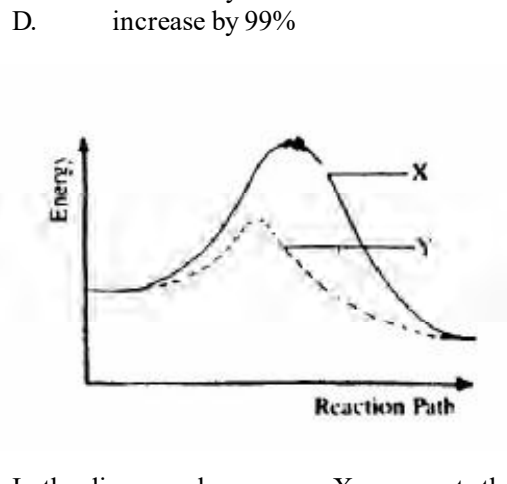
    27. In the diagram above, curve X represents the energy profile for a homogeneous gaseous reaction. Which of the following conditions would produce curve Y for the same reaction?
    Figure for: In the diagram above, curve X represents the energy profile for a homogeneous gaseous reaction…
    1. A.increase in temperature
    2. B.increase in the concentration of a reactant
    3. C.addition of a catalyst
    4. D.increase in pressure.
  8. Chemistry1993Acids, Bases and Salts
    28. NaCl(s)+H2SO4(l)→HCl(g)+NaHSO4(s)\mathrm{NaCl(s) + H_2SO_4(l) \rightarrow HCl(g) + NaHSO_4(s)}. In the reaction above, H2SO4\mathrm{H_2SO_4} behaves as
    1. A.a strong acid
    2. B.an oxidising agent
    3. C.a good solvent
    4. D.a dehydrating agent.
  9. Chemistry1993Metals and Non-metals
    29. Which of these salts will produce its metal, oxygen and nitrogen(IV) oxide on heating?
    1. A.Silver trioxonitrate(V)
    2. B.Sodium trioxonitrate (V)
    3. C.Calcium trioxonitrate (V)
    4. D.Lithium trioxonitrate (V)
  10. Chemistry1993Separation Techniques
    30. An experiment produces a gaseous mixture of carbon(IV) oxide and carbon(II) oxide. In order to obtain pure carbon(II) oxide, the gas mixture should be
    1. A.passed over heated copper(II) oxide
    2. B.bubbled through concentrated tetraoxosulphate(VI) acid
    3. C.bubbled through sodium hydroxide solution
    4. D.bubbled through water.
  11. Chemistry1993Metals and Non-metals
    31. Which of the following is property of ionic chlorides?
    1. A.They can be decomposed by heat.
    2. B.They react with aqueous AgNO3\mathrm{AgNO_3} to give a white precipitate which is soluble in excess ammonia
    3. C.They explode when in contact with dry ammonia gas
    4. D.They react with concentrated tetraoxosulphate (VI) acid to give white fumes of chlorine gas
  12. Chemistry1993Water, Solutions and Solubility
    32. When dilute aqueous solutions of lead(II) nitrate and potassium bromide are mixed, a precipitate is observed. The products of this reaction are.
    1. A.PbO(s) + Br−\mathrm{Br^-}(aq) + KNO3\mathrm{KNO_3}
    2. B.Br2+NO2(g)+PbBr2(s)\mathrm{Br_2 + NO_2(g) + PbBr_2(s)}
    3. C.PbO(s) + K+(aq)+Br−(aq)+NO2(g)\mathrm{K^+(aq) + Br^-(aq) + NO_2(g)}
    4. D.PbBr2(s)+K+(aq)+NO3−(aq)\mathrm{PbBr_2(s) + K^+(aq) + NO_3^-(aq)}
  13. Chemistry1993Metals and Non-metals
    33. Copper metal will react with concentrated trioxonitrate (V) acid to give
    1. A.Cu(NO3)3+NO+N2O4+H2O\mathrm{Cu(NO_3)_3 + NO + N_2O_4 + H_2O}
    2. B.Cu(NO3)2+NO+H2O\mathrm{Cu(NO_3)_2 + NO + H_2O}
    3. C.CuO+NO2+H2O\mathrm{CuO + NO_2 + H_2O}
    4. D.Cu(NO3)2+NO2+H2O\mathrm{Cu(NO_3)_2 + NO_2 + H_2O}
  14. Chemistry1993Metals and Non-metals
    34. The active reducing agent in the blast furnace for the extraction of iron is
    1. A.carbon
    2. B.limestone
    3. C.carbon (II) oxide
    4. D.calcium oxide
  15. Chemistry1993Acids, Bases and Salts
    35. Al2O3(s)+3H2SO4(aq)→Al2(SO4)3(aq)+3H2O(l)\mathrm{Al_2O_3(s) + 3H_2SO_4(aq) \rightarrow Al_2(SO_4)_3(aq) + 3H_2O(l)}; Al2O3(s)+2NaOH(aq)+3H2O(l)→2NaAl(OH)4(aq)\mathrm{Al_2O_3(s) + 2NaOH(aq) + 3H_2O(l) \rightarrow 2NaAl(OH)_4(aq)}. We can conclude from the equations above that Al2O3(s)\mathrm{Al_2O_3(s)} is
    1. A.an acidic oxide
    2. B.an amphoteric oxide
    3. C.a basic oxide
    4. D.a neutral oxide
  16. Chemistry1993Organic Chemistry
    36. H2N−CH−C−OH\mathrm{H_2N{-}CH{-}C{-}OH} (with H above the CH and a double bond shown above the C). The two functional groups in the above compound are.
    1. A.alcohol and amine
    2. B.acid and amine
    3. C.aldehyde and acid
    4. D.ketone and amine
  17. Chemistry1993Organic Chemistry
    37. The fraction of crude oil used as jet fuel is
    1. A.refinery gas
    2. B.diesel oil
    3. C.kerosene
    4. D.gasoline
  18. Chemistry1993Organic Chemistry
    38. CH3CH(CH3)CH2CH(CH3)CH2CH3\mathrm{CH_3CH(CH_3)CH_2CH(CH_3)CH_2CH_3}, that is, a six-carbon chain with a CH3\mathrm{CH_3} group on each of the two CH carbons. The IUPAC nomenclature for the compound above is.
    1. A.dimethylhexane
    2. B.3,5 dimethylpentane
    3. C.1,1 dimethyl, 3 methylpentane
    4. D.2,4 dimethylhexane.
  19. Chemistry1993Organic Chemistry
    39. It is not desirable to use lead tetraethyl as an anti-knock agent because
    1. A.it is expensive
    2. B.of pollution effects from the exhaust fumes
    3. C.it lowers the octane rating of petrol
    4. D.it is explosive.
  20. Chemistry1993Organic Chemistry
    40. The carbon atoms on ethane are
    1. A.sp2sp^2 hybridized
    2. B.sp3sp^3 hybridized
    3. C.sp2dsp^2d hybridized
    4. D.sp hybridized.

Other JAMB Chemistry papers