JAMB Chemistry 1994 past questions

44 questions from the 1994 paper, showing 21–40. Try each one, then open the solution to check your answer. Sign in to see the worked explanations.

  1. Chemistry1994Acids, Bases and Salts
    21. Which of the following compounds is a base?
    1. A.CO2\mathrm{CO_2}
    2. B.CaO
    3. C.H3PO3\mathrm{H_3PO_3}
    4. D.CH3COOH\mathrm{CH_3COOH}
  2. Chemistry1994Stoichiometry
    22. 20 cm3\mathrm{cm^3} of a 2.0 M solution of ethanoic acid was added to excess of 0.05 M sodium hydroxide. The mass of the salt produced is [Na = 23, C = 12, O = 16, H = 1]
    1. A.2.50 g
    2. B.2.73 g
    3. C.3.28 g
    4. D.4.54 g
  3. Chemistry1994Electrochemistry
    23. What volume of oxygen measured at s.t.p would be liberated on electrolysis by 9650 coulombs of electricity? [Molar Volume of gas = 22.4 dm3\mathrm{dm^3}, F = 96,500 C mol−1\mathrm{C\,mol^{-1}}]
    1. A.22.4 dm3\mathrm{dm^3}
    2. B.11.2 dm3\mathrm{dm^3}
    3. C.1.12 dm3\mathrm{dm^3}
    4. D.0.560 dm3\mathrm{dm^3}
  4. Chemistry1994Electrochemistry
    24. Crude copper could be purified by the electrolysis of concentrated copper(II) chloride if the crude copper is
    1. A.made both the anode and the cathode
    2. B.made the cathode
    3. C.made the anode
    4. D.dissolved in the solution.
  5. Chemistry1994Redox Reactions
    25. H−(s)+H2O(l)→H2(g)+OH−(aq)\mathrm{H^-(s) + H_2O(l) \rightarrow H_2(g) + OH^-(aq)}. From the equation above, it can be inferred that the
    1. A.reaction is a double decomposition
    2. B.hydride ion is reducing agent
    3. C.hydride ion is an oxidizing agent
    4. D.reaction is neutralization.
  6. Chemistry1994Acids, Bases and Salts
    26. An anhydride is an oxide of a non-metal.
    1. A.Which will not dissolve in water
    2. B.whose solution in water has pH greater than 7
    3. C.whose solution in water has a pH less than 7
    4. D.whose solution in water has a pH of 7
  7. Chemistry1994Redox Reactions
    27. MnO4−(aq)+8H+(aq)+5Fe2+(aq)→Mn2+(aq)+5Fe3+(aq)+4H2O(l)\mathrm{MnO_4^-(aq) + 8H^+(aq) + 5Fe^{2+}(aq) \rightarrow Mn^{2+}(aq) + 5Fe^{3+}(aq) + 4H_2O(l)}. The oxidation number of manganese in the above reaction change from
    1. A.+7 to +2
    2. B.+6 to +2
    3. C.+5 to +2
    4. D.+4 to +2
  8. Chemistry1994Equilibrium
    28. Which of the following is TRUE of Le Chatelier's principle for an exothermic reaction?
    1. A.Increase in temperature will cause an increase in equilibrium constant
    2. B.Increase in temperature will cause a decrease in the equilibrium constant
    3. C.Addition of catalyst will cause an increase in the equilibrium constant.
    4. D.Addition of catalyst will cause a decrease in the equilibrium constant.
  9. Chemistry1994Metals and Non-metals
    29. Which of the following are produced when ammonium trioxonitrate(V) crystals are cautiously heated in a hard glass round bottomed flask?
    1. A.N2O\mathrm{N_2O} and steam
    2. B.NO2\mathrm{NO_2} and ammonia
    3. C.N2O4\mathrm{N_2O_4} and NO2\mathrm{NO_2}
    4. D.NO and NO2\mathrm{NO_2}
  10. Chemistry1994Chemical Kinetics
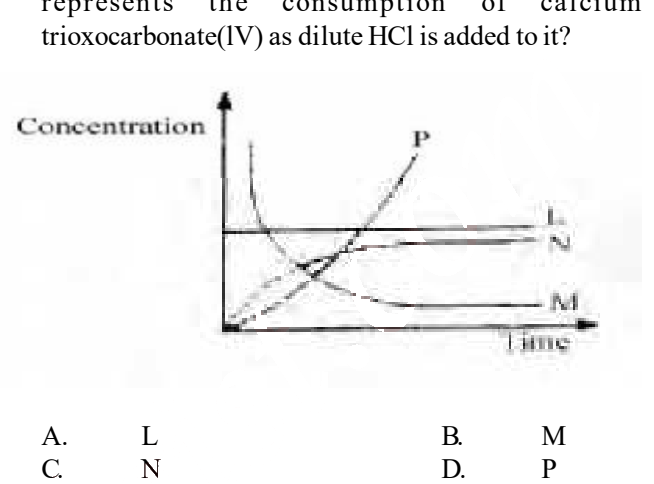
    30. 2HCl(aq)+CaCO3(s)→CaCl2(aq)+H2O(l)+CO2(g)\mathrm{2HCl(aq) + CaCO_3(s) \rightarrow CaCl_2(aq) + H_2O(l) + CO_2(g)}. From the reaction above, which of the following curves represents the consumption of calcium trioxocarbonate(IV) as dilute HCl is added to it?
    Figure for: 2HCl(aq) + CaCO3(s) CaCl2(aq) + H2O(l) + CO2(g). From the reaction above, which of the following…
    1. A.L
    2. B.M
    3. C.N
    4. D.P
  11. Chemistry1994Metals and Non-metals
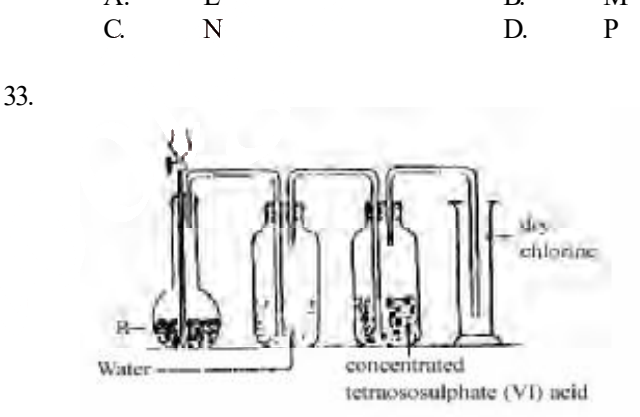
    31. In the diagram above, R is a mixture of
    Figure for: In the diagram above, R is a mixture of
    1. A.potassium tetraoxochlorate(VII) and concentrated H2SO4\mathrm{H_2SO_4}
    2. B.potassium tetraoxomanganate(VII) and concentrated HCl
    3. C.manganese(IV) oxide and concentrated HCl
    4. D.manganese(IV) oxide and concentrated H2SO4\mathrm{H_2SO_4}
  12. Chemistry1994Metals and Non-metals
    32. Which of these metals CANNOT replace hydrogen from alkaline solutions?
    1. A.Aluminium
    2. B.Zinc
    3. C.Tin
    4. D.Iron
  13. Chemistry1994Acids, Bases and Salts
    33. Clothes should be properly rinsed with water after bleaching because
    1. A.the bleach decolourizes the clothes
    2. B.chlorine reacts with fabrics during bleaching
    3. C.the clothes are sterilized during bleaching
    4. D.hydrogen chloride solution is produced during bleaching.
  14. Chemistry1994Acids, Bases and Salts
    34. Which of these solutions will give a white precipitate with a solution of barium chloride acidified with hydrochloric acid?
    1. A.Sodium trioxocarbonate(IV)
    2. B.Sodium tetraoxosulphate
    3. C.Sodium trioxosulphate (IV)
    4. D.Sodium sulphides
  15. Chemistry1994Acids, Bases and Salts
    35. SO3\mathrm{SO_3} is NOT directly dissolved in water in the preparation of H2SO4\mathrm{H_2SO_4} by the contact process because
    1. A.the reaction between SO3\mathrm{SO_3} and water is violently exothermic
    2. B.acid is usually added to water and never water to acid
    3. C.SO3\mathrm{SO_3} is an acid not dissolve in water readily
    4. D.SO3\mathrm{SO_3} is an acid gas.
  16. Chemistry1994Electrochemistry
    36. In an electrolytic set-up to protect iron from corrosion, the iron is
    1. A.made the cathode
    2. B.made the anode
    3. C.used with a metal of lower electropositive potential
    4. D.initially coated with tin
  17. Chemistry1994Metals and Non-metals
    37. Which of the following is NOT true of metals?
    1. A.They are good conductors of electricity
    2. B.They ionize by electron loss
    3. C.Their oxides are acidic
    4. D.They have high melting points.
  18. Chemistry1994Metals and Non-metals
    38. Which of the following is the correct order of decreasing activity of the metal Fe, Ca, Al and Na?
    1. A.Fe > Ca > Al > Na
    2. B.Na > Ca > Al > Fe
    3. C.Al > Fe > Na > Ca
    4. D.Ca > Na > Fe > Al.
  19. Chemistry1994Organic Chemistry
    39. When sodium is added to ethanol, the products are
    1. A.sodium hydroxide and water
    2. B.sodium hydroxide and hydrogen
    3. C.sodium ethoxide and water
    4. D.sodium ethoxide and hydrogen.
  20. Chemistry1994Organic Chemistry
    40. The general formula of alkanones is
    1. A.RCHO
    2. B.R2CO\mathrm{R_2CO}
    3. C.RCOOH
    4. D.RCOOR

Other JAMB Chemistry papers