JAMB Chemistry 1995 past questions

47 questions from the 1995 paper, showing 21–40. Try each one, then open the solution to check your answer. Sign in to see the worked explanations.

  1. Chemistry1995Electrochemistry
    21. In the process of silver-plating a metal M, the metal M is the
    1. A.anode and a direct current is used
    2. B.cathode and an alternating current is used
    3. C.anode and an alternating current is used.
    4. D.cathode and a direct current is used.
  2. Chemistry1995Electrochemistry
    22. How many moles of copper would be deposited by passing 3F of electricity through a solution of copper (II) tetraoxosulphate (VI)? (F = 96 500 C mol−1\mathrm{mol^{-1}}).
    1. A.0.5
    2. B.1.0
    3. C.1.5
    4. D.3.0
  3. Chemistry1995Redox Reactions
    23. 2Cl−(aq)→Cl2(g)+2e−2\mathrm{Cl^-(aq)} \rightarrow \mathrm{Cl_2(g)} + 2e^-. The above half-cell reaction occurring at the anode during the electrolysis of dilute ZnCl2\mathrm{ZnCl_2} solution is
    1. A.ionization
    2. B.oxidation
    3. C.reduction.
    4. D.recombination.
  4. Chemistry1995Redox Reactions
    24. Which of the following is a redox reaction?
    1. A.KCl(aq)+H2SO4(aq)→KHSO4(aq)+HCl(aq)\mathrm{KCl(aq) + H_2SO_4(aq) \rightarrow KHSO_4(aq) + HCl(aq)}
    2. B.2FeBr2(aq)+Br2→2FeBr3(aq)\mathrm{2FeBr_2(aq) + Br_2 \rightarrow 2FeBr_3(aq)}
    3. C.AgNO3(aq)+FeCl3→3AgCl(aq)+Fe(NO3)3(aq)\mathrm{AgNO_3(aq) + FeCl_3 \rightarrow 3AgCl(aq) + Fe(NO_3)_3(aq)}
    4. D.H2CO3(aq)→H2O(l)+CO2(g)\mathrm{H_2CO_3(aq) \rightarrow H_2O(l) + CO_2(g)}.
  5. Chemistry1995Redox Reactions
    25. Cr2O72−(aq)+14H+(aq)+6I−(aq)→2Cr3+(aq)+3I2(g)+7H2O(l)\mathrm{Cr_2O_7^{2-}(aq) + 14H^+(aq) + 6I^-(aq) \rightarrow 2Cr^{3+}(aq) + 3I_2(g) + 7H_2O(l)}. The change in the oxidation number of oxygen in the equation above is
    1. A.0.
    2. B.1
    3. C.2
    4. D.7
  6. Chemistry1995Energy Changes
    26. If an equilibrium reaction has ΔH<0\Delta H < 0, the reaction will proceed favourably in the forward reaction at
    1. A.low temperature
    2. B.high temperatures
    3. C.all temperatures
    4. D.all pressures.
  7. Chemistry1995Energy Changes
    27. Which of the following processes lead to increase in entropy?
    1. A.mixing a sample of NaCl and sand
    2. B.Condensation of water vapour.
    3. C.Boiling a sample of water
    4. D.Cooling a saturated solution.
  8. Chemistry1995Equilibrium
    28. Which of the following equilibria is shifted to the right as a result of an increase in pressure?
    1. A.H2(g)+I2(g)⇌2HI(g)\mathrm{H_2(g) + I_2(g) \rightleftharpoons 2HI(g)}
    2. B.2NO2(g)⇌N2O4(g)\mathrm{2NO_2(g) \rightleftharpoons N_2O_4(g)}
    3. C.PCl5(g)⇌PCl3(g)+Cl2(g)\mathrm{PCl_5(g) \rightleftharpoons PCl_3(g) + Cl_2(g)}
    4. D.2O3(g)⇌3O2(g)\mathrm{2O_3(g) \rightleftharpoons 3O_2(g)}.
  9. Chemistry1995Chemical Kinetics
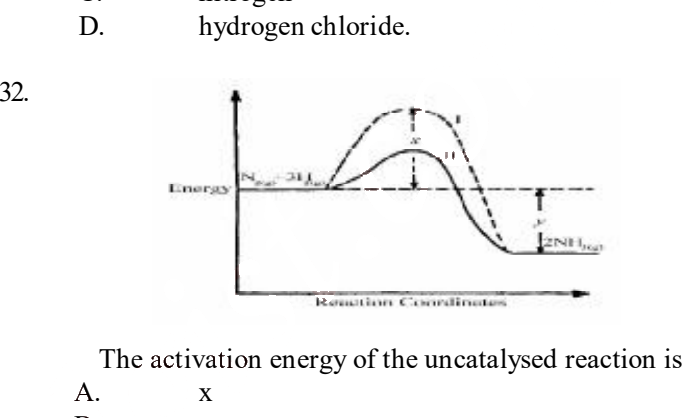
    29. The activation energy of the uncatalysed reaction is
    Figure for: The activation energy of the uncatalysed reaction is
    1. A.x
    2. B.x + y
    3. C.x - y
    4. D.y
  10. Chemistry1995Chemical Kinetics
    30. It can be deduced that the rate of the reaction
    Figure for: It can be deduced that the rate of the reaction
    1. A.for path I is higher than path II
    2. B.for path II is higher than path I
    3. C.is the same for both paths at all temperatures
    4. D.depends on the values of both x and y at all pressures.
  11. Chemistry1995Separation Techniques
    31. In the industrial production of hydrogen from natural gas, carbon (IV) oxide produced along with the hydrogen is removed by
    1. A.washing under pressure
    2. B.passing the mixture into the lime water
    3. C.using ammoniacal copper (I) chloride
    4. D.drying over phosphorus (V) oxide.
  12. Chemistry1995Metals and Non-metals
    32. Sulphur exists in six forms in the solid state. This property is known as
    1. A.isomerism
    2. B.allotropy
    3. C.isotopy
    4. D.isomorphism.
  13. Chemistry1995Redox Reactions
    33. A gas that will turn orange potassium heptaoxodichromate (VI) solution to clear green is
    1. A.sulphur (VI) oxide
    2. B.hydrogen sulphide
    3. C.sulphur (IV) oxide
    4. D.hydrogen chloride.
  14. Chemistry1995Metals and Non-metals
    34. Which of the following ions will give a white precipitate with aqueous NaOH and soluble in excess of the base?
    1. A.Ca2+\mathrm{Ca^{2+}}
    2. B.Mg2+\mathrm{Mg^{2+}}
    3. C.Zn2+\mathrm{Zn^{2+}}
    4. D.Cu2+\mathrm{Cu^{2+}}.
  15. Chemistry1995Metals and Non-metals
    35. In the extraction of iron in the blast furnace, limestone is used to
    1. A.release CO2\mathrm{CO_2} for the reaction
    2. B.reduce the iron
    3. C.Increase the strength of iron
    4. D.remove impurities.
  16. Chemistry1995Metals and Non-metals
    36. Which of the following compounds will impart a brick-red colour to a non-luminous Bunsen flame?
    1. A.NaCl
    2. B.LiCl
    3. C.CaCl2\mathrm{CaCl_2}
    4. D.MgCl2\mathrm{MgCl_2}
  17. Chemistry1995Periodic Table
    37. Group 1 A metals are not found free in nature because they
    1. A.are of low melting and boiling points
    2. B.have weak metallic bonding
    3. C.conduct electricity and heat
    4. D.are very reactive.
  18. Chemistry1995Organic Chemistry
    38. CH3COOH+CH3CH2OH→Conc H2SO4X+Y\mathrm{CH_3COOH + CH_3CH_2OH \xrightarrow{Conc\ H_2SO_4} X + Y}. X and Y in the reaction above are respectively
    1. A.CH3COCH3\mathrm{CH_3COCH_3} and H2O\mathrm{H_2O}
    2. B.CH3CH2COCH2\mathrm{CH_3CH_2COCH_2} and H2O2\mathrm{H_2O_2}
    3. C.CH3COOCH2CH3\mathrm{CH_3COOCH_2CH_3} and H2O\mathrm{H_2O}
    4. D.CH3CH2CHO\mathrm{CH_3CH_2CHO} and CH4\mathrm{CH_4}.
  19. Chemistry1995Organic Chemistry
    39. CHCl3+Cl2→HCl+CCl4\mathrm{CHCl_3 + Cl_2 \rightarrow HCl + CCl_4}. The reaction above is an example of
    1. A.an addition reaction
    2. B.a substitution reaction
    3. C.chlorination reaction
    4. D.a condensation reaction.
  20. Chemistry1995Organic Chemistry
    40. CH3−CH−CH=CH−CH3\mathrm{CH_3-CH-CH=CH-CH_3} with a CH3\mathrm{CH_3} group on the second carbon. The IUPAC nomenclature for the compound above is
    1. A.1,1-dimethylbut-2-ene
    2. B.2-methylpent-3-ene
    3. C.4,4-dimethyl-1-but-2-ene
    4. D.4-methylpent-2-ene.

Other JAMB Chemistry papers