JAMB Chemistry 1999 past questions

46 questions from the 1999 paper, showing 21–40. Try each one, then open the solution to check your answer. Sign in to see the worked explanations.

  1. Chemistry1999Energy Changes
    21. The entropy and enthalpy of a system are a measure of
    1. A.degree of disorderliness and heat content respectively
    2. B.heat content and degree of disorderliness respectively
    3. C.heat content of a system only
    4. D.degree of disorderliness only.
  2. Chemistry1999Chemical Kinetics
    22. 2SO2(g)+O2(g)⇌2SO3(g)\mathrm{2SO_2(g) + O_2(g) \rightleftharpoons 2SO_3(g)}. In the chemical reaction above, the substance that will increase the rate of production of sulphur (VI) oxide is
    1. A.manganese (IV) oxide
    2. B.finely divided iron
    3. C.vanadium (V) oxide
    4. D.nickel
  3. Chemistry1999Equilibrium
    23. N2O4(g)⇌2NO2(g)\mathrm{N_2O_4(g) \rightleftharpoons 2NO_2(g)}. Increases in total pressure of the equilibrium reaction above will
    1. A.Produce more of NO2(g)\mathrm{NO_2(g)} in the mixture
    2. B.Convert all of N2O4(g)\mathrm{N_2O_4(g)} to NO2(g)\mathrm{NO_2(g)}
    3. C.Have no effect on the concentrations of N2O4(g)\mathrm{N_2O_4(g)} and NO2(g)\mathrm{NO_2(g)}
    4. D.Produce more of N2O4(g)\mathrm{N_2O_4(g)} in the mixture
  4. Chemistry1999Electrochemistry
    24. What quantity of electricity will liberate 0.125 mole of oxygen molecules during the electrolysis of dilute sodium chloride solution? [F = 96 500 C mol−1^{-1}]
    1. A.24 125 coulombs
    2. B.48 250 coulombs
    3. C.72 375 coulombs
    4. D.96 500 coulombs
  5. Chemistry1999Chemical Kinetics
    25. X+Y→ZX + Y \rightarrow Z. The rate equation for the chemical reaction above is −Δ[X]Δt=[X]2[Y]-\frac{\Delta[X]}{\Delta t} = [X]^2[Y]. The overall order of the reaction is
    1. A.0
    2. B.1
    3. C.2
    4. D.3
  6. Chemistry1999Electrochemistry
    26. When a current I was passed through an electrolyte solution for 40 minutes, a mass X g of a univalent metal was deposited at the cathode. What mass of the metal will be deposited when a current 2I is passed through the solution for 10 minutes?
    1. A.x/4 g
    2. B.x/2 g
    3. C.2X g
    4. D.4X g
  7. Chemistry1999Energy Changes
    27. RS(aq)+HF(aq)→RF(s)+HS(aq)\mathrm{RS_{(aq)} + HF_{(aq)} \rightarrow RF_{(s)} + HS_{(aq)}} ΔH=−65.7 kJ mol−1\Delta H = -65.7\ \mathrm{kJ\,mol^{-1}}. From the equation above, it can be deduced that.
    1. A.the heat content of the reactants is lower than that of the products
    2. B.the heat content of the reactants is higher than that of the products
    3. C.the reaction is slow
    4. D.a large amount of heat is absorbed.
  8. Chemistry1999Periodic Table
    28. Which of the following statements is true of the electrochemical series?
    1. A.Electropositivity of metals increase down the series
    2. B.Electropositivity of non-metals decrease down the series
    3. C.Electronegativity of non-metals increase down the series
    4. D.Electropositivity of metal decreases down the series
  9. Chemistry1999Acids, Bases and Salts
    29. The gas that will form a white precipitate with acidified silver trioxonitrate (V) is
    1. A.NH3\mathrm{NH_3}
    2. B.SO2\mathrm{SO_2}
    3. C.CO2\mathrm{CO_2}
    4. D.HCl
  10. Chemistry1999Periodic Table
    30. Chlorine bromine and iodine resemble one another in that they
    1. A.dissolve in alkalis
    2. B.react violently with hydrogen without heating
    3. C.are liquids
    4. D.displace one another from solutions of their salts.
  11. Chemistry1999Acids, Bases and Salts
    31. The salt that reacts with dilute hydrochloric acid to give a pungent smelling gas which decolourizes acidified purple potassium tetraoxomanganate(VII) solution is
    1. A.Na2SO4\mathrm{Na_2SO_4}
    2. B.Na2SO3\mathrm{Na_2SO_3}
    3. C.Na2S\mathrm{Na_2S}
    4. D.Na2CO3\mathrm{Na_2CO_3}
  12. Chemistry1999Acids, Bases and Salts
    32. A pair of compounds that can be used to generate a gas which has no physiological effect on human beings is
    1. A.sodium trioxonitrate(V) and calcium chloride
    2. B.sodium dioxonitrate (III) and ammonium chloride
    3. C.sodium trioxonitrate(V) and ammonium chloride
    4. D.sodium dioxonitrate (III) and potassium chloride.
  13. Chemistry1999Energy Changes
    33. Hydrogen is used in oxy-hydrogen flames for melting metals because it
    1. A.evolves a lot of heat when burnt
    2. B.combines explosively with oxygen
    3. C.is a very light gas
    4. D.is a rocket fuel.
  14. Chemistry1999Acids, Bases and Salts
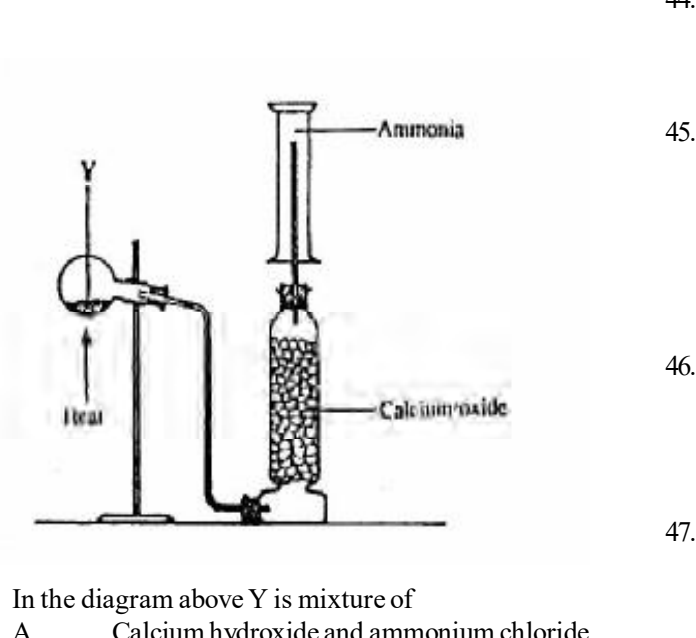
    34. In the diagram above Y is mixture of
    Figure for: In the diagram above Y is mixture of
    1. A.Calcium hydroxide and ammonium chloride
    2. B.Calcium hydroxide and sodium chloride(V)
    3. C.Sodium chloride and ammonium trioxonitrate(V)
    4. D.Sodium dioxonitrate(III) and ammonium chloride.
  15. Chemistry1999Metals and Non-metals
    35. What properties of duralumin make it more useful than its constituent metals?
    1. A.it is heavy with a high melting point
    2. B.it is malleable and has high density
    3. C.it is strong and light
    4. D.it is hard and ductile
  16. Chemistry1999Metals and Non-metals
    36. The pair of metals in the reactivity series that are usually extracted by the electrolysis of their ores is
    1. A.Magnesium and zinc
    2. B.Magnesium and calcium
    3. C.Copper and zinc
    4. D.Lead and calcium
  17. Chemistry1999Metals and Non-metals
    37. A metal that can be extracted from cassiterite is
    1. A.calcium
    2. B.magnesium
    3. C.tin
    4. D.copper
  18. Chemistry1999Metals and Non-metals
    38. Which of the following metals is passive to concentrated trioxonitrate(V) acid?
    1. A.iron
    2. B.tin
    3. C.copper
    4. D.zinc
  19. Chemistry1999Organic Chemistry
    39. The hydrocarbon that burns in air with a sooty flame is
    1. A.C6H6\mathrm{C_6H_6}
    2. B.C3H6\mathrm{C_3H_6}
    3. C.C4H10\mathrm{C_4H_{10}}
    4. D.C2H6\mathrm{C_2H_6}
  20. Chemistry1999Organic Chemistry
    40. 2-methylprop-1-ene is an isomer of
    1. A.but-2-ene
    2. B.pent-1-ene
    3. C.2-methylbut-ene
    4. D.2-methylbut-1-ene

Other JAMB Chemistry papers